Rusticles and the Disappearing Shipwreck of RMS Titanic
EducationRusticles and the Disappearing Shipwreck of RMS Titanic

Two and half miles deep in the North Atlantic Ocean lie the remains of the once majestic transatlantic ocean liner RMS Titanic. When Bob Ballard first observed the images from the submersibles Mir 1 and Mir 2 in 1986 he was stunned by the sight of what appeared to be stalactite formations or icicles hanging down from the ships structure. Bob named the strange brown deposits ‘rusticles’. Further investigation and research by microbiologists during the late 1990’s discovered that microbes were feeding on the ship's iron and that over time the shipwreck would disintegrate.
It’s a fact that despite being the most famous shipwreck in the world, more people visit the summit of Mount Everest every month than have seen the Titanic in the last decade. There are only four submersibles in the world that are capable of diving the 12,460 feet in order to reach the shipwreck. Two of them, Mir 1 and Mir 2 were originally funded and built by the Soviet Union at a cost of $20 million a piece. The submersibles are carried aboard the R/V Akademik Mstislav Keldysh, a research vessel which is owned and operated by the Russian Academy of Sciences. Since the fall of the Soviet Union the cost of funding the submersibles mission’s to the Titanic has been met by private investors such as film producers, and other projects. James Cameron used the two submersibles for the filming of Titanic. The submersibles will even take paying customers to the wreck site for a fee of $36,000 per person.
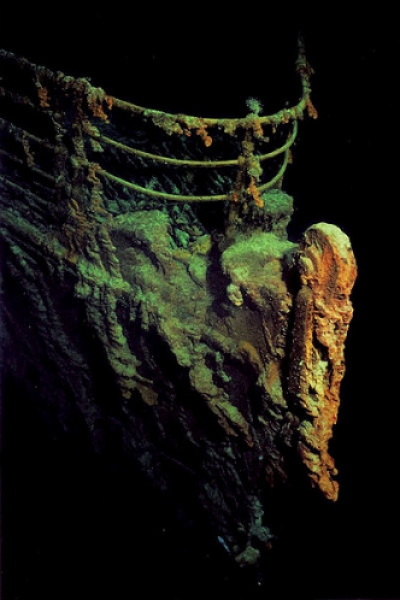
The bow section of Titanic as seen from Mir 1.
In order for the self-propelled submersibles to find the shipwreck and navigate over its large structure the crew of the Keldysh drop transponders near the wreck site using GPS coordinates. The wreck of RMS Titanic lies in two sections facing in opposite directions, almost half a mile apart. Both section had struck the sea bed with such tremendous force that they had entrenched in up to 60 feet of silt. The ships bow section is in better condition than the stern. Microbiologist believe the reason for the difference in deterioration is due to there being more damage to the stern section. Also perishable goods were stored in the Titanic’s stern; initially helping the microbes which fed of the nutrients in food.
The company that owns the salvage wrights to the shipwreck is RMS Titanic Inc. Salvagers have removed thousands of artifacts from the area immediately surrounding the shipwreck, although they are not allowed to sell them or remove artifacts from inside the wreck. Nevertheless, there are still hundreds of artifacts on the sea floor that are visible with the bright exterior lights of a submersible. Some of the most disturbing and eerie include a silt covered bath tub; hundreds of solitary wine bottles, their wooden crates long since gone, and dozens of odd shoes, some of them ladies, high-topped.
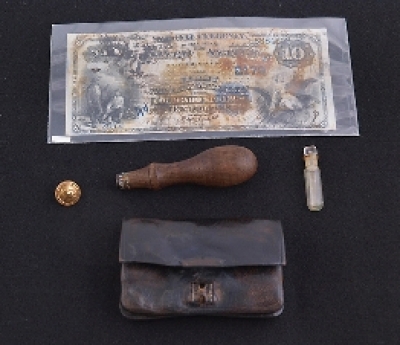
Artifacts recovered from RMS Titanic.
Each time submersibles dive to RMS Titanic the occasion is filmed and experts compare the amount of deterioration to previous visits. For the Titanic the prognosis is not good. The shipwreck’s iron and steel structure is being eaten by the North Atlantic faster than originally thought.
Images from commons.wikimedia and flickr.com