The Golden Age of the Great Ocean Liners
EducationThe Golden Age of the Great Ocean Liners

The roots of the great transatlantic liners came from the advent of steam ships in the early 19th century. The American Robert Fultan designed a paddle steamer called the Clemont that crossed the Hudson river. This led to the invention of the propeller in 1839 which was deemed superior at sea and was used to power commercial shipping. The first propeller-driven ship to cross the Atlantic was the SS Great Britain in 1843. The big advantage of steam was that ships could not only travel faster, but need not rely on the weather or currents. At that time all propeller or paddle driven ships still retained sail in case of mechanical failure.
The use of combined propeller and sail ships continued until the late 19th century, with the construction of even larger ships such as the SS Great Eastern at 27,000 tons, the SS Great Western, the Oceanic ( 1871) and the RMS Britannia. Built for the British and North American Steam Packet Company in 1840.
By the beginning of the 20th century large scale emigration had begun between Europe, the USA, Canada and Australia. There was a need for larger and faster ships that combined passenger and cargo. The first ship to be driven by propeller only was the second Oceanic liner at 28,500 tons. Built by Harland & Wolf in 1900 for the White Star Line, RMS Oceanic was esthetically attractive with clean, elegant lines. And moreover she was more comfortable than her predecessors. Only the finest available materials had been used to build her. Sadly her life was short lived as she struck a reef and sank in the Shetland Islands in 1914.
.jpg)
The Oceanic was the first luxury liner.
However the success of RMS Oceanic led to the construction of two sister ships, the Lusitania and the Mauritania. The Mauritania was built for the Cunard line at Tyne & Wear in 1906. She was a luxury liner with an enthuses on speed. She was awarded the prestigious Blue Ribbon for the fastest transatlantic passenger liner crossing, subsequently holding the title for 22 years, until her record was broken by the German liner Breman. The Mauritania was scrapped in 1934 despite protests by many of her former distinguished passengers, such as Franklin D. Roosevelt.
.jpg)
The Lusitania on her maiden voyage at New York, 1907.
Launched in the same year as the Mauritania, for Cunard, but built at the Clydebank shipyard; the Lusitania was a strong competitor for the Blue Ribbon title. Although slightly smaller than her sister ship, the Edwardian liner was lavishly furbished in neoclassical style.
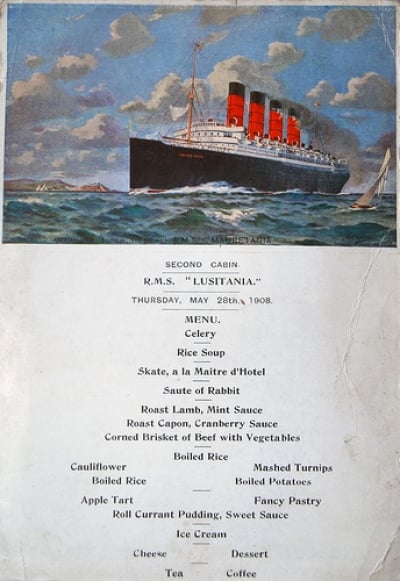
Second class cabin menu from RMS Lusitania.
During World War I many passenger liners were used a troop carriers or hospital ships. The largest ships such as the Mauritania and Lusitania were thought unsuitable as armed merchant, navy ships. So the Lusitania was maintained as a passenger ship. On the 1st May 1915 the Lusitania left New York bound for Ireland. Passengers had been warned about the danger of boarding the Lusitania by an official notice from the German government. An exert reads as follows;
TRAVELLERS intending to embark on the Atlantic voyage are reminded that a state of war exists between Germany and her allies and Great Britain and her allies; vessels flying the flag of Great Britain, or any of her allies, are liable to destruction in those waters and that travelers sailing in the war zone on the ships of Great Britain or her allies do so at their own risk.
The Lusitania was just 8 miles off the coast of Ireland, and Old Head of Kinsale, when she was struck by a torpedo from a German U-boat. The U-20 had already completed its mission and was returning home when it spotted the Lusitania. 1,195 passengers and crew lost their lives.
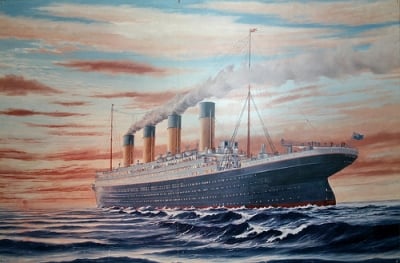
RMS Titanic
The fate of the Lusitania and the senseless carnage of World War I, could be seen as an ominous conclusion to a tragedy that took place three years earlier, When RMS Titanic, struck an iceberg in the North Atlantic. 1,490 passengers and crew lost their lives, in large part due to insufficient life boats. The result of these events was truly the end of the golden age of the large ocean liners as their Edwardian glamour faded. More transatlantic liners were built between the wars, such as the Queen Mary, Queen Elizabeth and the Normandie. But they didn’t encapsulate the romance or gain the frenzied public attention of their predecessors.
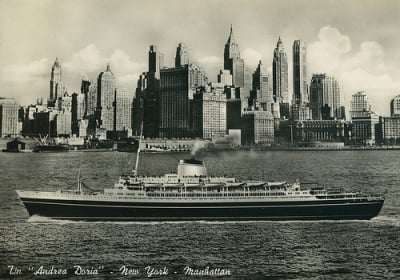
The Italian built Andrea Doria was one of the last great transatlantic ocean liners.
In 1959 tragedy once again struck at the heart of transatlantic travel when two passenger liners, the Andréa Doria and the Stockholm, collided near the coast of Nantucket, killing over 50 passengers. The Stockholm managed to limp back to harbor, but the Doria sank. Fortunately not before her surviving passengers climbed into life boats and were rescued by the French liner, Ile de France. The tragedy effected public opinion and people began to lose confidence in passenger liners.
In the 1950’s sea travel was still far cheaper than air travel; that had begun to change by the by the 1960’s, and the convenience of air travel was apparent; making transatlantic liners obsolete.
Images from flickr.com and commons.wikimedia
If you liked this you might like the following articles.
British Navy shipwrecks in the Caribbean: HMS Griffin.
Famous shipwrecks in the Caribbean Sea: RMS Rhone.
Shipwrecks and treasure: the Ines de Soto wreck.
The story of the Nuestra Senora de Atocha; the most valuable shipwreck ever discovered.