World War Two: Operation Pastorius
EducationWorld War Two: Operation Pastorius

On June 13, 1942, just after midnight, a German U-boat made its way past Long Island’s East End and came to a stop near Amagansett Beach. Four English speaking Germans, who had previously lived in the USA, came ashore in heavy fog. That same night four more men disembarked from a U-boat at Ponte Vedra Beach, Florida. It was the beginning of operation Pastorius, Nazi Germany’s attempt to sabotage and destroy several economic targets such as hydroelectric plants at Niagara Falls, locks on the Ohio river, and crucial railroad locations such as Pennsylvania station in Newark, New Jersey and several other strategic targets in the US.
John Cullen, a Coast Guard from Amagansett Coast Guard Station, had left the station and was on his routine nightly patrol when he spotted four suspicious looking men on Amagansett Beach. As Cullen approached the men he overheard them talking in what he thought sounded like German. He noticed that the men were dragging a heavy bag. Cullen asked the men who they were and what was in the bag? The mysterious men told Cullen they were fisherman and that the bag was full of clams.
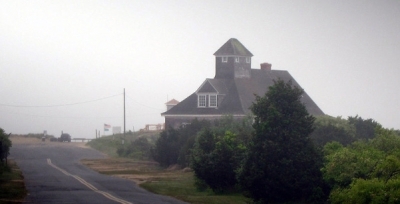
Amagansett Coast Guard Station.
At that point one of the saboteurs attempted to bribe Cullen with a handful of dollar bills, and told him “forget about this, forget you ever saw us” .The unarmed, shaken Coast Guard had no choice but to let the men on their way. Cullen alerted the Coast Guard Station and the guards returned with rifles to search the beach. They found no sign of the four men, but did hear the rumble of a diesel engine, as the U-boat departed.

Amagansett Beach.
The Coast Guards returned the following morning and found a number of clues that confirmed John Cullen’s story. There were the drag marks caused by the large bag. An empty packet of German cigarettes and a pair of bathing trunks, half buried in the sand. The beach was then excavated which revealed four wooden boxes that contained a huge amount of explosives, detonators and four German military uniforms.

A U-Boat at the Chicago Museum of Science.
After landing on the beach the saboteurs had changed into civilian uniforms and caught a train to New York. Amagansett Coast Guard Station called Washington which alerted the FBI. For reasons best known to themselves, two of the saboteurs, George Dash and Ernest Burger decided to abandon Operation Pastorius and turn themselves into authorities. When the FBI interrogated George Dash, the head of the operation, he revealed their plans to destroy industrial facilities. He told the FBI about the other four saboteurs who had landed in Florida and gave details of their identity’s. Within a few weeks the remaining six German spies had been arrested.
The trial of the eight men was conducted in a military court as ordered by President Roosevelt. All eight men were found guilty on charges of espionage and sentenced to death, apart from George Dash and Ernest Burger who were given life sentences. In 1948 Dash and Burger were given parole by President Truman and allowed to return to Germany, provided they live in the American zone.
All images from flickr.com
If you liked this you might also like the following articles.
British Royal Navy shipwrecks: HMS Griffin.
Shipwrecks in the Caribbean: RMS Rhone.