The Sinking of the Andrea Doria
EducationThe Sinking of the Andrea Doria

Built at the Ansaldo shipyard in Genoa, Italy, the Andrea Doria was the most luxurious liner of its time and was the pride and joy of the Italian line. She was named after a sixteenth century Genoan naval commander, an associate of Christopher Columbus. Her design was sleek and she had an average speed of 23 knots. Renowned Italian artists of the day had provided many works of art which graced her decks. In the custom of many great ocean liners, she had three passenger decks. First class, cabin class and tourist. She was fitted out with the latest navigational equipment, she even had a metrological station. At 656 feet long, the Doria was one of the largest liners of the day.
The ships captain was Pierro Calamai, and her maiden voyage, Genoa to New York, began on July 17, 1953. The Andrea Doria had completed 101 Atlantic crossings and on April 17, 1956, she left Genoa with 1,700 on board for what would be her last crossing. After stopping at Cannes and Gibraltar, she headed out into the deep water of the Atlantic Ocean, toward New York. Many of her third class passengers were immigrants. Crossing the Atlantic by ship was still the cheapest way in the 1950’s. The first class passengers could afford to fly, but preferred the leisure and luxury of the ocean liner.
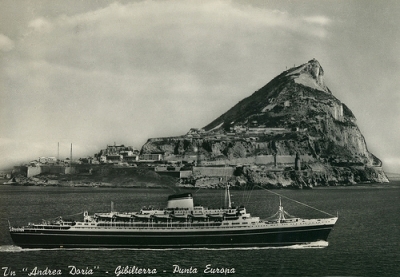
The Andrea Doria.
The Stockholm was a Swedish-American built transatlantic passenger liner. She was a smaller ship than the Doria, at 524 feet long and her interior was modest, designed for comfort and economy. Because the Stockholm had to navigate through Scandinavian waters, she had been fitted with a reinforced bow. This gave her icebreaker capability. A fact that would play a crucial role in the collision of the two ships.
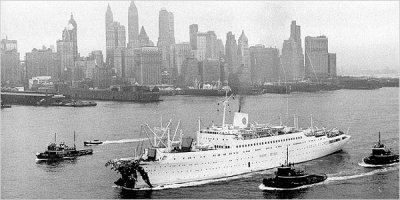
The Stockholm limps back to harbor after the tragedy.
As the Doria approached the coast of Nantucket, heavy fog descended, and the ship repeatedly sounded its foghorn. At the same time the Stockholm had left New York harbor and was headed east toward Nantucket lightship. Third Officer, Johannsen was in command. Aboard the Doria’s bridge Captain Calamai had reduced the ships speed to 21 knots. The Stockholm was cruising at her full speed of 18 knots. When Captain Johannson realized that the Doria was just a few miles away, he turned the Stockholm to starboard, which he believed would take her south of the Doria, in an effort to avoid a collision. Captain Calamai thought that the two ships would pass starboard to starboard, and so the Doria was turned to port. Unfortunately Captain Johannsen aboard the Stockholm thought the ships would pass port to port. Ultimately this mistake put the two liners directly in each others path.

The sinking Andrea Doria.
By the time the two ships had visual contact it was too late. Captain Calamai put the Doria hard-to-port, but it was a token effort. The Stockholm smashed through the side of the Andrea Doria at full speed, killing fifty people; her reinforced steel bow destroying the Doria. Initially the two ships were wedged together, then as the Doria’s torn hull began to flood, the Doria listed to starboard. This meant the lifeboats on the port side were inaccessible. Lifeboats were sent over from the Stockholm, which was not sinking, but was badly damaged.
The Stockholm later returned to New York harbor, with the loss of one crew member. Before long a French liner, the Isle de France had arrived on the scene; 1,660 people were rescued. Just like the Titanic, the Andrea Doria had been considered unsinkable. But as seawater breached above her bulkheads, the Doria slowly began to sink, and on the morning July 26, 1956, the Atlantic Ocean claimed the magnificent ship.
All images from commons.wikimedia.com
If you liked this you might also like the following articles.
Lesser known facts about the Titanic: Part 1
Lesser known facts about the Titanic: Part 2