Lesser Known Facts About RMS Titanic (Part 1)
EducationLesser Known Facts About RMS Titanic (Part 1)

The Titanic is without doubt the most famous shipwreck of all time. Since the 1990’s there has been a surge in the publics fascination with the sinking of the Edwardian liner. First there was the musical, then the opera; culminating with James Cameron’s 200 million dollar movie blockbuster which is the second highest grossing movie of all time. And the profusion of Titanic books goes without saying.
Yet the Titanic wasn’t carrying a particularly valuable cargo. Neither was her loss of life as great as other shipping disasters. And her sinking was a result of human error and environmental forces. Less dramatic than say, the Lusitania, which was sunk by a torpedo from a German U-boat. Or the Andrea Doria, a passenger liner that tragically collided with another ship and sank in 1956. But we have yet to see Celine Dion singing the theme song to the Andrea Doria disaster. So why all the attention? The answer is that the Titanic disaster had the same captivating elements as the death of Princess Diana or the assassination of JFK; glamour, money, betrayal, honor, treachery, heroism and death. Also the shipwreck lies almost two and a half miles deep, with its wreckage spread over a large area. The idea that there could be riches that haven’t yet been discovered, helps to maintain public interest.
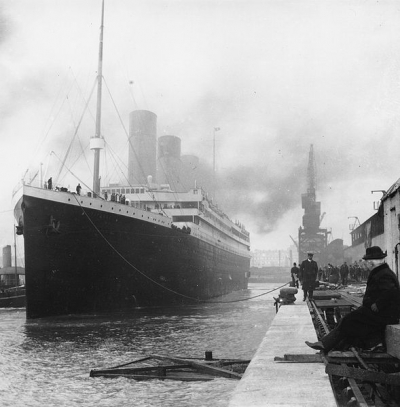
The day of the disaster at nine a.m., a Titanic Marconi operator had received a message from a ship called the Carolina. The message warned of iceberg and gave the approximate coordinates. Capt. Edward smith did order that the ship head slightly to the south but did not order her speed to be reduced, as is correct protocol. At 10.30 p.m. SS Californian which was also traveling west entered a field of pack ice and her captain decided that the ship should remain stationary over night. The Californian’s Marconi operator also sent a message to the Titanic warning of the imminent danger. At 11.40 p.m. a large iceberg was spotted and 1st Officer William Murdoch gave the order “hard a starboard”.
But of course it was too late. Titanic’s first five compartments were flooded and she could only stay afloat with a maximum of three compartments holed. It’s a cruel irony that if Titanic hadn’t been put “hard a starboard” and hit the iceberg head-on, no more than two possibly three compartments would have been flooded and the closed bulk doors would have contained the flooding.
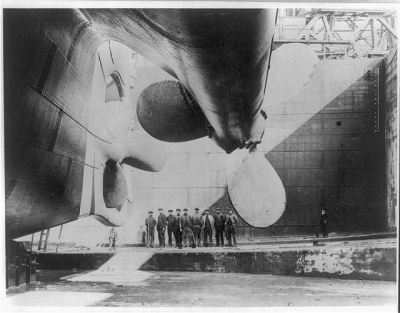
This view of the Titanic's propellers gives one an idea of the liners immense size.
There was also the question of the life boats. Titanic’s life boat capacity was 1,178, but her number of passengers, after leaving the port of Calais had risen to 2,228. This deficiency was seem as a failing by Cunard. Yet the number of life boats was significantly higher than Board of Trade regulation required in 1912.
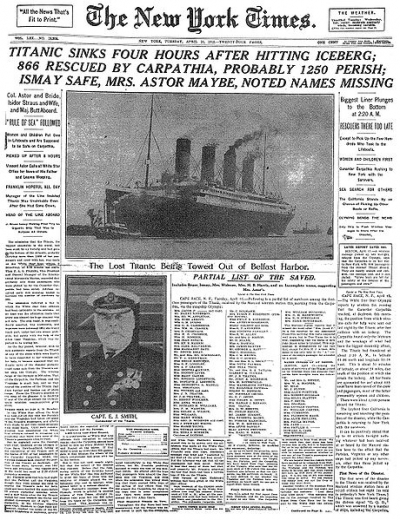
1,523 people lost their life’s during the disaster. But according to evidence at the enquiry, the rescue effort could have been much more successful. The nearest ship to the Titanic at the time of its sinking was the Californian, at about 20 miles away. However the Californian’s Marconi operator had gone to bed, and so did not receive the Titanic’s signals. The Californian’s watchman did report seeing several rockets being fired and reported this information to Captain Stanley Lord. However the Captain chose to ignore the rockets believing them to be private signals. Survivors and crew members of the Californian recall seeing the lights of another ship in the immediate vicinity. Morse code signals were sent to the mysterious ship from the Californian, but no reply was received.
Many years later a Norwegian Captain called Henrik Naess said his ship, the Samson, had been in the locality of the Titanic, and he had seen the distress rockets. He claims his ship was involved with illegal sealing, and that he thought the rockets were a signal to search his ship. So Naess ordered his ship to leave. Although several ships heard the Titanics wire-less distress signals, many were hundreds of miles away. The first ship on the scene was the Capathia, which arrived at 4 a.m. Eye witnesses described an eerie silence, over the calm ocean.
All images from commons.wikimedia.com and flickr.com.
Please see also; Lesser known facts about RMS Titanic (part 2)