Historical Shipwrecks in the Florida Keys: the U.S.S. Alligator
EducationHistorical Shipwrecks in the Florida Keys: the U.S.S. Alligator

Just off Islamorada, in the Florida Keys at Alligator Reef lie the remains of the schooner U.S.S Alligator. The vessel, which ran aground in November 1822, is highly significant in U.S. Naval history.
On March 3, 1819 the U.S. Congress passed legislation known as; An Act to Protect the Commerce of the United States ,and Punish the Crime of Piracy. The purpose of the act was to stop the slave trade, which became illegal on March 7, 1807, and to wipe out piracy on the high seas. At that time pirates attacked commercial shipping almost at will and Portuguese slave traders were still in business. The Royal Navy was forced to put much of its resources into the West Indies and the U.S. Navy lacked vessels because of the War of 1812.
The ship designer William Doughty was commissioned to build four fast schooners named U.S.S Dolphin, Shark, Porpoise and the Alligator. The U.S.S Alligator was 86 feet in length, had a beam of 25 feet, displaced 198 tons and was armed with 12 six pound cannons. The Alligator was commissioned into the U.S Navy on March 21, 1821 and her commanding officer was Lieutenant Robert Field Stockton. Her maiden voyage was to Africa. On board was Dr. Eli Ayres of the American Colonization Society. Dr Ayres and Lieutenant Stockton were on a mission to negotiate the purchase of land. That strip of land became known as the Republic of Liberia.
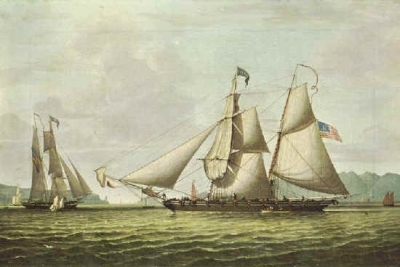
The Alligator continued to patrol the southern oceans in its attempts to curtail the Africa-to-America slave trade, capturing several slave ships including the Marianna Flora. In June of 1822 the schooner was sent to the Caribbean Sea under the command of William H. Allen to search for pirates. In particular, Lieutenant Allen and two other U.S. Navy vessels of the West India Squadron, were in search of five merchant and navy vessels that had been taken by pirates. After searching the coast of Cuba three pirate schooners were sighed along with their captured prizes at a bay near Mantanzas. After a fierce battle the navy was victorious in capturing the pirate schooners. Unfortunately Lieutenant Allen and 13 marines were killed ordered the attack.
Lieutenant John Dale took command of the Alligator and the convoy of ships, including the brigantine U.S.S. Ann Maria, sailed for Norfolk Virginia. The Alligator was always further ahead of the other ships and continually had too tack back and fourth so as to stay with the convoy. As night fell the Alligator entered shallow water and was grounded on a reef. After sighting the Alligator’s distress signal, the U.S.S Ann Maria anchored near by and waited. Lieutenant Dale ordered that the cannons be thrown overboard to lighten the load, but the Alligator only moved further onto the reef. By the following morning the Alligator had begun to break up, so the crew transferred its cargo to the Ann Maria. Before they left the Lieutenant ordered that the ship be blown up so that it could not fall into the hands of pirates. A subsequent court inquiry in Norfolk exonerated Lt. Dale of all responsibility for the disaster.
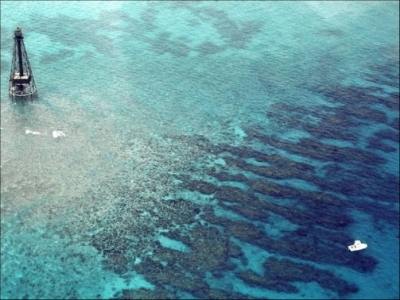
Alligator Lighthouse and Reef.
As a result of the shipwreck, the reef where the U.S.S. Alligator sank was named in its honor. Fifty one years later a lighthouse was placed at the reef which was named Alligator lighthouse. This follows a Florida Keys tradition of naming reefs and subsequently lighthouses after the ships that sank nearby. Others are Carysfort Reef, named after HMS Carysfort and Fowey Rocks Reef lighthouse after HMS Fowey.
All images from commons.wikimedia.com