Scapa Flow: the Worlds Largest Maritime Museum
EducationScapa Flow: the Worlds Largest Maritime Museum

Scapa Flow was a British Royal Naval base from 1904 to 1956 and its principle purpose was to control the entrances to the North Sea. The base was located in a large expanse of water in the Orkney Islands near Scotland. At the end of the First World War, 52 vessels of the German High Seas Fleet were scuttled by their crews, to avoid the ships from falling into allied hands.
Most of the warships have been salvaged over the years but some remain. HMS Vanguard also sank at Scapa Flow because of a fire that ignited magazines and caused an explosion during the First World War*. During the Second World War HMS Royal Oak* was sunk by a German U-boat. The sunken vessels make Scapa Flow the world's largest maritime museum, which is enjoyed today by scuba divers.
The islands were chosen as a base because they were in a good strategic position for the British fleet to protect the convoys and also to launch attacks against the German High Seas Fleet, during World War One. By 1918 the German fleet had been beaten by the larger and superior British fleet. The admirals of the German fleet had decided they could fight one last battle against the British, but before they could the German sailors mutinied, fearing annihilation. After the armistice in November 1918, which ended the war, the peace treaty of Versailles took place.
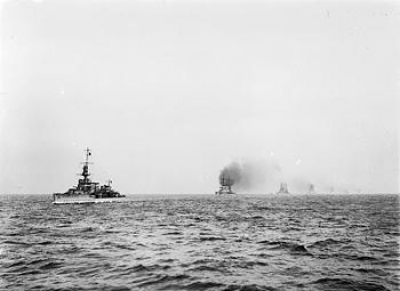
The German fleet heads for Scapa Flow led by HMS Cardiff. Image credit.

Whilst the fate of Germany and its military was being decided at Versailles, the entire German fleet was to be interned. A meeting took place aboard HMS Queen Elizabeth and the terms were presented by Admiral David Beatty to Rear-Admiral Hugo Meurer. All U-boats were to be surrendered. The surface fleet would maintain a skeleton crew and would be escorted to Scapa Flow, where it would remain until its destiny was decided. On November 21, 1918 HMS Cardiff headed the convoy of German warships which included 11 battleships, 5 battle cruisers and 50 destroyers. The Board of the British Admiralty remarked of the occasion; “The surrender of the German fleet accomplished without shock of battle will remain for all time the example of wonderful silence and sureness with which sea power attains its ends”
As several months went by the German fleet was still at Scapa Flow. Its crews were not permitted to leave their ships or visit each others ships. Food was brought from Germany and liquor provided. The crews only recreational activity was fishing. Eventually many of the original 20,000 sailors were repatriated back to Germany.
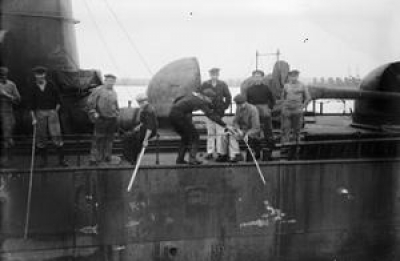
German sailors fishing. Image credit.

Rear-Admiral von Reuter who was in command of the fleet, was becoming suspicious that the fleet would be divided amongst the Allies and that war could break out again. He decided that the only solution was to scuttle the fleet. His opportunity came when most of the British fleet stationed at Scapa Flow went on exercises, leaving three destroyers to guard the German fleet. The German sailors had carefully planned the operation and once the order was given they set about irreversibly sinking their ships. As the German crews manned the life boats the sea turned black with oil and debris. British sailors boarded and managed to beach a few of the warships. And in one incident six German sailors were shot as they tried to stop British sailors from preventing the scuttling.
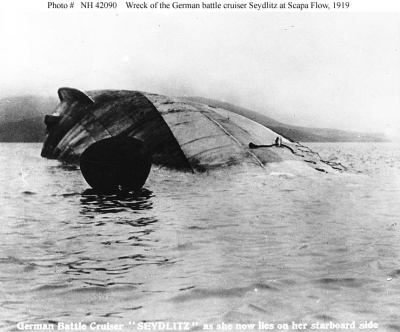
The German Battle Cruiser SMS Seyditz, capsized after being scuttled 21 June 1919; Image credit

As HMS Fremantle and other British ships hastily returned to Scapa Flow, to prevent the destruction, they watched the last of large German battleships sink. In the ensuing years that followed the world's largest salvage operation has taken place. Over forty ships have been raised and towed to scrap yards. A few warships were left at Scapa Flow, presumably for posterity. They are the battleships Konig, Markgraf and Kronprinz Wilhelm, plus three destroyers and four battle cruisers.
.jpg)
A piece of German pottery recovered from one of the wrecks. Image credit. Primary image; day break at Woodwick Bay, Orkney, image credit, flickr.com.
.JPG)
* The shipwrecks of HMS Royal Oak and HMS Vanguard are considered war graves. They are only accessible to official British naval personnel.
All images from commons.wikimedia.com
If you liked this you might also like the following articles.
The Andrea Doria: the sinking of a luxurious passenger liner.