HMS Royal George: One of Britain's Worst Maritime Disasters
EducationHMS Royal George: One of Britain's Worst Maritime Disasters

HMS Royal George was the largest and most magnificent battleship of the her time. It took Woolwhich Dockyard ten years and 3,840 English elm and oak trees to construct the prestigious vessel. The ship had originally been named after Britain’s first monarch Queen Anne, but was renamed HMS Royal George after the raining monarch King George II. The Royal George was a first rate ship-of-the-line. She displaced 2,047 tons, was 178 feet long and 51 feet wide at her beam. The ship was built for combat and so was heavily armed with 100 guns, divided on four decks and a forecastle. She was launched on February 18, 1765.
For over 26 year HMS Royal George was an integral part of the British Navy's fighting force. Most notably she took part in the Seven Years War and the Battle of Quiberon Bay. By the time the Royal George sunk in 1782, Britain had became a colonial power, due in large part to the strength of the British Navy and battleships such as HMS Royal George.
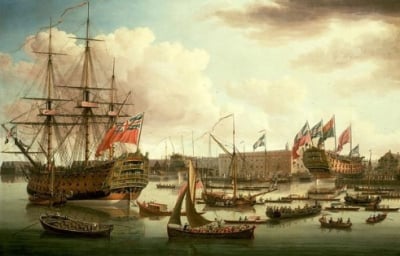
HMS Royal George with HMS Cambridge.
After launching HMS Royal George joined the Western Squadron and took part in the blockade of the French fleet at Brest. Edward Hawke who was First Lord of the Admiralty took over command of the Royal George after his flagship HMS Ramilies was sent to Portsmouth for repairs. This transition coincided with the start of the Seven Years War which pitted a British coalition between itself and Prussia against its rival colonial power France. France had allied itself with Austria, Russia, Sweden and Saxony. The year 1759 was a successful one for Britain and its navy with victory’s over the French at Quebec and other territorial gains in India and the Caribbean.
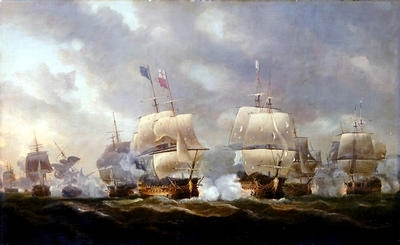
The Battle of Quiberon Bay by Nicholas Pocock.
By November of 1759 the French had decided to put everything in an invasion of Britain and so formed an invasion army. The French navy was under the command of Hubert de Brienne, Conte de Conflans and the navy was to rendezvoused with the army at Quiberon, Brittany. However, Admiral Hawke was one move ahead of his opponent. The western squadron located the French fleet and gave chase to engaged the enemy by night fall, during a bitter gale, at Quiberon Bay. The Royal George joined with the Magnanime to attack the Héros which surrendered. The George then engaged the Superbe and sank the ship with a single broad side shot. The following morning the Royal George pursued the French fleets flagship, Soleil Royal. As the Royal attempted to escape it struck rocks and was shipwrecked. Its crew escaped then destroyed the ship to avoid its capture.
At the end of the battle the British fleet had destroyed seven French ships with the loss of only two of its own. The result was that the French could no longer invade Britain and the British controlled the seas for the remainder of the war.
In 1782 the Royal George was under going repairs at Spithead in the Solent. At the time there were 35 other Naval vessels at anchor, including HMS Victory. As the work was almost complete the crew of 800 was joined by their family’s aboard the ship to say their farewells. Without warning the ship suddenly keeled over and water entered its gun ports capsizing the ship. Nine hundred lives were lost; the only survivors were 11 women and one child. Between 1782 to 1843 several salvage attempts were made and eventually the entire ship including the keel and bottom timbers were raised. A cannon salvaged from the shipwreck can be seen at Southsea Castle, Portsmouth.
All images from commons.wikimedia.com