Shipwrecks and Treasure: H.M.S Fowey of 1744
EducationShipwrecks and Treasure: H.M.S Fowey of 1744

In 1978 a sport diver named Gerald Klein discovered an 18th century shipwreck near Legare Anchorage, Biscayne Bay, Florida. After returning regularly to the wreck site and recovering artifacts, he Initially believed the shipwreck was from the 1733 Spanish treasure fleet ( flota). Klein then attempted to claim the shipwreck in order to salvage its treasure. However, because the wreck is located in Biscayne National Park the department of Justice intervened on behalf of the M.P.S to claim the wreck as a national, cultural resource. After a highly publicized and lengthy lawsuit which came to a conclusion in 1983, the United States government was awarded ownership of the shipwreck.
After speculation that the shipwreck could have been H.M.S Wolf or Nuestra Señora del Pópulo, the shipwreck was formerly identified by graduates of Florida State University as H.M.S Fowey. However, in another twist of the tail, the government of the United Kingdom claimed that under Articles 95 and 96 of the United Nation Convention pertaining to the law of sea, it retains sovereign rights and ownership over all of its British Navy warships.
.jpg)
H.M.S Fowey was built at Hull shipyard in 1744. She was a fifth rate frigate at 709 tons. Although modest in size, the Fowey was heavily armed with 22 upper deck, 9 pound cannons and 20 lower deck 18 pound cannons. The Fowey’s first commanding officer was Captain Policarpus Taylor and the ship had a crew of 200 men. HMS Fowey’s first duty was to escort British shipping to and from the West Indies. After capturing the French ship Mentor, the Fowey fought a battle with the Griffin, with she sunk. She was then sent to assist British battleships at Louisbourg, Cape Breton, principally scouting for the enemy and delivering troops and supplies from Virginia.
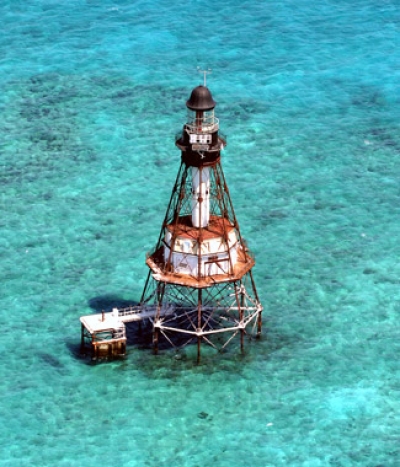
Fowey Reef Rocks Lighthouse is named after H.M.S Fowey.
In 1748 Captain Francis William Drake, a relation of Sir Francis Drake, took command of the ship and the Fowey was sent to the West Indies as part of the Caribbean squadron to escort British vessels along the Eastern seaboard. In June of 1748 H.M.S Fowey was escorting two British merchant ships from Jamaica to Virginia when she spotted and captured a Spanish merchant ship called the St. Juan. On the night of June 27th the frigate struck a reef near Elliot Key and began to flood. Captain Drake attempted to ground the Fowey on the reef and thereby prevent her from sinking. However the Fowey overshot the reef into deeper water and so Drake gave the order to transfer the ships supplies to the St. Juan and scuttle the frigate.
The excavation of H.M.S Fowey revealed gunpowder barrel hoops marked with the *‘Broad Arrow’ and iron cannons. These and other artifacts such as English ceramic tableware, designated the vessels country and royal naval heritage. After Hurricane Andrew in 1992, which uncovered more of the wreck site, archeologists were given a better opportunely to excavate the wreck. Swords, muskets and pewter were found. The artifacts from H.M.S Fowey are on display at the Southeast Archeological Center in Tallahassee.
*The Broad Arrow is a symbol first used by the Office of Ordnance in 1544 to donate property of the English and later the British crown.
Images from commons.wikimedia and flickr.com with creative commons licence.