Shipwrecks and Treasure: HMS Winchester
EducationShipwrecks and Treasure: HMS Winchester

Sailing ships that return from the West Indies to Europe have to navigate past the Florida Keys in order to catch the trade winds east of Florida. These days there are lighthouses or lightships to warn shipping of Florida’s beautiful but hazardous coral reefs. However in the 17th century that wasn’t the case.
Just off the coast of Key Largo, south east of Carysfort Reef Lighthouse, in 28 feet of water are the remains of HMS Winchester. She sank after running aground on the 24th September 1695. But her demise wasn’t a result of hurricane or navigational error, as was most often the case in those days. It was the result of an unknown sickness that spread through the ships crew, until there were but eight fit seaman to sail a 934 ton British man-of-war past one of the worlds most treacherous reefs, in darkness.
HMS Winchester was a fourth rate ship-of-the-line. She was designed by William Wyatt and built at a dockyard in Bursledon, Hampshire, England. The Winchester was 146 feet long, and she carried 60 guns. She was launched in April 1693, and her crew of 285 was commanded by Captain Edward Bibb.
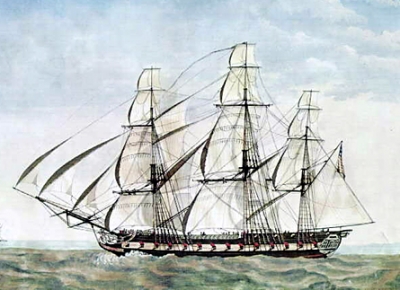
When the Winchester left Southampton on the 23 January 1695, along with a squadron of 19 ships, her mission was to deliver 150 British marines to the island of Haiti, in the Caribbean. The marines were to join with British and Spanish forces in Santo Domingo, then attack the French. She was also to harass French shipping and protect British interests in the region. After completing its mission in Haiti the Winchester loaded supply’s and joined the rest of the squadron which sailed for Port Royal Jamaica. By the time the ships reached Port Royal, the log of the Winchester and other ships had recorded sickness and some deaths amongst the crew. Over the following six weeks almost one death per day was recorded, including the ships captain, who was replaced by Captain John Soule. When the squadron left Port Royal on September 3 for its return journey to England, many of the ships stayed behind because of sickness. It took three weeks for the ships to reach the coast of east Florida, during that time 140 sailors had died and many others where critically ill.
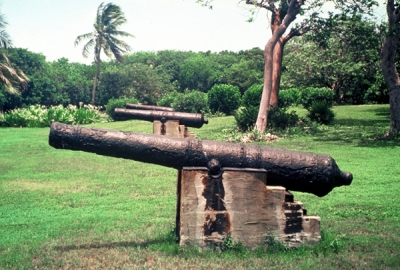
These cannons at Lignum Vitae Key State Park, Florida, came from the wreck of HMS Winchester.
What exactly happend next is not completely clear, as the official ships log of the Winchester was lost. However an excerpt from the log for HMS Dunkirk gives us an insight into the Winchesters final hours; *At 12 last night we tacked and stood to ye leeward ye weather fair but ye wind fresh we met ye Winchester standing to ye Florida shore northward & sometimes after heard guns fired without intermission by which we apprehend a farther addition to our increasing sorrows, for we did believe ye Winchester was runned aground but could give them no relief in ye night being very dark & ye wind blowing directly upon ye shore.
Although HMS Dunkirk was able to do little during the night, 110 men were rescued at day break, (of the 300 that left Port Royal) including Captain Soule. HMS Dunkirk returned safely to England.
In 1938 two fisherman came across the shipwreck and told Charles Brookfield, a local historian. Brookfield organized salvage operations which recovered many artifacts such as cannons, silver coins, muskets and part of a prayer book, written in Latin. The book was lodged under a cannon and had been protected by sand. Subsequent salvage operations in the 1950’s recovered the remaining cannons and a gold watch.
In 1941 National Geographic Magazine published a successful article about Charles Brookfield and the salvage operation. Then in 1962 National Geographic researched and published an article about the circumstances that surrounded the sinking of HMS Winchester. A medical doctor looked at records from the British Admiralty in London. He came to the conclusion that scurvy and dysentery had weakened the crew. They had then drunk mosquito larvae infested water from Haiti, which had given them yellow fever.
The wreck of HMS Winchester is now part of a marine preserve at John Pennekamp Coral Reef State Park.
Images from commons.wikimedia.com
* Excerpt from Ancient Ships ' Logs in London by Gail Swanson.