Shipwrecks of Tragedy: the Story of the Ex Slave Ship James Matthews
EducationShipwrecks of Tragedy: the Story of the Ex Slave Ship James Matthews

The story of the brig James Matthews could almost be taken from the pages of the novel, Roots. However, unlike Alex Haley's novel which was primarily a work of fiction, the true history of the brigantine James Matthews is one of disturbing reality. During its 41 year history, the snow brig had been a slave runner, which was seized and sold by the British Royal Navy, its West African slaves being freed. The ship had changed owners several times, finely becoming a merchant ship and sinking near Fremantle, Western Australia, with its cargo and a chest of full of gold coins.
Ultimately, the shipwreck of the James Matthews bears testimony and is evidence of the cruelty and barbarity of the slave trade. Moreover, to the shameful acts of those people involved who regarded themselves as Christians.
The brigantine James Matthews is believed to have been built in France around 1800 and was originally called the Voltigeur. The ship was 167 tons, with the dimensions of 80 feet long by 21 feet wide. After the abolition of the slave trade in Britain and France, Portugal signed a treaty with Britain that prohibited slavery north of the equator until 1839, when it was abolished outright. As a result many vessels used in the illegal slave trade had their ownership changed to Portuguese and many French slave traders continued on Portuguese registered ships.
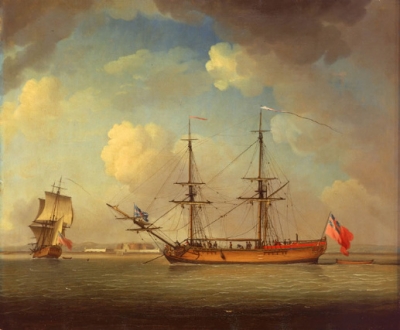
A Royal Navy Snow or Snow Brig, similar to the James Matthews.
The Voltigeur was purchased by Don Francisco Felix de Souza and converted as a slave runner. The snow brig was then renamed the Don Francisco. De Souza was a Brazilian of Portuguese decent who owned many vessels for the purpose of the slave trade. He was wealthy, influential and a close friend of the King of Dahomey ( present day Benin). He was also a ruthless and wicked slave trader. A comparatively high proportion of the west African slaves aboard his ships did not survive the horrendous journey to the Americas.
Under the command of Antonio Pereira Lisboa, the Don Francisco sailed from the Gulf of Guinea, after receiving official Portuguese papers from the government of St. Thomas and Prince, to Fort of Whydah in late 1836, where 439 West African slaves were embarked. By April 1837 De Souza’s brig had almost achieved its objective of reaching the slave market at Havana when the vessel was intercepted near Dominica by the brigantine Griffon of her Majesty’s Royal Navy. According to the House of Commons papers, the ships commander Antonio Pereira Lisboa was arrested and put on trial. Of the 439 slaves, six slaves died during transit, the remainder of the slaves were emancipated on the island of Dominica. The brig Don Francisco was seized by the admiralty and was to be used as evidence during the trial. But because of its terrible condition, being virtually un-seaworthy, it could not travel the distance.
The Lloyd’s of London shipping registry recorded the capture of the Don Francisco ( Voltigeur,James Matthews) on September 7th 1837 as a ‘prize’ of HMS Griffon. The Don Francisco was then sold and renamed James Matthews. The brig sailed for Liverpool, where it was purchased for a third time as a merchant ship by two Irish brothers, Henry and Robert De Burgh. The brothers loaded the brig with a cargo of roof slates and other goods. The brig set sail for Fremantle, western Australia along with a crew of 15, plus three passengers.
The day after arriving at Fremantle a fierce storm swept through the port, which broke the ships masts, forcing one through the bottom of the brig. One person was killed during the incident as the brig sank to the bottom of the bay.
In 1973 a group of sport divers discovered the shipwreck near Woodman Point. Archaeologists form the Western Australian Maritime Museum excavated the wreck and found a large number artifacts, including a chess set made by Henry de Burgh. There was also the matter of a chest said to have contained 200 gold sovereigns which apparently sank with the brig. The chest was never found and it is believed that the de Burgh brothers may have salvaged it.
However the real archaeological value of the brig James Matthews lie in its previous history as a slave runner. To date the wreck is the only slave ship still in existence. Archaeologists have had the opportunely to study a type of vessel only before seen in plans. Their dream is to eventually fully excavate the hull of the wreck and create an exhibition which would be the first of its kind anywhere in the world.
All images from commons.wikimedia.com