World War II: the Tragic Story of the Bedfordshire and the British Cemetery in North Carolina
EducationWorld War II: the Tragic Story of the Bedfordshire and the British Cemetery in North Carolina

Winston Churchill once said, quote; “the only thing that ever frightened me during the war was the U-boat peril”. The worst period for U-boat attacks was from January of 1942 until March of 1943, during which time a staggering 7 million tons of merchant shipping was sunk. It's hard to imagine, but just one merchant vessel could carry enough goods to supply the entire population of England for almost a month.
The battle ground of the U-boats was the Atlantic which saw the loss of over 100 ships in the month of May, alone. Twenty five of those ships were sunk off the east coast of the United States. The U.S. Navy did not have enough vessels to protect merchant shipping; this became most apparent after the loss of the tanker Allan Jackson. The 6,635 ton, unescorted oil tanker was torpedoed by U-66 off the coast of North Carolina. After a request from the US government Britain loaned the US 24 trawlers, fitted out with antisubmarine armaments. One of those vessels was HMT* or HMS Bedfordshire, as it is somtimes referred to; a converted fishing vessel, with a crew of 33, plus 4 officers.
HMT Bedfordshire was built in Middleborough in 1935. She was 130 feet long and displaced 900 tons. The Bedfordshire began life as a ocean going fishing vessel, however with the out break of war she was sold to the Royal Navy, as were hundreds of ships. Her new armaments included depth charges and a 0.303 caliber Lewis machine gun. All antisubmarine vessels were also fitted with ASDIC. A sonar device developed by the Anti-submarine Detection Investigation Committee.

After the Bedfordshire left England its destination was Halifax, where along with three other trawlers, it was to escort the merchant cruiser HMS Queen of Bermuda to New York. After that the Bedfordshire headed south to relieve the USS Roper, and protect a U.S. Navy diving operation. The trawler then returned to the port of Morehead City, where it was based. On May 11, 1942, the Bedfordshire left port with HMS St Loman to petrol and seek out U-boats. U-558 was on patrol off Cape Lookout when it spotted the trawlers. The U-boat's 27 year old commanding officer Gunther Kretch gave the order to fire two torpedoes at HMS St. Loman. Luckily the ships lookout spotted the torpedoes and evasive action was taken to avoid damage. After avoiding detection U-558 then turned its attention to HMS Bedfordshire. The u-boat fired two torpedoes which hit the trawler amidships, causing an enormous explosion. HMT Bedfordshire sunk within minutes; there were no survivors.
The Bedfordshire’s commanding officer was Lieutenant R.B Davis. And the junior officers were Sub-Lt. H. Clutterbuck, Sub-Lt B. Hall and Sub-Lt. T. Cunningham. Before the ship left England Lieutenant Cunningham was given six British flags which he was to deliver to US Naval Intelligence. Four of the flags were for the bodies of British seaman that were from the torpedoed tanker San Delfino. Three days after the disaster the bodies of two men washed up on Ocracoke Island. They were identified as Sub-Lt. Thomas Cunningham and Stanley Craig, Ordinary Telegraphist of HMT Bedfordshire. In a cruel twist of fate one of the six Union Jack flags was to grace the coffin of Lieutenant Cunningham.
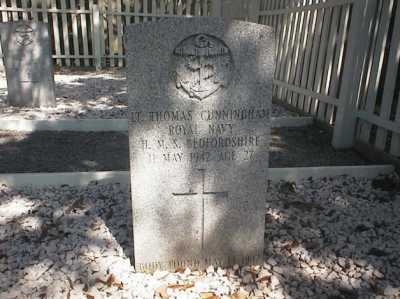
The British Cemetery in North Carolina: On the island of Ocracoke, North Carolina, there is a cemetery that will always be a little piece of England. The land was donated by the U.S. government to the commonwealth War Graves Commission in London. The bodies of four seaman are buried at the cemetery. Two of them are Thomas Cunningham and Stanley Craig, the other two were unidentified; however it was determined that the unidentified men were from the crew of HMT Bedfordshire. The U.S. coastguard takes care of the cemetery. Ocracoke Cemetery.
U-66: 14 months after sinking HMT Bedfordshire, U-boat 66 was destroyed by aircraft from USS Block Island and the destroyer USS Buckley.
*HMT stands for his or her majesty's trawler.
All images from commons.wikimedia.com