Missing Ships of the British Royal Navy
EducationMissing Ships of the British Royal Navy

Throughout history a number of ships and their entire crews have gone missing, never to be seen again. The notion of the Flying Dutchman, a ghost ship that endlessly cruises the worlds oceans is a thing of the past. With todays satellite technology scanning every inch of the worlds surface, such a phenomenon would not even be possible.
In most cases probable causes such as storms can be attributed to a ships disappearance. Moreover, the lack of witnesses cannot rule out other causes such as human error. Also keep in mind that ships launched before the late 1890’s did not have wireless telegraphy, which would have enabled them to send distress signals.
While it is now possible to find and salvage most shipwrecks in deep water using side-scan-sonar, the cost of such operations far out way any financial returns. This rules out commercial salvage operations, but governments sometimes fund salvage operations, especially for naval vessels because of their historical significance.
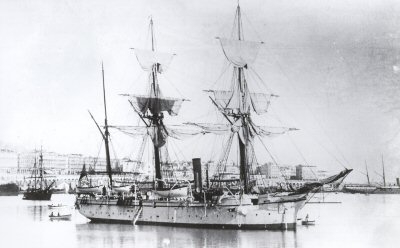
HMS Condor of 1898: the Condor was a steel sloop, barkentine-rigged, steamship. She was built at Sheerness Royal Dockyard and launched in 1898. At a time when Great Britain still had an empire the sloop was part of the Pacific Squadron. The three year old ship had a regular crew of 130, plus 10 cadets. In 1901 HMS Condor left Esquimalt, British Colombia bound for Hawaii when she was caught in a storm off Vancouver. The Condor last made contact with the light station at Cape Flattery. When the Condor did not arrive at Hawaii, British and U.S. Navy vessels began searching for the missing sloop. Nothing was found. However a few days later a dinghy and a sailors cap, marked HMS Condor were found on the west coast of Vancouver Island.
Nothing more was heard of the missing ship for many years. Then, in May 1949 a fisherman aboard the trawler Blanco discovered some wreckage in a fishing net hauled from a depth of 250 feet. Among the wreckage was a rusty ships binnacle identical to those manufactured for HMS Condor and other screw steel sloops class ships. However, the ship itself has never been discovered.
HMS Atalanta of 1844: the Atalanta was a Royal Navy training ship, that was originally a Spartan-class sixth-rate frigate named HMS Juno. On January 31st 1880, the ship left Bermuda for Falmouth, England with a crew of 317. Two weeks out she foundered during a storm with the loss of all on board. The tragedy was one of the British Navy’s worst sea disasters. After it was announced that the ship was missing with all hands there was public outcry in Britain and the disaster gained worldwide attention. The subsequent investigation focused on the fact that 300 of the ships crew were inexperienced sailors and cadets. There were only 11 able seaman, not nearly enough fully trained sailors to sail the Atalanta under exceptional circumstances. This accusation was supported by the testimony of a former Atalanta Able Seaman, John Varling. Varling stated that the Atalanta was often overweight and rolled to 32 degrees. He said that he had overheard Captain Stirling remark that if the ship rolled one more degree, “she would have gone over and foundered”
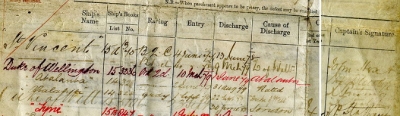
Records from the last completed training mission of the Atalanta.
Two months after the incident HMS Avon was returning to Portsmouth when her crew sighted a tremendous amount of wreckage floating in the ocean near to the Azores. The shipwreck of HMS Atalanta has never been discovered. The HMS Atalanta memorial is located at St Ann's Church in Portsmouth.
Images from commons.wikimedia.com
.