Things to Come: an Analysis of H.G. Wells's Sci-Fi Classic
EducationThings to Come: an Analysis of H.G. Wells's Sci-Fi Classic

This article examines the British science fiction film Things to Come (1936), which was based on a novel by H.G. Wells. The film projects a Utopian vision of the future.
On Christmas Eve 1940, the Second World War begins as the city of Everytown is bombed. The war lasts 66 years, during which time civilization falls into anarchy. Eventually a warlord who calls himself the Boss emerges to establish brutish control over the chaos. A scientific group called Wings over the World emerges and is able to quash the regime of the Boss using an airborne anaesthetic known as the gas of peace. The scientists then set about building a new scientific Utopia on the ruins of the old civilization. In the year 2036 (one century after the film’s release) the culmination of the new society's vision is the launching of the first Moon mission.
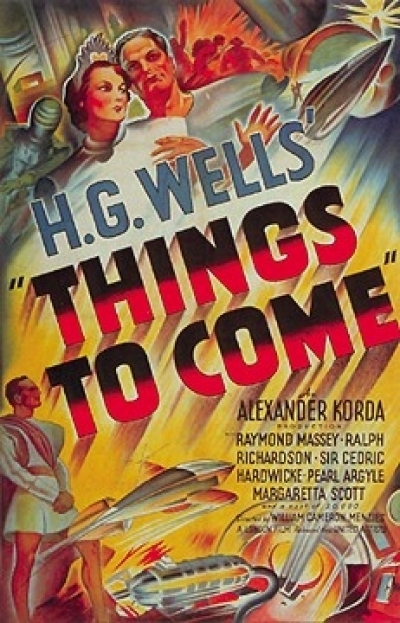
The release of Things to Come in 1936 was one of the key moments in the history of science fiction cinema. The film was the brainchild of H.G. Wells, whose worldwide reputation as a thinker had persuaded its producer, Alexander Korda, to offer him a contract giving him virtually total control over the project. Korda drafted a dazzling array of talents to render into pictures Wells' ideas of the future one hundred years hence. His brother, Vincent Korda, a distinguished painter, was employed as art director, and the Bauhaus artist Laszlo Moholy-Nagy contributed ideas for futuristic sets. As director, Korda hired William Cameron Menzies, who had practically invented the profession of Hollywood art director through his work with Douglas Fairbanks on The Thief of Baghdad (1924), and whose career would climax with Gone with the Wind (1939).
The following individuals were involved in the film's production:
Director - William Cameron Menzies
Screenplay - H.G. Wells
Producer - Alexander Korda
Production Design - Vincent Korda & Moholy Nagy
Cast:
Raymond Massey (John Cabal/Oswald Cabal)
Edward Chapman (Passworthy/Raymond Passworthy)
Margaretta Scott (Roxana Black/Rowena Cabal)
Ralph Richardson (the Boss)
Cedric Hardwicke (Thetocopolous)
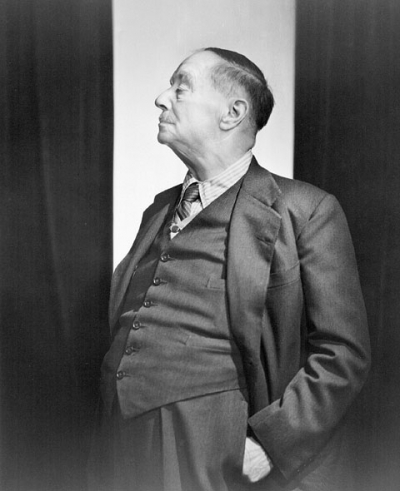
H.G. Wells
Herbert George Wells (1866-1946) was one of the founding fathers of modern science fiction. The peak of Wells' success was during the first decade of his publishing career, 1895 to the early 1900s. During this time Wells published major works and laid down what today are still some of science fiction's major thematic preoccupations – The Time Machine (1895) conceived the idea of time travel; The Island of Dr. Moreau (1896) anticipated themes of genetic engineering; The War of the Worlds (1898) was the first alien invasion story; When the Sleeper Awakes (1899) was the first story in which a cryogenic sleeper awakes to encounter a future society. By the time of The Shape of Things to Come (1933), the book that this film is nominally based on, his scientific romances had become dry speculative sociological tracts.

The Central Artium of Everytown
In his analysis of the film Professor Christopher Frayling argues that ‘Things to Come is to Modernism what Blade Runner is to Postmodernism'. The symbolism of technological progress in design was a key factor in this period. The key iconography presented in the film is linked to European and American Modernism. See for example:
? Futurist visions of the city
? Le Corbusier's Towards a New Architecture (1927)
? The work of Bauhaus designers
? Specific buildings such as the De La Warr Pavilion by Erich Mendelsohn
? The work of American industrial designers, for example Norman Bel Geddes in his book Horizons (1932) and the futuristic designs he presented at the New York World's Fair (1939).
Reading:
For specific design influence and iconography see:
? Christopher Frayling, Things to Come, 1995.
? Chapters 2 & 3 in Woodham's Twentieth Century Design (1997) are useful introductions to the key debates, designers and developments in design.
? Norman Bel Geddes Horizons (1932) and Le Corbusier's Towards a New Architecture (1927).
? Donald J. Bush, The Streamlined Decade (1975)
Please see my additional articles on science fiction cinema:
https://knoji.com/science-fiction-filmography/
https://knoji.com/the-artificial-human-representations-of-the-robot-in-science-fiction-cinema/