The Artificial Human: Representations of the Robot in Science Fiction Cinema
EducationThe Artificial Human: Representations of the Robot in Science Fiction Cinema

The concept of the artificial human has been a central theme in science fiction since Mary Shelley published Frankenstein in 1819. The artificial human has appeared in a number of different guises: as robot, android, cyborg and replicant. Each persona has different implications. The artificial human is a polysemic figure, which has been used to explore anxieties surrounding technology, conformity, slavery and racial difference, depending on the cultural preoccupations of the period.
The term ‘robot’ comes from the Czech word robota, meaning drudge or slave. It was first used to denote a mechanical man in a play by Karel ?apek called Rossum’s Universal Robots (1920). So the word is relatively new, but the concept is much older. Frankenstein was one of the first texts to deal with the idea of an artificial man. This was a morality tale about science being used to create life without reckoning upon God. Metropolis (1927) was a key representation, in which robots are being produced to replace human workers. This responded to contemporary fears that technology was displacing humanity. More recently, I, Robot presented artificial humans as modern-day slaves and examined themes of race.
The Cyborg
The image of the artificial human varies according to the anxieties of the period. In the 1980s, the most common image was the cyborg (cybernetic organism), a hybrid of man and machine. Robocop is a cyborg because he’s a human who has been mutilated and whose body has been rebuilt; technology is keeping him alive. The poster spells out the definition: part-man, part-machine. Likewise, the Terminator is a cyborg because it consists of living tissue over a metallic endo-skeleton. In the Star Wars films, Darth Vader is a cyborg – he’s a living man who has been cybernetically enhanced to the point where he’s ‘more machine than man.’ The cyborg usually personifies the fear that technology is changing us, invading our bodies and slowly destroying our humanity.
.jpg)
Science fiction has always dealt with the relationship between the human and the robot, but combining the two into a hybrid being is a particular trend of the 1980s. We have to ask why that is? The cyborg is a fusion of the human body and technology and it’s been argued that both of these things were central concerns of the 1980s.
Super-bodies
If we take them one at a time, the human body was a major preoccupation within popular culture of the 80s. A lot of cultural products focussed on the human body to an obsessive degree. Action movies are a good example of this. The key action heroes of the period were stars like Arnold Schwarzenegger and Sylvester Stallone. Their star persona was based on the bulked-up, hyper-masculine body, which was achieved through weightlifting. You can see this in the Rambo movies with Stallone, and in Conan the Barbarian and The Terminator with Schwarzenegger. This is an image from Conan in which you see an almost fetishistic worship of Schwarzenegger’s physique.
.jpg)
It wasn’t just the male body that was worshipped; the female body was also celebrated (of course that’s nothing new in Western culture). The actress Jane Fonda famously made a work-out video that became the best-selling video in history. This was part of a craze for transforming the body through aerobics or weight-lifting. Movies like Flashdance and Dirty Dancing were ostensibly about dance, but they were also about writhing bodies and rippling musculature. Of course, pornography is another arena in which the body was obsessively scrutinised.
.jpg)
Even horror and sci-fi were preoccupied with the human body. We’ve already looked at the sub-genre of body horror, a trend of the 80s which is represented by the work of David Cronenberg. In science fiction, the human body was transformed by interspecies rape (Alien), gene-splicing (The Fly) and cybernetic enhancement (Robocop).
So the popular culture of the 1980s placed tremendous emphasis on the human body. It’s been argued that this was a response to the postmodern era. We looked at postmodernism a few weeks ago, and saw that it was characterised by chaos, dislocation and the breakdown of identity. In this context, the human body became the last source of stability; it was the one part of us that hadn’t changed. Popular culture of the 80s ‘retreated’ into the human body in an attempt to defy the contradictions of postmodern existence. Again, the human body became the last refuge of identity, the last source of stability. This accounts for the fetishistic worship of the bulked-up physique in films of the period.
Linda Mizjewski has written an essay called ‘Action Bodies in Futurist Spaces’, which was published in the book Alien Zone II. She asks why the male super-body features so prominently in science fiction, a genre that continually re-imagines and transforms the human body and its genders. She writes:
Science-fiction films have been instrumental in visualizing and narrativizing the qualities associated with postmodernism: disorientation, powerlessness, fragmentation, disintegration, loss of boundaries, and hybridization. Warding off these threats was one of the symbolic functions of the iron-clad muscular cyborg in science-fiction films of the 1980s and early 1990s.
However, there’s a contradiction here. We’ve seen that postmodernism is characterised by hybridisation - the fusion of different elements. The forces of globalisation and mass communication have created a hybrid culture. Different cultures from around the world have fused together to create a disorientating hybrid. The cyborg is a hybrid being because it’s a fusion of living tissue and technology. Because of this, its authority is compromised. It can’t fight off the threats of the postmodern era because it is itself a symptom of postmodernity.
Mizjewski writes:
Despite the irony that the fortified cyborg was itself a man—machine hybrid and could no longer lay claim to a unified identity, it fought hard to resist the postmodern breakdown of gender boundaries and rigid rules pertaining to sexuality. But its own compromised status as a hybrid made its mission futile.
So to summarise that, steel-clad muscular cyborgs were a mainstay of science-fiction cinema during the 1980s. The cyborg was created to defy the postmodern breakdown, but as a hybrid being, its authority was compromised and its mission inevitably failed. In the 1990s, a new type of action hero emerged: not muscle-bound supermen, but slim young men and women surfing through cyberspace.

High Tech
The human body was one component of the cyborg, but the other was the machine. Technology and the machine were also obsessions of the 1980s, and Robocop responded to aesthetic trends of the period. Robocop has a metallic body; he’s encased in gleaming steel armour. This seems to reflect the High Tech style of architecture. High Tech began in the 1970s and was practiced mainly by British architects. The name is derived from a book, High Tech: The Industrial Style by Joan Kron and Suzanne Slesin (1978).
The High Tech style celebrated technology and promoted a cult of the machine. This is the Pompidou Centre (1977) in Paris, which was built as an art gallery. This was an early example of High Tech architecture designed by Richard Rogers. It looks like a giant machine. All the functional elements – pipes, service stacks, lifts and escalators – are exposed on the outside in an overt celebration of technology.
The prime example of High Tech architecture is Lloyds Bank in London. This was also designed by Richard Rogers. It’s encased in a gleaming steel skin, like Robocop himself. The use of steel and glass is almost muscular and aggressive. Again, the service strips are placed on the outside. This is certainly functional – it makes them easier to repair – but it could also be regarded as a fetishisation of technology. This represents a resurgence of the obsession with technology. High Tech fetishized engineering and technology as the substance of architecture. Not surprisingly, High Tech became the face of global finance. Huge corporations like Lloyd’s used it to promote a strong, macho image.
Apart from Richard Rogers, the other leading exponent of High Tech is Norman Foster. He designed the Sainsbury Centre in East Anglia. A local example of Foster’s work is the Sage Music Centre in Gateshead. This is still in the High Tech mode, but it’s been softened to reflect the spatial fluidity of the digital age.
American Values
In analysing the film, we have to think about the political context. Robocop is often viewed as just another dumb action movie, but it’s actually a subversive, razor-sharp satire. The film was directed by Paul Verhoeven, who also made Total Recall and Starship Troopers. Verhoeven’s critics see his films as ultra-violent and over-the-top, and they are, but that’s appropriate because Verhoeven is depicting a dystopian future, which is a nightmarish extension of the present. In particular, Robocop dissects contemporary American values and the ethos of the 1980s.
In this era, Ronald Reagan was President of the USA. Reagan was a Republican (i.e. right-wing) president. His policies reflected his personal belief in individual freedom. He wanted to reduce people's reliance on government because he thought that state intervention compromised the status of the individual. Accordingly, he cut the budgets of social programmes including Medicaid and food stamps: the state should no longer support the vulnerable in society. Conversely, Reagan empowered private businesses by reducing business regulation and taxes. Reagans’s economic policies were dubbed ‘Reaganomics’.
Critics labeled Reagan's foreign policies aggressive and imperialistic. He denounced the Soviet Union in ideological terms, famously describing it as an ‘evil empire.’ In 1983, he introduced the Strategic Defense Initiative, a defense project that would have used ground and space-based systems to protect the United States from attack by nuclear missiles. The programme was nicknamed ‘Star Wars.’ In fact, it was the inspiration for SkyNet in the Terminator films.
The political situation in Britain was very similar. Margaret Thatcher was Prime Minister of Britain from 1979 to 1990. Her political philosophy was very similar to Reagan’s and they became very close political allies. Thatcher believed in reduced state intervention, the free market and entrepreneurialism. She privatized state-owned companies and sold off council housing to tenants. She deregulated the financial sector, making private companies more powerful. She was opposed to the Soviet Union and her tough-talking rhetoric earned her the nickname the ‘Iron Lady.’
Paul Verhoeven is often accused of being misogynistic and obsessed with sex and violence: he directed Basic Instinct, which isn’t the most progressive of films. Fundamentally, however, he seems to be a left-wing liberal. He grew up under Nazi occupation in Holland and that shaped his political outlook. Robocop is a ruthless satire on the right-wing policies of Reagan and Thatcher.
Reagan and Thatcher both believed in privatization – public services being run by private companies instead of the state. This is a capitalist ethos that relies on the notion of the free market. The idea is that market competition will force companies to provide a good service. The danger is that private companies will only care about private profit. Robocop exaggerates this situation. Even the police force is run by a private company, OCP. A private police force is dangerous, because it’s completely unaccountable, and can’t be controlled by the state.
Another theme of the 1980s was aggressive business culture. This was the era of the yuppie – young professionals in pinstripe suits and braces, armed with file-o-faxes and mobile phones that looked like bricks. ‘Greed is good’ was an iconic line from the film Wall Street. Reagan and Thatcher permitted this unrestrained business culture by cutting regulations. Business is portrayed as a macho, dog-eat-dog world. The OCP executives are even willing to murder each other for private profit. Even the criminals are talking about capital investment.

Corporate paranoia was a major theme of the postmodern era. Each of the films we’ve seen this semester features a sinister global corporation: Weyland-Yutani, Tyrell, OCP. As a police officer, Murphy is owned by OCP: he’s signed a waiver that gives them permission to use his body in the event of his death. OCP sees Murphy not as a human being, but as private property and they further dehumanise him by turning him into a machine, a piece of hardware. Dehumanisation is one of the central fears of science fiction. However, a remnant of Murphy’s humanity survives and his partner Anne Lewis recognises it. At the end, the head of the company asks Robocop his name and he replies ‘Murphy.’ This suggests that he has retrieved his humanity.
America is portrayed as an increasingly trashy culture, with inane sitcoms and aggressive advertising. In the film we see a series of TV commercials. What is the function of these adverts? They give us a snapshot of society, revealing all of its problems. One of the products is a board game called Nuke’em, in which you try to nuke members of your family. The slogan is ‘Get them before they get you.’ This is a comment on America’s aggressive foreign policy in the 1980s, in which death was dealt out liberally. Reagan’s second term as president was marked by the bombing of Libya.
We see a car advert for the 6000 SUX, which is obviously a joke about the quality of American cars. The political activist Ralph Nader criticised the US automobile industry for investing in styling at the expense of safety. American cars were notorious for their lack of fuel efficiency. Nevertheless, the criminals desire these cars as status symbols. When one of the gang members gets one of these cars, Clarence Boddiker blows it up because he can’t stand someone having the same model as him. This reflects the materialistic ethos of the 1980s.
We also see snapshots of TV shows. A running joke is the annoying sitcom character with the catchphrase ‘I'd buy that for a dollar!’ This suggests that in this society everything is for sale, monetary value is the only thing that matters. This can be seen as a critique of the free market ethos of the 80s. Overall, we are presented with a vulgar, shallow and aggressive culture not a million miles away from ours.
Motor City
Last semester we were looking at the concepts of Utopia and Dystopia. This dichotomy is visualised in Robocop. The old city of Detroit is crime-ridden and corrupt. It’s littered with the relics of a decayed industry. However, the technocrats are building Delta City, a futurist utopia. This echoes the dream of Modernist architects who wanted to build ideal cities on the ruins of the old. Delta City is portrayed as the safest place on earth. Its slogan is ‘The future has a silver lining.’
The film is set in Detroit, but the urban scenes were actually filmed in Dallas due to its futuristic appearance. The film’s producer Jon Davison said ‘We had scouted Detroit as a possible location - after all, the movie takes place there - but its architecture just wasn't right.’ This means that Detroit of the future is represented by the skyscrapers of Dallas, which is significant because they were built by Texas oil barons, so they are corporate citadels.
.jpg)
Why was the film was set in Detroit? Detroit is famous for two things, cars and soul music. Detroit is the centre of the US automobile industry, with both Ford and General Motors basing their operations there. For this reason, Detroit is known as the ‘Motor City’ or ‘Motown.’ In the early 20th century the USA led the way in making mass-produced goods thanks to pioneers like Henry Ford and the famous Model T Ford that made him rich.
Ford opened a car plant in Detroit. Instead of being built from scratch, each car was built from prefabricated parts. The car moved along an assembly line and each worker fitted a standardised part; he performed the same task all day long. Ford rationalised the manufacturing process, which enabled him to dramatically increase car production. Even the worker’s activities were rationalised. The company did motion studies in order to improve efficiency. So Detroit was the perfect setting for this story of the mechanisation of humanity.
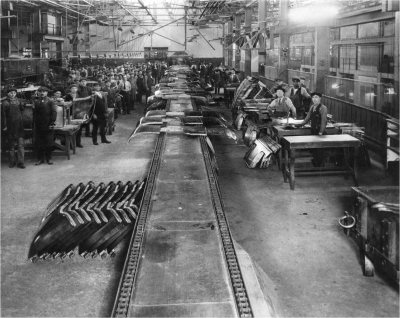
The film plays out against a series of industrial backdrops dominated by decaying factories, the industrial archaeology of Detroit. The action revolves around the abandoned Rust Belt factories that Clarence Boddicker and his gang use as hideouts. We’ve seen that the postmodern era (the 1970s onwards) is a post-industrial era. Blade Runner depicted the world as a post-industrial wasteland. Likewise, Robocop depicts the decay of American industry. This is very reminiscent of Get Carter and the way it represents Newcastle. We see the grim relics of a dead industry. Again, it represents the shift the postmodernity.
Conclusion
The artificial human has been a central theme in science fiction, but its image varies according to the anxieties of the period. In the 1980s, the artificial human adopted the guise of the cyborg, a fusion of man and machine. As a hybrid being, the cyborg is a quintessentially postmodern figure. The postmodern era was characterised by chaos, dislocation and the hybridisation of culture. To cope with this sense of chaos, action movies of the 1980s focussed on the human body and presented it the last refuge of the fractured self, the last source of stability. This accounts for the obsessive worship of the bulked-up super-body in popular culture of the period.