The History of Gambling: Tools and Games
EducationThe History of Gambling: Tools and Games

Just as gambling evolved from divinatory practices of early societies, so too did the tools of gambling evolve from ritualized objects--stones, sticks, nuts, shells, and bones. Small bones, particularly knucklebones (astragali) became the direct predecessors of modern dice.
Astragali have irregular, non-symmetrical shapes, with four large sides and two more-or-less rounded ends. When thrown, an astragalus will land on one of its four big sides, delivering a seemingly random outcome of the throw.
Over time, the sides of an astragalus were given value and markings; the lowest value “1” assigned to the largest side of a concave shape because of a higher chance that the bone will rest on it, the highest value “6” given the smallest side of a convex shape for its greater odds--thus "Roll 'em bones!".
Four-sided astragali dating to 6000 BCE have been found in many archaeological sites of Mesopotamia.
Also from this period, gaming boards have been recovered revealing a game similar to modern Backgammon, the throw of the astragali used to determine how far a player could move his or her piece on the board.


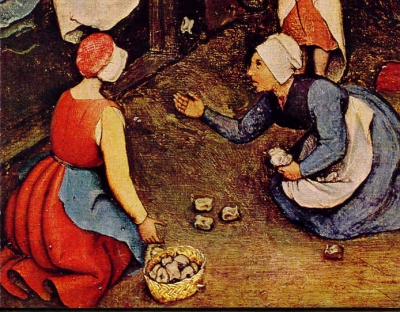

Knucklebones were in common use until the Romans began using other materials--ivory, stone, silver, wood, amber, and animal and human teeth--to produce dice of a more symmetrical shape and even density. As history reflects, Roman soldiers regularly played dice games during their military campaigns and even carried heavy and bulky gaming tables into war along with their weaponry. And as the New Testament describes, the Roman soldiers guarding Jesus’ cross were tossing dice for his garments.
As expected, numerous gaming boards, tables, and dice have been recovered from the ruins of the Roman Empire. In fact, the oldest known “loaded” dice were discovered in the ruins at Pompeii, the earthquake that buried the city apparently surprising a group of players at the dice table where they were found 2000 years later with the dice still clenched in their fists.
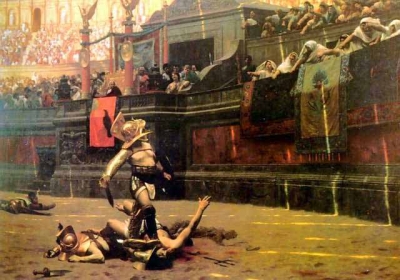
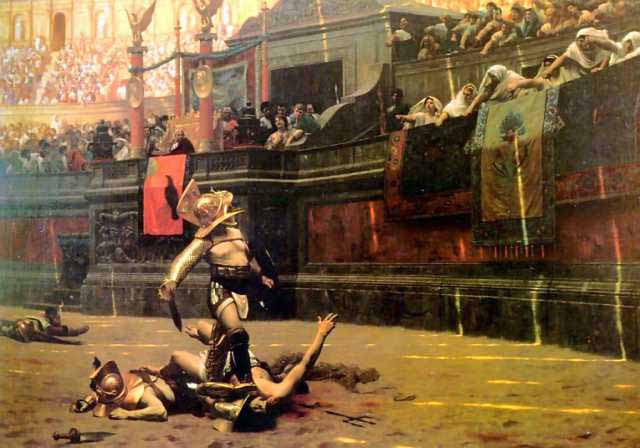
Although according to the Roman law a winner could not legally claim money won by gambling and a loser could not be forced to pay his gambling debts, gambling was apparently more than just a source of entertainment. Gladiatorial contests, chariot races, animal fights, and combats between animal and humans, as well as an array of other sporting events provided constant opportunities for the masses to bet and satisfy their growing hunger for gambling.
Around the 7th Century CE, the Chinese modified western dice into Chinese dominoes, often made of ivory and other materials, incorporating red and black pips.
In the 12th Century CE, playing cards entered the Chinese gambling scene, adding another dimension to the already rich and diverse gambling life flourishing in China (and later brought to America).
As with the ancient relationship between divinity and dice, the origins of playing cards also evolved from divinatory practices, specifically the symbolic "sacred arrows" used for fortune telling around 6th Century CE in Korea. Made of oiled paper and silk, early Korean cards were called Htou-Tien or “fighting arrows.” In later centuries, these cards were modified by the Chinese to reflect their paper money design, leading to the games Blackjack and Poker.
From the practice of shuffling paper money in China around 900 CE, card playing was consequently brought to Europe via the Mameluke Empire. As followers of Islam, the Mameluke people did not adorn their playing cards with human figures as with modern cards, but illustrated them instead with intricate designs reminiscent of Muslim carpets.
When the cards made their way to Italy and Spain, it was there that card makers began illustrating cards with members of royalty. The “Queen” cards of today, however, did not appear until the 1500's when the French chose to replace one of the male cards with a female figure representing the Queen. This design became known as the "French Pack,” and served as the prototype of the 52-card deck we commonly use today. (Although many have long assumed that modern playing cards derived from fortunetelling, Tarot cards, this link has not been historically confirmed.)

Eighteenth Century Spanish deck

In Medieval Europe, gambling with dice games remained as popular as it had been in ancient times. English chronicler Ordericus Vitalis (1075-1143) wrote that in his time, "English clergymen and bishops were fond of dicing." In 1190 King Richard the Lion-Hearted and Philip Augustus of France, who led the Third Crusade, issued orders restricting games of dice among the troops; knights and clergymen allowed to lose no more that 20 schillings and ordinary foot soldiers not permitted to play at all. Some historians believe the dice game Hazard was invented by English Crusaders during the siege of the Arab fortress of Hazart--or perhaps learned it from the Arabs; the word “Az-zahr” is Arabic for dice.
By 15th Century the popularity of dice games diminished in Europe, with card games replacing dice as the most popular way to gamble.
Toward the end of the Middle Ages, in addition to playing cards, the lottery had also become an important form of gambling in Europe. First appearing in Rome, lotteries were a means to distribute gifts without offending individuals. In Europe, lotteries originally served the purpose of disposing of expensive merchandise which had not been sold. The widow of great Flemish painter Jan van Eyck promoted that type of lottery at Bruggs in 1446, and a century later the merchants of Venice and Genoa used lotteries to move unsold goods. The first nation-wide English lottery took place under Queen Elizabeth in 1569 with prizes in silverware, tapestry, and money.
Another popular game of wager, Roulette, has a singularly unique history in the annals of gambling. Roulette, which means "small wheel" in French, was modernized into the game we know today by Francois and Louis Blanc who conceived the "Single 0" game in 1842, which was subsequently brought to America around the same time. Adding the "Double 0" to the wheel to create an Americanized--American Roulette--version, the origins of the roulette wheel itself are a little more ambiguous. Some sources credit the 17th century mathematician, Blaise Pascal, with creating the wheel, with other information supporting the theory that the Chinese invented the wheel, and that it eventually made its way into Europe by Dominican monks. In any regard, when Prince Charles of Monaco implemented the roulette wheel as a means of counteracting the financial problems of his kingdom in the late 19th century, the popularity of roulette skyrocketed and spread.
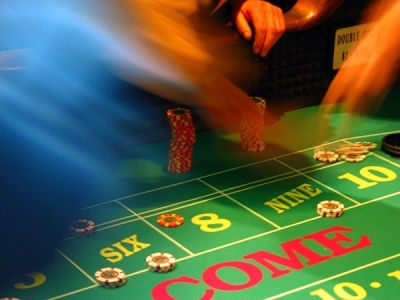
Of all the gambling games of chance, craps has achieved the most lasting fame and popularity. Originally called "Hazard,” craps was originally played in private gambling parlors by elite and upper class citizens of 18th and 19th Century England. The game was imported into France soon after and was renamed "craps"-- a derivation of the word "crabs,” meaning "pair of ones.” When the game arrived in America, it was simplified and became an instant success for all the classes--rich and poor--becoming the common game played on the steam powered show boats in American waterways.

When America became an independent nation in 1776, the newly formed government, which was in need of revenue, used gambling as a way to cultivate large sums of money for its early activities. But when gambling became a virtual addiction among American citizens of the frontier--negatively impacting countless families--Nevada made it illegal from 1850 to 1910. In a reverse decision, however, it was re-sanctioned in 1931, beginning Las Vegas’ rise as the greatest gambling phenomenon in the world.
References:
http://www.gamblingphd.com/historical-information.htm
A History of Gambling, Leo Markun
Something for Nothing: A History of Gambling, Alice Fleming
Harper's Weekly: "1863 Cards and Dice"
Roll the Bones: The History of Gambling, David G. Schwartz
Related Articles:
> The History of Gambling: Ritual Beginnings
Visit JAMES R. COFFEY WRITING SERVICES & RESOURCE CENTER for more information