The Mysterious "Red Paint People" of Ancient Labrador
EducationThe Mysterious "Red Paint People" of Ancient Labrador

The so-called “Red Paint People” of New England and the Atlantic Canadian coastal regions of North America were a pre-Columbian indigenous culture named for the large quantities of red ochre they typically used in their mortuary practices.
Sometimes referred to as the Moorehead Burial Tradition after archaeologist Warren K. Moorehead who was instrumental in bringing this mysterious culture to the attention of the scientific community, archaeological evidence shows that the Red Paint People hit their peak of cultural development between 3000 BCE and 1000 BCE--but have a history spanning thousands of years prior to this time.
An otherwise unknown seafaring group that began fishing and hunting along the coasts and rivers of North America at least 7,000 to 9,000 years ago, these ancient Americans came to rival their European counterparts in sophisticated stone and bone tool-making and navigational skills, several millennia before the Vikings. With some of their coastal sites showing evidence of year-round occupation, evidence shows that their diets included sea fish, anadromous fish, shellfish, meat, berries, acorns, nuts and roots, with regular hunting (probably by spearing) of swordfish obtained from the Gulf of Maine.
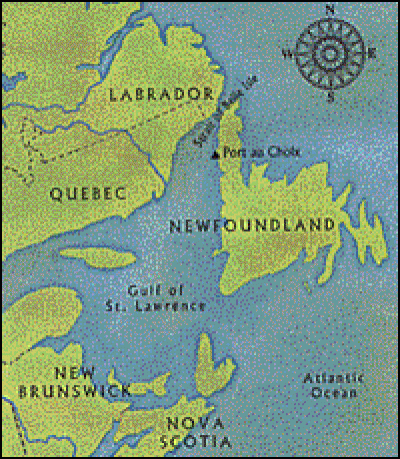
With a trading range known to have extended from Labrador to the New York side of Lake Champlain, the Red Paint People’s cultural influence is believed to have covered most of this geographic area, with their burial traditions believed to have influenced cultures from other regions. While no pottery or metal tools have been found in sites associated with this culture (which is actually typical for this era and location) for unknown reasons, these ancient sailors routinely covered both their dead and the grave goods they buried with them, with red ochre, making their burial traditions more elaborate than any subsequent culture of the area. (Red ochre, or iron oxide, is historically known to have been used for both spiritual and practical purposes-dating back tens of thousands of years---as an honorific in burials and sites, as well as for protection from sun and insects.)
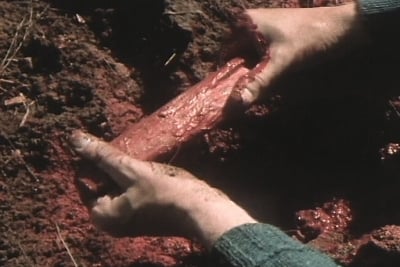
Unearthing red ochre
While the gravesites of the Red Paint People had been known as early as the 1840s, the first scientific examination didn’t occur until 1892 when a Harvard professor made the first archaeological assessment, assisted by a man named Charles Willoughby. Willoughby subsequently exhibited a scale model of the dig at the Chicago Columbian Exposition in 1893, which caught the attention of Warren Moorehead who decided to further excavate, unearthing beautifully crafted stone artifacts (gouges or woodworking tools), fishing plummets, flaked stone knives, and spearheads of ground slate. Publishing his extraordinary finds from 1912 to the 1920s in prominent American archeological journals, Moorehead concluded that the Red Paint People were much older than other known groups of this area, and were in fact a totally different culture from that of the later Algonquin tribes. His proposal of a “new” ancient culture was, however, consistently challenged, sparking a controversy based on his assessed of the red ocher deposits.
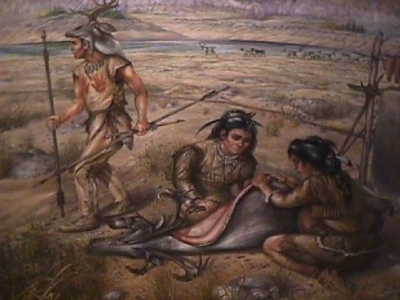
Artist's rendition
Although the sites, which were little more than rock deposits, were generally accepted as graves, they were so deteriorated that no bones were preserved, and some of the stone artifacts were badly eroded. The advent of the Carbon-14 dating process, however, later proved that Moorehead was indeed correct, and that the graves dated to between 2,000 to 6,000 years ago, with the grave stones dating to at least 4,000 BCE. Thus, no known culture could have made them.
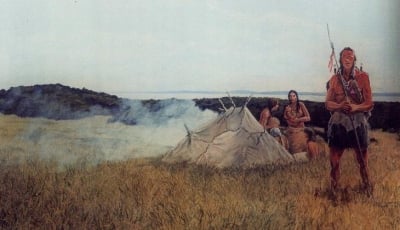
Artist's rendition
While an early hypothesis that concluded that the red paint graves were the remains of a more advanced culture that had been wiped out by tidal waves lost credence due to lack of physical evidence, it has lead to the suggestion that the Red Paint People may possibly have been the descendants of an even more ancient sailing people who once traded along these North Atlantic coasts and the Arctic Circle, island-hopping--perhaps in large skin boats--along a string of islands now known to have existed when sea-level was lower, just as the last of the Wisconsin Glacier melted away. This hypothesis raises a question many anthropologists now ponder, “How early and for how long did people inhabit these coastal regions before the Atlantic submerged them around 8,500 years ago?”
References:
http://www.seacoastnh.com/history/prehistoric/redpaint.html
http://home.myfairpoint.net/espooner/id51.html
http://www.archaeology.org/0005/abstracts/letter.html
Images via Wikipedia.org
Artist renditions via ancientgreece-earlyamerica.com
Related Articles:
> Voyages to America Before Columbus
Visit JAMES R. COFFEY WRITING SERVICES & RESOURCE CENTER for more information