Bamboo: Nature's Amazing Eternal Clock
EducationBamboo: Nature's Amazing Eternal Clock

Since the Stone Age, humans have depended on the giant grass known as bamboo. And despite most varieties having never been cultivated, there are over 1000 known species, and over seventy-six genus in existence today. Of the few that have been cultivated, Arundinaria amabilis and Bambuse vulgaris have been cultivated so long that their native origins and ranges have long been forgotten.
In Asia, bamboo is an unequalled source of timber, animal fodder, and paper. Bamboo hay contains four times the protein of other grasses, its foliage is easily woven into baskets, and the cane is a strong and rot-resistant material used in houses, furniture, and countless household goods. Even used in large-scale construction, the concrete and glass skyscrapers of Hong Kong are actually built on frames made of bamboo.
Similarly, in North America, bamboos are used for housing, furniture, window shades, household utensils, ornamental planters, water piping, fishing rods, and other uses too numerous to list. Additionally, the sprouts are edible and are being tested for nutritional and curative values. And when Thomas Edison was experimenting with the first electric light bulbs, he used carbonized strips of bamboo as filament.
.jpg)
One of the most fascinating properties of bamboo is its flawless internal clock. Big bamboos, like those found in the tropics, flower every thirty years right on cue, sending out rhizomes which run under the ground to produce new shoots. Until quite recently, it was impossible for hybridization or selective breeding of bamboo because the process required having to wait thirty, sixty, or even one hundred twenty year to complete a desired process.
.jpg)
Amazingly, this thirty-year bamboo cycle indicates when an entire generation of plants will flower, even if burnt, cut to the ground, or transplanted to gardens in other parts of the world. Indeed, if a plant is moved from a field in Hong Kong, China to a garden in Madrid, Spain, you will know when those in Hong Kong are flowering by those in Madrid. And when a life/death cycle of a plant is completed, every shoot from the smallest to the tallest, youngest to the oldest everywhere in the world, will die.
Until fairly recently, no known outside stimulus was known to affect the bamboo clock. In 1990, however, three scientists from the National Lab in Opune, India, reported that they had managed to trick two species into flowing out of season. Two tiny cuttings were taken from seedlings and grown in coconut milk and a hormone called cytokinin. While they were initially unable to explain why this mixture promoted early flowing, when cytokinin had been used on other crops such as palm and mustard, the results were the same: early flowering.
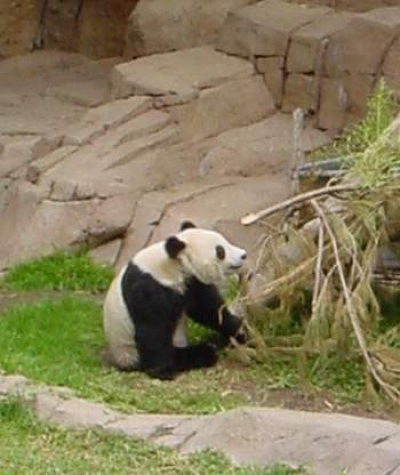
Speeding up the bamboo clock offers several quite valuable possibilities. For one, breeders may be able to selectively produce more hearty and disease-resistant varieties. A hybrid, for instance, of one that is very strong and one that is very tall, could be quite beneficial for construction and engineering. For another, being able to control the flowering of bamboo could help produce a predictable and regular supply of bamboo. This would be effective in reforesting areas of the world where varieties have completed their life-cycle and died. And last but not least, this means good news for Giant Pandas who are in danger of extinction due to the disappearance of bamboo forests, a sad reality zoologists all around the world had once thought hopeless.
For more information on related topics see:
images via wikipedia.org