Apple Pear or Asian Pear: Its Gastronomical Uses and Nutrition
EducationApple Pear or Asian Pear: Its Gastronomical Uses and Nutrition

While browsing the grocery section of your local supermarket this winter you might come across an exotic fruit known as apple pear. But if you were misled into thinking that this was another fancy fruit hybrid, you would be wrong. Apple pear (pyrus pyrifolia) or Asian pear is actually an ancestor of the common pear (pyrus communis) and is from the same botanical family of fruits, known as Rosaceae, as apples, apricots, loquat, raspberries and of course pears. Apple pear is indigenous to China and Japan. Marco Polo, during his travels of discovery across Asia was one of the first Europeans to taste apple pear and remark on its mouthwatering and distinct flavor.
Just to confuse the matter even more this fruit has many names and there are about 1000 varieties, most of which are round and resemble apple, although some varieties are pear shaped. Apple pear is this fruits common name in the USA, however it is also known as Asian pear, snow pear, nashi pear, Japanese pear, sand pear, Chinese white pear, ya pear or Korean pear. In China they are called nashipati or nashpati.
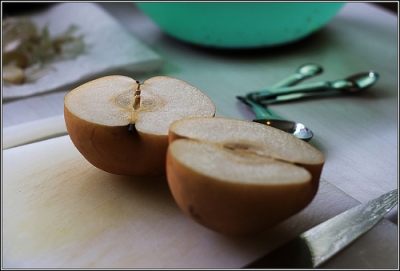
Apple pear is usually about the same size as an apple and has smooth, edible skin which can be yellow, green or sometimes golden brown, with light colored speckles. It has a semi-sweet, delicate flavor, similar to a pear, but with the crispness of the apple. Unlike a European pear, most varieties of apple pear have no grainy texture. The worlds largest producers of apple pear are Japan, China, Korea, Taiwan, New Zealand, Australia, Brazil, the USA and most recently Cyprus. In the USA they are cultivated in Oregon, California and Washington. The most popular types in supermarkets are called 20th Century and Nijisseki.
Apple Pear: its Gastronomical Uses and Storing: Just like pear or apple, apple pear is most often eaten fresh, on its own, or as in China, sliced with a sprinkling of salt. This fruit is extremely versatile and can be used in sweet or savory dishes. For dessert it is added to fruit salad or poached; baked with spices and used for puddings and pies.
In savory dishes apple pear is used for mixed salads, to substitute for apples and in Chinese-style dishes, for its crisp texture. A sauce made of apple pear makes a good accompaniment for duck, pork or chicken. It can also be used like apple or quince to make stuffing for goose or duck. Because of its high moisture content it is best to bake apple pear for longer than common pear, as this tends to bring out its sweetness. Apple pear blends particularly well with cream cheese, yogurt, prosciutto, walnuts, almonds and the spices, cardamom and star anise. Apple pear juice also makes a refreshing drink and is used to make cider.
Apple pears will only keep for a few days at room temperature so it is best to refrigerate them after ripening. Wrap them individually in paper towels or use perforated bags. Fruits that have yellow skins are the most perishable, whereas brown skinned varieties tend to keep for longer.
Apple pear and its Nutrition: Pyros pyrifolia is a good source of vitamin C, potassium, B complex vitamins, vitamin K, and also vitamin A or beta carotene. This fruit has a high fiber and carbohydrate content, but is low in calories. One 4.3 oz apple pear contain about 51 calories. So Apple pear are an excellent fruit for a weight controlled, healthy diet.
Antioxidants: The peel and pulp of apple pear contain the phytochemicals quercetin and rutin. Rutin is a type of flavonoid or bioflavonoid that helps to neutralize damaging free radicals and reduce the Fenton reaction. Rutin also helps strenghen blood capillaries and is a useful dietary aid for those who suffer with hemophilia. It is thought that the antioxidant properties of both quercetin and rutin can inhibit the growth of cancerous conditions. These bioflavonoids may also help prevent atherosclerosis by reducing LDL ( or bad) cholesterol.
Images from flickr.com with creative commons licence.