World War II: The Sinking of S.S. Gulfamerica
EducationWorld War II: The Sinking of S.S. Gulfamerica

In April of 1942 the majority of Americans still considered the war in Europe as being far from American soil, despite the fact that Germany and Italy had declared war on the United States on December 11, 1941. Germany, by contrast was quick of the mark. By January of 1942, Admiral Doenitz had ordered the second phase of the U- boat war in the Atlantic known as the ‘second happy time’ or Operation Drumbeat. German U-boat Commanders’ must have thought Christmas had arrived early when they arrived at the east coast of America to discover no blackout; merchant ships without convoy or armed escort and all coastal navigational markers, such as lighthouses, still in operation. The result was the destruction of million of tons of merchant shipping and a drastic change in U.S. defense policy.
When Captain Oscar Anderson and his crew of 47 left Port Arthur, Texas aboard the 8,081 ton tanker, SS GulfAmerica, they were well aware of the danger of U-boat attacks. The ship was fitted with two 50 caliber Browning machine guns as well as one four inch gun which were manned by U.S. Navy Guards. After loading 90,000 barrels of oil, the 445 foot long, Golf Oil Corporation tanker began its maiden voyage to New York.
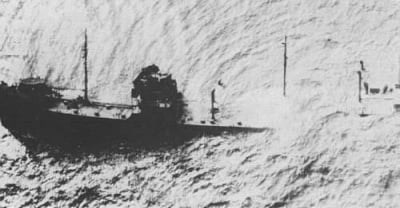
At the same time U-123, commanded by Reinhard Hardengen, was patrolling a few miles off Florida’s east coast. The GulfAmerica maintained blackout and radio silence throughout its journey; the tanker also had four lookouts posted. When U-123 sighted the GulfAmerica off the coast of San Augustine, commander Hadengen was right to be cautious. Only days before the U-boat had been spotted and almost destroyed by the Liebra. The U.S. patrol vessel attacked the U-boat with depth charges. Assuming that U-123 had been sunk, the Liebra left the scene. Fortunately for the U-boat’s crew the submarine had sustained only minimal damage which could be repaired when surfaced.
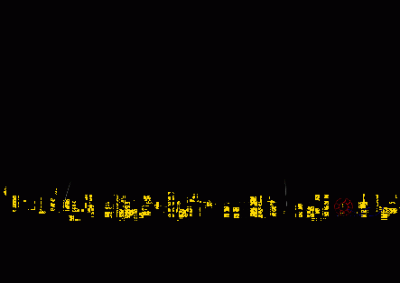
Illustration of a ships silhouette against the coastline.
U-123 followed the S.S. GulfAmerica for over an hour, until it reached Jacksonville Beach. At Jacksonville Beach, April 10, 1942 it was a pleasant spring evening. The streets were illuminated, businesses were open, folks promenaded and the sound of screams from a roller coaster echoed across the clam ocean waters. U-123 had only two torpedoes left and Hardegen new he could not miss. With the silhouette of the GulfAmerica against the lights of Jacksonville beach, U-123 fired its torpedoes. The first struck the tankers starboard side and the second the engine room. A massive explosion followed but the huge tanker did not sink immediately. Hardegen maneuvered the U-boat between the tanker and the shore, taking care to avoid grounding the U-boat. The U-boat then opened fire with its deck guns, facing away from shore and the many civilians watching the unfolding disaster. Hardegen’s intention was to knock out the tankers radio antenna.
The GulfAmerica was unable to return fire as by this time almost the entire ship was ablaze. Captain Anderson ordered abandon ship. Rescue vessels soon arrived and picked up 29 survivors. Aircraft were sent from a Naval Air Station near Tampa and the destroyer USS Dahlgren searched and eventually discovered U-123. The U-boat was depth charged and suffered extensive damage but managed to escape the scene.
As you can imagine after that incident the coastal towns of Florida as well as other states maintained a blackout. All merchant vessels were protected by escort and traveled in convoys. The U.S. govenment suspended the eastern seaboard route for tankers and although merchant vessels continued to be sunk, their destruction was drastically reduced by the end of 1942.
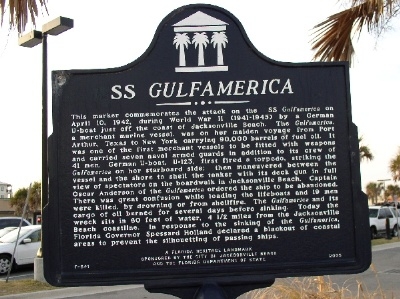
The Gulfamerica finely sunk after four days.The shipwreck rests on its starboard side in 60 feet of water and was considered a navigational hazard for many years.
Long before the B.P.oil spill in the Gulf of Mexico, tar balls have been turning up on Florida's beaches. More than 68 years after the fact oil is still slowly leaking from shipwrecks such as the S.S. GulfAmerica and other shipwrecked oil tankers sunk by U-boats in WW2.
All images from commons.wikimedia.com