The Wonderous Maya Ruins at Tulum, Mexico
EducationThe Wonderous Maya Ruins at Tulum, Mexico

Tulum is the site of a Pre-Columbian Maya walled city now serving as a major port for Cobá in the modern state of Quintana Roo, Mexico.
The remains of one of the very few ancient walled cities built in this part of the Western Hemisphere, the ruins of Tulum are located on a 39 ft. bluff along the east coast of the Yucatán Peninsula, almost directly west of the Cayman Islands, Cuba, and Jamaica.
Dated to the 6th century CE, Tulum rose to its height of occupation and cultural development between the 13th and 15th centuries. Protected on one side by steep sea cliffs, and on the landward side by a very impressive wall that averaged between 14 ft to 16 ft in height, Tulum is completely encircled. On the southwest and northwest corners of Tulum are small structures that have been identified as watch towers, emphasizing how well defended the city must have been. Near the northern side of the wall a small cenote which would have provided the city with fresh water.
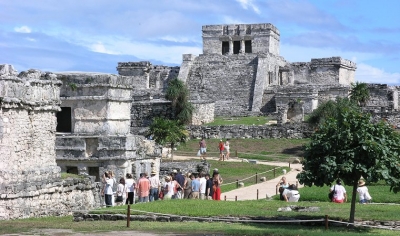
For centuries, Tulum was a major link in the Maya's extensive exotic trade network, connecting Central Mexico to Central America, by both land and sea. A tiny cove nestled at the foot of the cliffs was where the trading canoes would slip ashore. Copper rattles and rings from the Mexican highlands, flint and ceramics from various locations across Yucatán, and jade and obsidian from Guatemala attest to their far-flung trade network.
The first known Europeans to discover Tulum were the Spanish Conquistador Juan de Grijalva and his crew while sailing reconnaissance along the Eastern coast of Yucatán in 1518. The Spaniards would later return to conquer the Maya, unwittingly bringing Old World diseases against which the Maya had no natural immunity, which effectively decimated the majority of the indigenous population. Following years of civil war, the Spanish onslaught, and then a series of European-born plagues, Tulum, like so many other cities of Latin America, was abandoned to the elements.
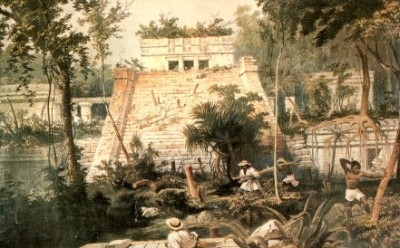
Typical of other Maya sites on the east coast of Yucatan Peninsula, Tulum’s architecture resembles that of nearby Chichen Itza, just on a much smaller scale.
This architecture is characterized by a number of features including a step running around the base of the buildings which sets on a low substructure. Doorways are usually narrow, with columns used as support if the building is big enough. As the walls flare out, there are usually two sets of molding near the top, where rooms roofed by either a beam-and-rubble or vaulted ceilings typically feature one or two small windows with an altar at the back wall.
There are three major structures of significance at Tulum, as well as several minor, with El Castillo, the Temple of the Frescoes, and the Temple of the Descending God the most prominent.
El Castillo (The Castle), which is 25 ft (7.5 m) tall and sometimes referred to as the “lighthouse,” is the tallest building at Tulum, as well as the most well-known. Standing high above the bluff, it provides a view of the ocean and coast for miles in both directions.
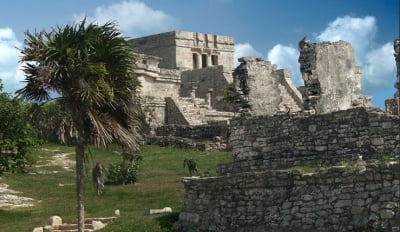
El Castillo
El Castillo's construction appears to have occurred in several phases, developing over a period of perhaps several decades, which is illustrated by the lintels of its upper rooms that are carved with the plumed serpent motif of a more recent era. The rooms themselves are vaulted in classic Maya style.
Also on the site is a small shrine marking a break in the barrier reef that is opposite the site, which archaeologists assume was used as a beacon for incoming canoes. At this spot there is a cove and landing beach in a break in the sea cliffs that would have been perfect for canoes full of trade goods to come in.
.jpg)
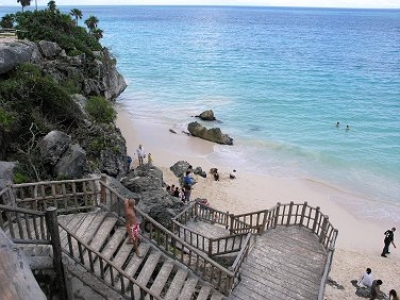
This site characteristic is most likely one of the reasons the Maya founded the city of Tulum here in the first place, with Tulum later becoming a very prominent trading port of the Maya Empire during the late Postclassic period (1000-1500 CE). El Castillo flanks a large public square at the center of the city assumed to have been once used for rituals or ceremonies.
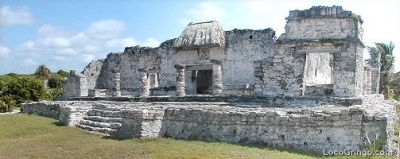
The Public Square Flanking El Castillo
Among some of the more spectacular features of the Temple of the Frescoes is a large lower and a smaller second story gallery where niches on the facade of the temple house figurines of the Maya “diving god” or Venus deity. This “diving god” is also depicted in the Temple of the Diving God in the central area of the site. Above the entrance in the western wall a stucco figure of the “diving god” is still well preserved, from which the temple gets its name. A mural can still be seen on the eastern wall that resembles that of a style that originated in highland Mexico called the Mixteca-Puebla style.
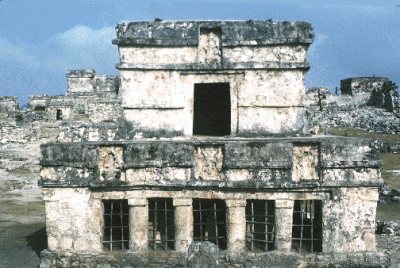
Temple of the Frescoes
On the façade of the Temple of the Descending God is a figure sculpted head down, and the walls inside show traces of the original pigments applied by Maya craftsmen. The descending figure is thought to represent a deity, with Tulum the center of his cult.
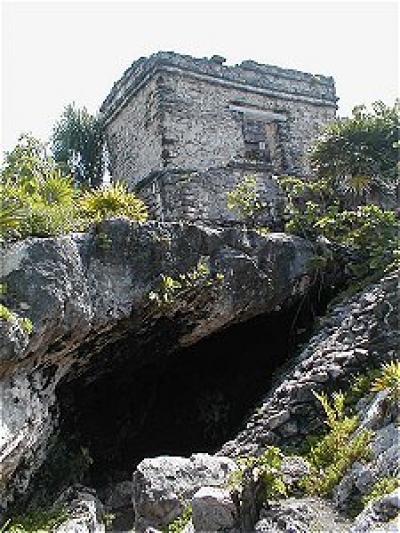
Temple of the Descending God
Other notable structures on the site include the Temple of the Initial Series, whose façade bears several stucco figures as well as a stele in the inner sanctum that has supplied the earliest date found at Tulum.
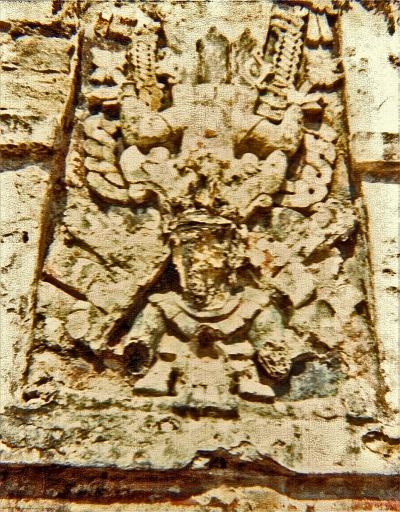
Additionally, the Temple of the Frescos is filled with murals, which although mostly erased by the ravages of time, still show traces of several building styles.
The House of the Columns, a palace-like structure with four rooms whose principal entrance faces South, is more complex than most structures at the site, having a roofed sanctuary that opens to the sea.
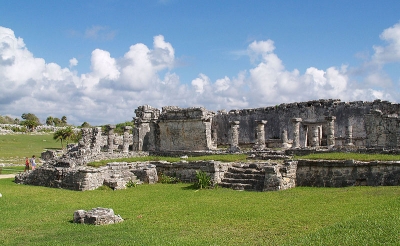
House of the Columns
Others structures of note include KuKulcan, located just to the north of El Castillo, the Kukulcán Group, which is formed by several minor structures, the most outstanding being the Templo del Dios del Viento (Temple of the God of the Wind) which is named after its round base.

Kukulcán Group
Traditionally related to Kukulcán is the god of the Wind Ehécatl from Central Mexico.
References:
http://www.mayanmagick.com/maya_post_classic_period.html
http://www.tierrasdelsol.com/tulum/index.htm
Images via Locogringo.com
wikipedia.org
private photo archive
Related Articles:
> The Magic Mushroom in Ancient Maya and Aztec Culture
> The Ancient Red Paint People of North America
> Voyages to North America Before Columbus
> A Cross-cultural Look at Witchcraft
Visit JAMES R. COFFEY WRITING SERVICES & RESOURCE CENTER for more information