Photography: How to Take Close Up Pictures of Wild Life
EducationPhotography: How to Take Close Up Pictures of Wild Life

Taking pictures of wild life presents many challenges to amateurs and professionals alike because of the variety of conditions during which wild life is being photographed. Unlike human subjects, wild life will not pose for the photographer. You need to understand the situations and conditions by which you have to exploit when taking such pictures of wild life.
Here are three situations exploited by this author in taking probably marvelous pictures of wild life occurring near his home. He used his knowledge and experience in photography to take the following pictures under a set of unique circumstances. The aperture values and shutter speed were included in each picture as reference during the discussion.
1. Zebra dove (Geopelia striata) preening its feathers.
A zebra dove was preening its feathers with another dove when the author spotted them. The author initially took a picture from a distance of about 8 meters then gradually approached the birds while busy preening their feathers. The birds are quite busy to notice the author advancing towards their direction. So this is a situation favorable for exploitation. The birds were approached to a distance of about 5 meters.
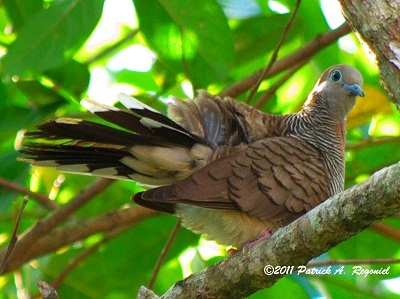
Normally, these birds are not easy to approach but walking slowly and keeping the camera on his face the author managed to take advantage of a nearby interlink fence to support himself and take stable shots. In fact, he took many shots to ensure that this rare occasion is recorded. This is the situation where a zoom lens will be most helpful. Zooming in instead of getting closer to wild birds will prevent unnecessary stress to the subjects. Thus, a close up picture of otherwise unapproachable wild life is possible.
Another helpful tip to this picture of the ground dove is the use of manual focus instead of the usual autofocus setting of the camera. Manual focus ensures that the desired features of wild life are revealed. Putting your camera in autofocus mode might focus on branches instead of the bird thus spoil your day. Always focus on the eyes of the animal subject as this mirrors the animal's essence.
For zoom lenses that normally have shallow depth of field, a good knowledge of aperture setting is a must. The author used the zoom len's maximum aperture setting of 5.6 to allow the minimum light to pass through the lens and achieve greater depth of field. This is matched automatically for proper exposure by the camera with a shutter speed of 1/80.
As the author was shooting in raw mode, the resulting picture was developed using Silkypix Developer Studio. A few adjustments were made to come up with the above picture. This picture, in fact, was cropped from a bigger composition.
2. A Tokay gecko (Gecko gecko) trapped by the window.
A Tokay gecko was unfortunately accidentally trapped when the window was closed for the night. In the morning, it was so weak so the author was able to clamp it up with a bread tong and bring it outside of the house. Geckos fight aggressively when threatened. A close up picture focusing intently on the eyes was possible.
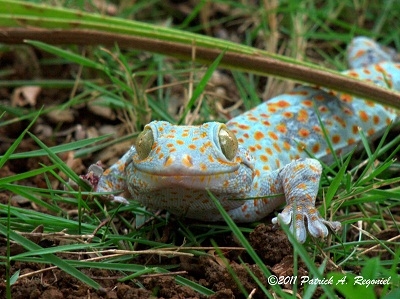
Sunlight was quite strong when this picture was taken so the author used the highest aperture possible (f14) at a speed that he thought will prevent blurring (shutter speed = 1/60). This close up picture was taken at about a meter away from the Tokay gecko. The gecko lay motionless for minutes allowing a series of pictures to be taken. It was so weak it could not scramble to the trees.
3. An agamid lizard (Bronchocela cristatella)
An agamid lizard passed by the garden looking for prey. This agamid lizard was busy looking for prey that made it unmindful of the author focusing on it from different angles. In fact, it jumped quickly on a bee and nearly gulped it down but the bee struggled hard. It was so quick that the opportunity to take that feeding behavior was not possible.
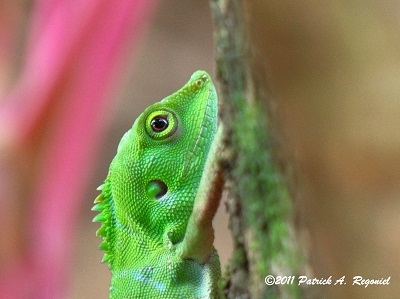
Anyway, the picture was taken under the shade (this is important to avoid casting strong shadows that make the pictures harsh) of trees at an aperture of f8 and shutter speed of 1/25 (rather slow but manageable) behind some ornamental plant leaves that helped prevent the lizard from scrambling away. It stayed there probably thinking it blended well with its surroundings so as to be noticed. That is a nice paint job on his hide.
All these pictures were taken using Panasonic Lumix G10, a mirrorless interchangeable-lens camera (MILC) that works like a digital single lens reflex (DSLR) camera. A zoom lens of 45-200 mm was used.
©2011 November 26 Patrick A. Regoniel Photography: How to Take Close Up Pictures of Wild Life