Macro Photography Techniques Using a Compact Digital Camera
EducationMacro Photography Techniques Using a Compact Digital Camera

Macro photography or close up photography of small objects using digital cameras has its rewards. What the naked eye cannot see can be revealed by a blown up picture of an easily overlooked subject. Small animals, particularly, are not usually appreciated because the inherent beauty they possess is so small to notice.
One typical example of an interesting subject is the hermit crab, a common decapod crustacean belonging to the superfamily Paguroidea.[1] They usually take over empty gastropod shells and carry them around as if their own.
But this is not about the hermit crab per se, but the interesting features that can be featured out of their scavenging activities, aside from the wide array of choices on the color of the shells they occupy. The author chose this crustacean as a subject to show the various effects that could be achieved by varying the camera's depth-of-field, shutter speed, and ambient lighting conditions. It is easy to catch one and watch the animal come out of its shell and shoot at various angles to get the effect you want.
The camera in use in this photo session is a Panasonic Lumix LX5, the author's favorite compact with photographic settings comparable to a full single lens reflex (SLR) camera. Conventional digital SLRs are usually bulky and difficult to lug around. Aside from the fact these cameras are much more expensive than the digital compacts. This is a major consideration when travelling a lot to remote places where weight is a factor to consider for convenience.
Automatic Exposure in Macro Photography
To illustrate the differences between different aperture and speed settings of the digital camera, an automatic exposure of the hermit crab was taken by the author to serve as baseline for comparison. A hermit crab encased in a shell with a color similar to the background of sand served as the subject. The crab was placed just in front of a coconut tree's trunk under the shade. Placing the subject under the shade is one trick to minimize distracting shadows and make the picture look softer and easy to the eyes.
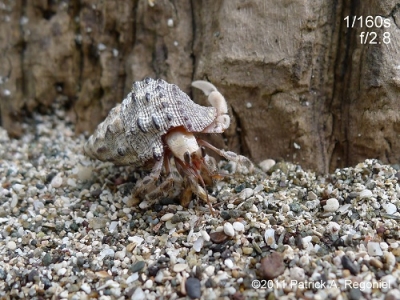
Note that the camera barely misses the subject because of the automatically determined speed of 1/160s and an f value of 2.8. A shallow depth-of-field indicated by the focal length value of 2.8 is favored by the camera in taking a subject at close range and ambient light condition of bright sunlight. The camera compensates at a relatively high shutter speed of 1/160s. This picture was taken from a distance of about 20 cm. This was just cropped to bring the subject closer in the photograph.
Effect of Bringing the Camera Closer to the Subject
Bringing the camera closer to the subject, the f value is retained while the shutter speed is reduced at 1/125 (see below).
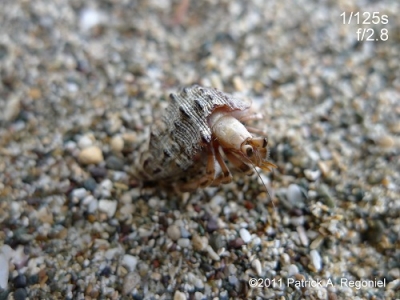
Note in the above picture that the focus of the camera is shallower than the one taken from a distance. Only a limited region of the head of the hermit crab is distinct. All the rest are blurred. The eyes of the hermit crab should be an ideal focus to make it look much more interesting.
Aperture Priority Mode Effects
To highlight the eyes and increase the area of focus, the author changed the setting to aperture priority mode. Aperture priority mode should be selected if you want your subject to be vividly clear at close up.
The intention this time is to reveal more of the head portion of the hermit crab. The maximum aperture achievable in Panasonic Lumix LX5 at close up is f/8.0. This focal length was selected and the shutter speed left to the camera to determine. The camera indicated a shutter speed of 1/60s. This is good enough for a hand-held camera. A shutter speed lower than this will make the picture blurred as it is difficult to keep the camera steady unless you are a seasoned photographer. The resulting picture using the setting is shown below.
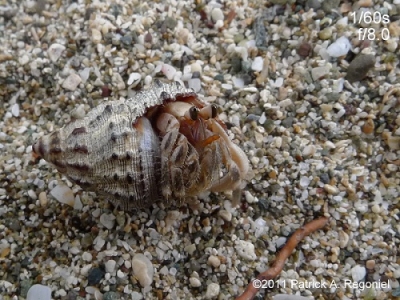
Notice that this time the hermit crab and the shell are all distinctly in focus while the background and foreground are blurred, in effect highlighting the subject. The eyes particularly look interesting -- it's some kind of a character in a comic strip expressing eagerness.
The macro photography techniques demonstrated herein just illustrate how subjects may appear by varying the focal length while not sacrificing desirable shutter speeds. Of course, you have your choice on how you want your subject to appear and achieve the effects you want.
Try these macro photography techniques and you will get interesting results.
Reference
[1] Wikipedia
©28 May 2011 Patrick A. Regoniel Macro Photography Techniques Using a Compact Digital Camera