Organic Gems: Amber the Colorful Gem That Solidifies Earths History
EducationOrganic Gems: Amber the Colorful Gem That Solidifies Earths History

Our fascination with amber lies not only with its vibrant colorful appearance but also with its ancient origins. Every piece of amber is infused with millions of years of the history of our planet. People have been collecting amber since Pre-Historic times and discovering various uses for it other than for adornments. Nowadays it is mostly worn as jewelry and is very collectable. It can also be found as Stone Age exhibits in museums.
.jpg)
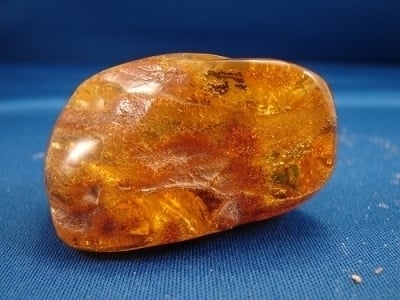
Amber is an organic resin that is formed by the process of polymerization which takes place in ancient trees. The most common colors are golden-orange to golden yellow, but amber can also be red, violet, green, blue or black. It is thought that the amber’s color is determined by which type of tree it came from. As the amber forms and sets over millions of years it often traps dead insects, small animals, pine needles or other matter from the remains of ancient trees. These occurrences greatly add to the beauty and value of amber. Moreover scientists have been able to study and gain knowledge of earth’s early environment from fossilized amber. Amber is translucent and often contains air bubbles and cracks which produce a cloudy appearance.
Amber is most often found in sedimentary rocks. It can also be found in lignite, sandstone and clay. Because amber floats in water, it washes up from the seabed and it is deposited on the shoreline. Amber from the ‘Amber Coast’ (Western Lithuania) is known as succinite; it has been known to wash up as far away as England and Norway. Apart from the Baltic states of Estonia, Latvia and the Baltic region of the former USSR, other important sources of amber include the Dominican Republic, Mexico, France, Spain, Sicily (simetite) Germany, Romania ( rumanite) Canada and the USA.
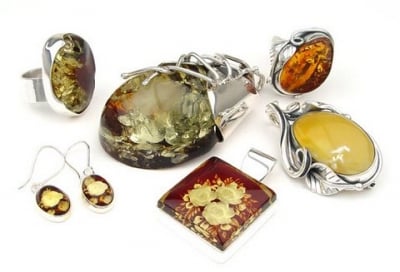
Amber is highly sensitive to heat and Amber jewelry should not be kept in direct sunlight or washed with hot water. Ambroid is a type of amber made from pieces of amber that are too small to be polished. The amber pieces are heated, compressed and sometimes color is added. Much of the amber in the market is Imitation; it is made from plastic, glass, and synthetic resins. Also natural resins like copal, a resin made from plant sap.

Blue amber.
The ancient Greek philosopher Thales of Miletus discovered that rubbing amber against fur creates a negative electrical charge (static) that attracts particles such as dust or hair. This revelation was the basis for the Greek word for amber; elektron. The English word electricity was derived from the word elektron.
All photo's from commons.wikimedia and flikr.com with creative commons licence.
If you liked this you might also like the following articles.
Organic Gems: pearl the classic gem thats second only to diamonds.
Gemstones: peridot the olive gemstone from antiquity that's enjoying a renaissance.
Gemstones: about jade; how and where to find it and make money selling it.
Gemstones: the beryl family of gemstones and aquamarine.