London Guide - The Royal Parks
EducationLondon Guide - The Royal Parks

England's capital London is home to over 1,500 parks and open, green spaces that between them cover an area of more than 8,000 acres.
Eight of London's parks and 1 cemetery are classified as Royal Parks, which between them cover over 4,800 acres of prime land within London.
Most of these parks receive their Royal designation as they are made up of land either owned by the crown or were the grounds or gardens of a former royal palace.
Many of these parks play host to several different types of entertainment throughout the year, details of these events can be found at the Royal Parks website, listed at the end of this article.
Below is a small overview of each of the London Royal Parks.
BUSHY PARK.
Bushy Park, situated just north of Hampton Court Palace in the London Borough of Richmond sits on 1,100 acres of land and is London's second largest park.
Originally used as land set aside for royal shooting parties, the park today is home to Bushy House a 17th century former royal residence which is now part of the National Physical Laboratory, the Diana Fountain a 17th century statue and fountain complex and the Chestnut Avenue.
.jpg)
CANADA GATE.
GREEN PARK.
Green Park, situated near Buckingham Palace, is a 47 acre area made up entirely of wooded glades.
The only landmark within the park is the Constance Fund Fountain. The park's entrance is flanked by the highly ornate Canada Gate, situated along London's famous Mall, opposite the Queen Victoria statue that is in front of Buckingham Palace.
GREENWICH PARK.
Once the home of Greenwich Palace built in 1433 - the birthplace of most of the Tudor royals - this park is now a World Heritage Site and probably London's most famous, if not by name, certainly by location, as it is the location of the Royal Observatory and the Prime Meridian, home of Greenwich Mean Time.
The park is set in 180 acres of land and is home to several small herds of Fallow and Red deer.
Located in the London Borough of Greenwich, the whole borough, including the park, is set to become London's second and newest Royal Borough in 2012.
The park will be the venue of the modern pentathlon event and equestrian events during London's 2012 Olympic Games.
HYDE PARK.
Known the world over, London's Hyde Park is situated in the centre of London. The 350 acre park is actually two parks in one, as it is situated alongside Kensington Gardens, which were seperated by order of Queen Consort Caroline in 1728, wife of King George IV.
The park is famous for it's Speakers Corner, The Serpentine, the Prince Albert Memorial, the Princess Diana Memorial and the London 7/7 memorial.
The park has been planted with over 4,000 trees and is accessed by a labyrinth of pathways.
The park will be the location of the Olympic Triathlon event and open water swimming events, when the Olympic Games are held in London in 2012.
KENSINGTON GARDENS.
Once the private gardens of the 17th century, Kensington Palace, this 111 acre park is seperated from Hyde Park by the famous body of water known as the Serpentine and is accessed by way of the Serpentine Bridge.
Situated in the London Borough of Kensington and Chelsea, home of the United Kingdom's most expensive real estate, the park is flanked by formal avenues, a sunken garden, the Albert Memorial and several statues, including one of J.M Barrie's, Peter Pan.
Along with Hyde Park, Green Park and St James' Park, these four London parks form an almost continual band of parkland within the centre of London.
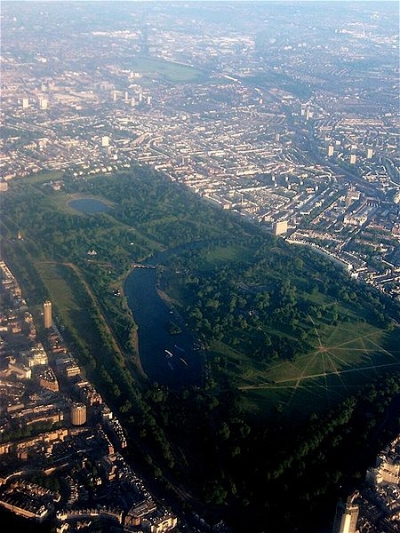
London's Hyde Park and Kensington Gardens.
THE REGENT'S PARK.
As it's name suggests this one time private park of the Prince Regent - the future King George IV - , was opened to the public in 1835.
The 410 acre site is home to The Regent's College, London Zoo, The Regent's Canal and an open air theatre.
The park is flanked by 10 terraces of houses designed by John Nash during the 1820's, which are the homes of several of London's titled residents.
The park's garden hosts 30,000 roses from 400 varieties and is the location of a 100 acre sports area which is London's largest outdoor sports venue.
Situated on the park's northern periphery is the 256 foot high Primrose Hill, which commands stunning views of the City of Westminster and it's surroundings.
RICHMOND PARK.
Situated, as it's name suggests, in the London Borough of Richmond, this 2,360 acre park is London's largest and oldest park and the United Kingdom's second largest walled park, which is the home to the 650 head, Royal Herd of Red Deer.
The park was originally the gardens that surrounded Richmond Palace, the former home of King Charles I and his family.
Today the park is a nature reserve and site of special scientific interest due to it's abundant wildlife and flora and fauna.
Set in a pastoral landscape, the park is also home to Pembroke Lodge - a Georgian manor house which was once home to Queen Victoria's prime minister Lord John Russel - the Royal School of Ballet and King Henry's Mound.
ST JAMES' PARK.
Named after St James the Lesser who had a leper hospital dedicated to him on this site, this 58 acre park is situated on London's Mall, and is home to a lake, a canal and a myriad of gladed pathways, all of which were landscaped by architect John Nash for King George IV.
Also home to the Victoria Monument, the park commands stunning views of Buckingham Palace.
London's famous Marble Arch was once located at the entrance to this park as the parkland was once in the grounds of Buckingham Palace when it was known as Buckingham House. The arch was removed to it's present location opposite Hyde Park's Speaker's Corner because the arch was too small to accommodate King William IV's royal carriage, after he bought the house for his wife, the Queen Consort Charlotte.
THE BROMPTON CEMETERY.
The Brompton cemetery situated in south west London, is the only cemetery to receive a Royal Park designation.
The cemetery was designed by Benjamin Baud in 1839 and includes a domed chapel that is a small replica of St Peter's Basilica in Rome.
Set amongst 39 acres of sculpted gardens, this grade II listed park was opened for buriels in 1840 and is now a public park,which includes the final resting place of Emmeline Pankhurst, as well as many other notable former London residents.
.jpg)
Buckingham Palace as seen from St James' Park.
Visit The Royal Parks website -
OTHER ARTICLES YOU MAY BE INTERESTED IN BY THE SAME AUTHOR.
london-guide-the-city-of-london
london-guide-the-city-of-westminster
A Guide to london-greenwich
royal-residences-of-queen-elisabeth-ii
Facts and history about the-royal-pavillion-brighton