London Guide - The City of London
EducationLondon Guide - The City of London

No visit to England's capital is complete without a tour of the City of London, the original area from which the great metropolis of London grew.
The City of London is London's historic core and financial district, and covers an area of just one square mile, giving rise to the areas other names of The City and The Square Mile.
Situated in the post code areas of W.C 1, W.C.2 and E.C 1, 2, 3 and 4, this area is crammed with London's most famous landmarks as well as a thriving community of residents.
The City has a resident population of around 11,500 people who live in and around the area known as The Barbican - an area also reknowned for it's arts and cultural centre - who between them earn the highest wages in the land, due to the expense of living in London's second most expensive borough.
These people live in what is the smallest ceremonial county in the country and are served by way of their own police force - The City of London Police - one fire station, one hospital - St Bartholomew's known locally as Barts - 3 national rail stations, 12 metro stations, 13 churches, 1 primary school, 3 secondary schools, the campuses of 5 universities and 5 libraries, not forgetting the 750 restaurants and 200 pubs and bars based in the vacinity.
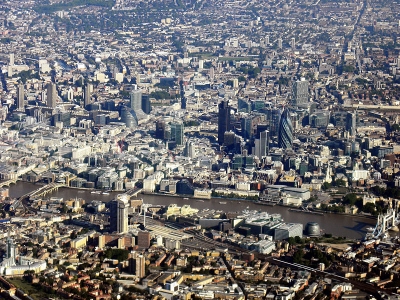
Image courtesy of Kraken Hammer, wikimedia commons.
The City - The Square Mile - The City of London.
The title picture of this article is the Temple Bar Griffin - some may call him a dragon - situated in the the very heart of the city and it is from this landmark that all routes into the City of London are measured.
The Temple area of the city is where London's Inns of Court are located, in the areas known as Middle Temple and Inner Temple.
The national roads of the A1, A3 and A4 all begin from this statue.
The city however is better known for being the largest and oldest financial district in the world, which also includes Paternoster Square, home of the London Stock Exchange and Hatton Garden - home of London'sdiamond centre . Other iconic buildings of the financial district are The Gherkin, otherwise known as 30, St Mary Axe, The Guildhall, The Mansion House - home of the Lord Mayor of London, the Corn Exchange and the Bank of England, also known as the Old Lady of Threadneedle Street - as that is where it is located - to name but a few.
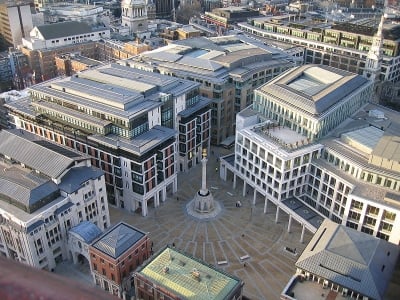
Paternoster Square, home of the London Stock Exchange.
Other notable or famous buildings in the city are The Tower of London, Smithfield's Market, Leadenhall Market, The Lloyd's Building, The Monument - the monument to the Fire of London that is, as this is where it began - The Heron Tower - the city's tallest building at 753 foot high - St Paul's Cathedral - named after London's patron saint St Paul - and the Central Criminal Court, known throughout the the world as The Old Bailey. The Old Bailey is not actually the name of the building at all, but the name of the street it is located on. The street follows the course of the city's old, fortified walls, which were known in olden days, as a bailey.
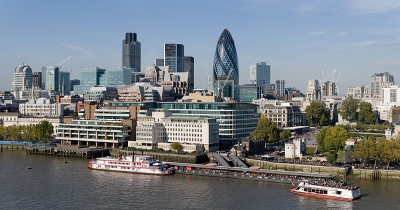
Image courtesy of Diliff, wikimedia commons.
The City of London's riverfront.
For those of you that fancy a look around the very heart of London, this area is accessed by way of 12 metro, aka tube, stations, 3 national rail stations, 2 Dockland Light Railway stations,1 footbridge, 2 rail bridges, 3 road bridges, 1 river crossing, and 28 cycle hire dockings for use with a cycle hire system run by Barclay's Cycle Hire for the London Cycle Network, which are known locally as Boris Bikes, after the the Mayor of London, Boris Johnson.
The city is part of the Travelcard Zone One area, which also covers The City of Westminster and the West End. These travel cards are bought for use on any of London's undegound trains or buses and can be purchased at train stations, on buses and from newsagents. Some hotels also sell them.
Below is a list of transport links within the City of London.
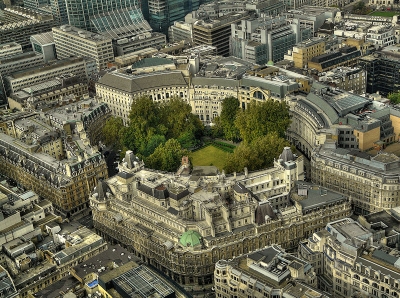
Finsbury Circus, one of the city's few green areas.
DOCKLAND LIGHT RAILWAY STATIONS.
City Thameslink.
Tower Gateway.
NATIONAL RAILWAY STATIONS.
Blackfriars.
Cannon Street.
Fenchurch Street.
Liverpool Street.
UNDERGROUND ( Metro / Tube ) STATIONS.
Aldgate.
Bank.
Barbican.
Blackfriars.
Cannon Street.
Fenchurch Street.
Liverpool Street.
London Bridge.
Mansion House.
Moorgate.
Monument.
St Paul's.
BRIDGES INTO THE CITY.
Blackfriars - road bridge.
Blackfriars - rail bridge.
Cannon Street - rail bridge.
London Bridge. - road bridge.
Millenium Bridge - foot bridge.
Southwark. - road bridge.
RIVER CROSSING PIER.
Blackfriars Millenium Pier, part of the London River Services system.
CYCLE HIRE DOCKINGS.
One can not miss the cycle hire dockings, they are rows of bright blue bicycles kept in locked cycle racks, situated alongside a computerised machine. Pay for your cycle and you will be issued with a key to access your bicycle, which is paid for by credit or debit card. There are 28 cycle hire dockings in and around the City of London.
This is a new transport scheme recently started in London, which London's Mayor, Boris Johnson, hopes will soon be as common place as London's red buses or black cabs ( taxis ).
For City of London hotels please visit - milesfaster.co.uk/city-of-london-hotels
For City of London pubs and bars please visit - www.citypubs.co.uk
For City of London restaurants please visit - bestlondonrestaurants.co.uk
For City of London coffee houses please visit - londoncoffeeguide.com
Other London articles you may be interested in by the same author -
london-guide-the-city-of-westminster
the-london-eye-a-birds-eye-view-of-london
london-little-known-facts-about-the-uks-capital
Title image of Temple Bar griffin, courtesy of MykReeves, wikimedia commons.