Jacques Yves Cousteau: the Man Who Taught the World About the Mysteries of the Deep
EducationJacques Yves Cousteau: the Man Who Taught the World About the Mysteries of the Deep

Jacques Cousteau's groundbreaking work in ocean exploration, his inventions and pioneering work revolutionized diving, and ultimately brought the inaccessible world of the deepest oceans into peoples living rooms. He was also a conservationist who was publicly acclaimed for his incredible achievements.
Jacques Yves Cousteau was born in southwestern France in 1910. As a young man Cousteau was extremely creative and he often went free-diving in the Mediterranean Sea with a group of friends. After graduating from Ecole Navel academy, he joined the French Navy in 1933 as a gunnery officer. Cousteau began working on underwater lungs, using compressed air and various types of diving equipment.
When France fell to Germany in 1940, Cousteau was allowed to continue his work. This also provided a ruse for Cousteau’s secret work with allied naval intelligence, to help organize several operations against the Germans. For his actions Cousteau was decorated after the war. Cousteau worked with Emile Gagnan to develop the worlds first diving regulator. And in 1943 a crowd gathered at the town of Bandol to watch him test the new equipment in the Mediterranean sea. Cousteau later described in his own words the first successful use of what he called the Aqua-Lung.
“I breathed sweet effortless air, there was a faint whistle while I inhaled, and the light rippling sound of bubble when I breathed out. The regulator was adjusting pressure precisely to my needs….The sand sloped down to a clear blue infinity…my arms hanging at my sides, I kicked the fins languidly and traveled down. I reached the bottom in a state of excitement….I looked up and saw the surface shining like a defective mirror.” It worked!
Cousteau and his team completed many more dives, each time diving deeper, until they reached 240 feet. At this point they discovered the effects of nitrogen narcosis. A condition that causes a feeling of disorientation, similar to alcohol. In such a dangerous environment it can prove fatal, because divers make illogical decisions. Cousteau and his team subsequently learned through trial and error, that it was necessary to breath a mixture of oxygen and helium below depths of 150 feet.
After the war Cousteau continued to work for the government, and at the same time founded the Undersea Research Group. He was given the task of searching and recovering wartime wrecks, aboard the Calypso, his research vessel. In 1952 Cousteau discovered and excavated the wreck of a merchant ship, the Grand Conglue, dating from 230 BC. Hundreds of preserved ancient artifacts were recovered, and Cousteau had proved to the world that underwater archeology was paramount to better understanding our past.
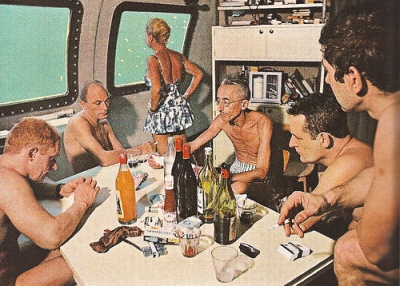
Cousteau and his team on board Conshelf III, the underwater laboratory. Image credit, flickr.com.
Conshelf: Conshelf was an experiment to find out whether humans could live and work for extended periods of time in deep water. It began with conshelf I, an underwater laboratory, that housed two scientists or “oceanauts”, for up to one week. The “oceanauts” had their health monitored, and Conshelf was fitted out with all necessary comforts such as beds, a library, kitchen and TV. The first Conshelf was built in 1962, its success led to Conshelf II, at a depth of 15 meters. And in 1965 the largest Conshelf was constructed, big enough for six oceanauts. It was stationed in the Mediterranean, near Nice, France, at a depth of 100 meters. The Conshelf experiment was a complete success, although it did prove that humans are not designed to live without sunlight. Conshelf III was later used for training astronauts.
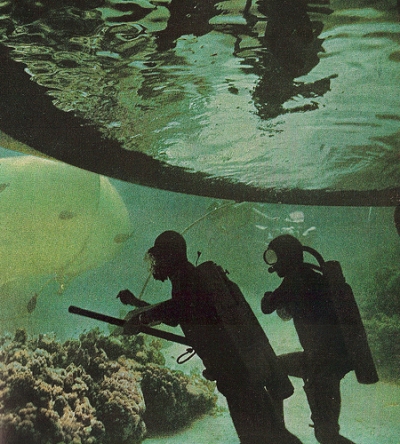
This image is of Conshelf III and was taken by Cousteau for National Geographic magazine. Image credit, flickr.com
Cousteau developed manned submersibles and was the first to deploy divers with cameras. His revolutionary underwater filming techniques led to Television programs that gave millions their first view of deep sea aquatic enviroments. Cousteau continued to explore the oceans natural resources. He became a leading conservationsist and took part in the 1992 Rio Summit.
Jacques Cousteau died in 1997. He left a legacy of over 120 television documentaries and 50 books. Cousteau paved the way for future documentary film makers, and moreover he changed public opinion and created an environmental awareness through his work in preserving the worlds fragile marine ecosystems.
Primary image credit flickr.com.
If you liked this you might also like the following articles.
Famous shipwrecks in the Caribbean Sea: RMS Rhone.
The golden age of the transatlantic ocean liners.
British Royal Navy shipwrecks in the Caribbean: HMS Griffin.