Cragside: the Romantic Country House of a Victorian Inventor
EducationCragside: the Romantic Country House of a Victorian Inventor

During the nineteenth century, the region of Tyneside stood at the forefront of Britain’s industrial development. Capital was generated from the mining of coal, shipbuilding and heavy engineering. Tyneside was home to industrial pioneers and inventors. Foremost among Newcastle industrialists was William George Armstrong, who was a brilliant inventor, a dominant figure in Newcastle’s cultural sphere and a major architectural patron.
Like many leading industrialists Armstrong moved to rural Northumberland. As a child he had often visited the picturesque village of Rothbury, staying in a house owned by Armorer Donkin, where he spent many hours fishing in the River Coquet. He returned to Rothbury in 1863 and determined to build a house there. As Armstrong later told a meeting of Northumberland County Council:
After that interval I again visited my old haunts and decided to build for myself a small house in the neighbourhood for occasional visits in the summer time. I well knew the site upon which Cragside now stands, and by good fortune I was able to purchase it, together with a few acres of adjoining land.
.jpg)
Armstrong bought land from the Duke of Northumberland, and in 1864 he began construction of a country house, which he initially envisaged as a fishing lodge. Continuing his work at Jesmond Dene, however, he gradually transformed the house into a permanent residence and extensive country seat. Cragside underwent a continuous evolution between 1869 and 1885 at the hands of architect Richard Norman Shaw. Shaw's other work includes the famous Scotland Yard and Albion House, Liverpool, the headquarters of the White Star Line.
.jpg)
Cragside c.1864. A rare photograph showing Cragside before Shaw’s alterations were commenced.
A rambling composition anchored around a remarkable tower, Cragside is protean in its massing and bewildering in its variety of detail. The main bulk is executed in sandstone, but it abounds with half-timbered gables and decorative motifs drawn from a range of styles. The tower terminates with a diminutive but fully formed gable recessed behind mock battlements. The house unfolds as a series of carefully constructed vistas which proclaim the wealth and status of the owner. The entrance porch is framed by a rich Tudor arch with strikingly naturalistic leaf and animal forms and the wide doorway features large panes of bevelled glass permitting a view of the opulent interior.
.jpg)
Design for Cragside, Rothbury, Northumberland - south west prospect, Richard Norman Shaw.
.jpg)
.jpg)
The interior featured wallpapers by Morris and Co., including Bird and Trellis and Pomegranate. The baronial dining room is a large chamber dominated by an inglenook fireplace. The drawing room was completed in 1884, but Frederick Waller of Gloucester carried out alterations in 1895. Clive Aslet contends that Shaw left the project because he was infuriated by endless requests to revise his plans. A Baroque chimneypiece in white marble was designed by Lethaby (1885). The drawing and dining rooms were separated by a distance of 175 feet, but this was not a straight axis – guests had to pass through the long picture gallery and down six flights of stairs.
.jpg)
Design for Cragside, Rothbury, Northumberland - perspective of drawing-room chimneypiece, William Richard Lethaby.
The stylistic programme enacted at Cragside was part of a much wider domestic revival. Andrew Saint argues that architects in search of a means of designing picturesque houses that were fully integrated with the landscape turned from dogmatic Gothic to the vernacular, since ‘Gothic was far more compartmentalized and formal than its adherents admitted.’ Figures such as Webb and Shaw began to explore the legacy of English domestic architecture by reviving Tudor and Queen Anne styles. Innovation and eccentricity flourished in Victorian domestic architecture because wealthy private patrons were often more amenable than the bureaucratic committees that tended to regulate public commissions. Nevertheless, Armstrong seems to have been a difficult client, demanding constant revisions to the plans and exercising a strong control over the building process. The design also exhibits Shaw’s evolving tastes. The tower at Cragside was derived from that at Leyswood in Groombridge, Sussex, a house Shaw had designed in 1866-69.
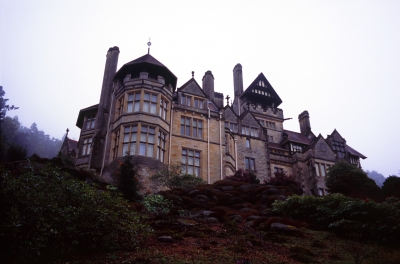

The house was built on an expanse of land comprising 1729 acres. Armstrong reshaped the topography, planting over 7 million trees and shrubs including conifers, rhododendrons and azaleas. He built an iron footbridge echoing that at Jesmond Dene. This was manufactured in Armstrong's Elswick Works. The dominant impression is of man’s control over nature, and indeed Armstrong was able to harness the power of nature within the house. He created five artificial lakes on the hillside and used the water power to generate electricity for electric lights within the house, as well as passenger and service lifts. The kitchen was equipped with hydraulic machinery. Incandescent electric lamps were installed in 1880. Cragside was in fact the first house in the world to be lit in this way. As Armstrong wrote in the Engineer:
The case possesses novelty, not only in the application of this mode of lighting to domestic use, but also in the derivation of the producing power from a natural source – a neighbouring brook being turned to account for that purpose. The brook, in fact, lights the house, and there is no consumption of any material in the process.
.jpg)
Armstrong working by electric lighting in his study at Cragside.
Initially conceived as a country retreat, the house became a statement of the pride and status of the owner. Cragside provided a base for Armstrong’s international business relations, where potential clients could be accommodated in luxury and given a tangible vision of Armstong’s success. Guests included the Shah of Persia and Prince Yamashino of Japan. The house was also a staging point for ceremonial visits to Newcastle. The Prince and Princess of Wales visited Cragside in 1884. Whilst in the North East they formally opened the Hancock Museum, Free Library and the Jesmond Dene portion of Armstrong Park. They also visited the Elswick Works. The Prince of Wales returned with Princes Albert Victor and George in 1887, attending the Newcastle Exhibition and the Elswick Ordnance Works. Armstrong had effectively become Newcastle’s international ambassador. The estates created by Victorian industrialists are often viewed as a means by which industrial magnates emulated the manners and tastes of the upper classes. The purchase of rural estates is often viewed as an attempt to retreat from the realities of industrialisation and urbanisation. In Armstrong’s case, however, both mansion and estate were products of his technological ingenuity and key sites within his business relations.
After Cragside, Armstrong embarked on another ambitious project. In 1894 he purchased Bamburgh Castle on the Northumberland coast for £60,000 from the trustees of Lord Crewe. He intended to covert it into a convalescent home for retired gentlemen and spent one million pounds on restoration, but before the project was completed Lord Armstrong died at Cragside on 27th December 1900. At the time of his death, his estate was valued at £1.4 million.
.jpg)
For a biography of Lord Armstrong, see:
https://knoji.com/the-great-gun-maker-lord-armstrong-of-cragside/
For a discussion of Armstrong's contribution to Newcastle's history, see:
https://knoji.com/lord-armstrong-newcastles-city-father/
https://knoji.com/cultural-oligarchy/
Langham Tower in Sunderland is a suburban immitation of Cragside:
https://knoji.com/langham-tower-a-spectacular-victorian-mansion/
For a discussion of Newcastle architecture see:
https://knoji.com/architects-to-a-diocese-dunn-and-hansom-of-newcastle-1/