Charles Mitchell: Pre-eminent Victorian Shipbuilder
EducationCharles Mitchell: Pre-eminent Victorian Shipbuilder

Charles Mitchell was a Newcastle shipping magnate who used his immense wealth to become a major patron of the arts. He was born in Aberdeen on 20 May 1820, the son of a merchant. After studying chemistry and physics at Marischal College, Aberdeen, he arrived at Newcastle on 24 September 1842 and worked at John Coutt’s shipyard at Walker. Mitchell was introduced to the banker Matthew R. Bigge, whose family members were coal owners and industrialists. Bigge provided the capital for the establishment of Mitchell’s Low Walker yard in 1852. The buildings were erected by Richard Cail, a builder and future mayor of Newcastle. In 1854 Mitchell married Anne Swan, the sister of the Jarrow shipbuilder Henry F. Swan, and this connection brought Mitchell valuable business contacts. In 1860 Swan joined the company and later became a partner in the business. Expanding his interests, Mitchell established a repair yard at Wallsend in 1871. He was a director of the Wallsend Slipway Company, together with Henry and Charles Swan, and the retailer Thomas Hudson Bainbridge. As part of Newcastle’s integrated elite, Mitchell formed links with many prominent men and had a lucrative sideline in building luxury yachts for his associates. In 1866, for example, he built the yacht Northumbria for George Robert Stephenson (1819-1905), head of Robert Stephenson and Company. The majority of Mitchell’s ships were built for the coal trade, which made him a lynchpin of industrial relations in the North East.
.jpg)
Charles Mitchell
Mitchell lived initially at Low Walker, in close proximity to his ship yard. Following the example of the Newcastle gentry, however, he moved to Jesmond in 1869, purchasing a mansion from Richard Burdon-Sanderson II and renamed the house Jesmond Towers. He amassed great wealth but was enigmatic in his politics and his role as a philanthropist. A frustrated charity worker is said to have exclaimed, ‘It is not worth spending a penny stamp on him.’ Yet Mitchell did provide amenities for his workers and spent large sums on himself, his family and his immediate social circle. It seems that his philanthropy was thoroughly strategic. Mitchell built several institutions for his workers, in whose welfare he had a vested interest, including a Mechanic’s Institute and Hall in Bath Street, Walker (1861). He built Walker Infirmary to provide medical attention for workers injured in his shipyard. This was a modest two-storey brick building that was domestic in character. The building cost £2000, but each worker was required to pay one halfpenny per week towards its upkeep. It was opened in May 1870 by the mayor of Newcastle, James Morrison.
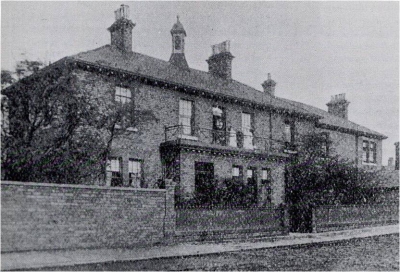
Walker Hospital
Mitchell did much business with Russia, having longstanding connections with the country and a grasp of the language. The warships Ijora and Stavianka were built for the Russian Navy and launched in 1861. The Saratovski Ledokol was the first purpose-built icebreaker, launched in 1895 for use on the Volga. Most famously, Mitchell built the Baikal, a 3000-ton railway ferry steamer that was dismantled into 7000 parts and reassembled at Lake Baikal as part of the Trans-Siberian railway (1896). In building these ships Mitchell served a global market and his vessels were crucial to the industrial and military development of other countries. This demonstrates that Newcastle’s economy functioned on a truly global scale.
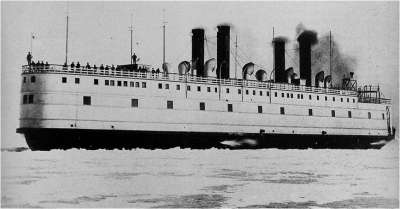
The Baikal
Please see my related articles:
https://knoji.com/cultural-oligarchy/
https://knoji.com/lord-armstrong-newcastles-city-father/
https://knoji.com/the-great-gun-maker-lord-armstrong-of-cragside/