The Elements of Magic(k): Method
EducationThe Elements of Magic(k): Method

Specialized Tools
For many aspirants, it is with the acquisition of ritual tools that the magic(k)al journal actually begins.
In that magic(k) requires a vast selection of highly specialized tools, each chosen specifically for one and one purpose only, this process typically takes many years to complete. For many adepts, the acquisition of ritual tools becomes an ongoing, lifetime mission, with instruments of higher magnitude replacing lesser ones as fate provides. Thus, as any ritualist will attest, establishing the proper “thinking” behind choosing one’s magic(k)al tools cannot be simplified or overemphasized.
While one school of thought contends that it is the intent with which a practitioner directs a tool that ultimately decides its usefulness, (all tools being neutral objects through which the magician’s power is directed), most masters accept that a tool’s life-history can greatly affect ritual outcome.
.jpg)
A commonly-held belief among many Native American shaman is that every object carries an invisible history of all the places, events, and people is has touched, and that a tool such as a knife once used in an act of violence can never be transformed into an athame of positive works. Thus, magicians never forget that the intent they bestow upon a particular tool may not have been its first.
While purification methods should always be a new practitioner’s first acquired skill, most adepts opt for new tools whenever possible (trade or barter preferable to money exchange) or have them hand crafted with their specific ritual purpose in mind. (There are a number of craftsmen who specialize in this.) In time, a practitioner’s tool kit will invariably include a number of tools acquired from more advanced ritualists, which are often most preferred as they carry the accumulated energy of untold rituals, (but also have their inherent dangers).
Formalized Ritual
For many neophytes, the term ritual is often misunderstood.
Although ritual is most certainly the step-by-step formalized procedure associated with ceremonies conducted within a consecrated space, it is also any number of other behaviors that can and do affect magic(k)al outcome.
For example. Many ancient cultures (including the Babylonians, Hebrews, Egyptians, and Germanic Pagans) discovered that number patterns have a direct ritual relationship. They found that the number of strokes a magician may brush his or her hair, or even the number of times they wash their hands during the course of a day, can be analogous with ritual.
Over time they ritualized these behaviors, incorporating them into magic(k)al preparation. Likewise, fasting or special diets, wearing particular clothing (particularly underwear), or choosing a particular soap over another can all have unintentional ritual significance–and therefore affect the outcome of magic(k).
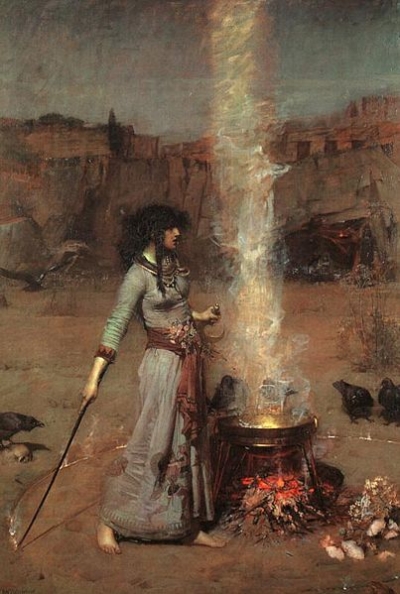
Many traditionalists consider every act and thought–even unintentional–as potentially affecting ritual outcome once it has been consciously decided that magic(k) is to be performed.
And once inside the ceremonial space, any unplanned action, utterance, or thought should be expected to affect ritual outcome with unpredictable consequences. It is often said to be better to abort a ritual once an incantation has been botched, rather than deal with untold consequences later.
Magic(k)al Language
Although mere thoughts are believed to affect the chain of natural events, it is spoken language that is considered most sacred.
In that magic(k)al language (including vocables: words and tones that by their very sound carry magic(k)al qualities) is formally established to be used in a ritual context only, prayers, spells, incantations, mantras, blessings, and chants have long been associated with magic(k) most high.
Crowley, Gardner, and Carmichael are among several purists who firmly believed that ritual must be performed in its “mother tongue” to work effectively, with Crowley said to have invested countless protracted hours learning the precise pronunciation of the ancient incantations he reenacted.
This timeless (and time-tested) belief is reflected in the Pope’s Vatican Christmas Mass which is always delivered in an archaic form of Latin, and traditional Jewish rites and rituals like Passover which are always recited in Hebrew–even in the most modest of Jewish households.
.jpg)
In that the ultimate power of language is thought to be in its vibrational qualities, one can only speculate as to what ultimate affect a mispronounced word or syllable may have on magic(k)al outcome. But considering that sound is of the most primal communicative properties and fundamental to our relationship with the natural world, it would be careless to underestimate the importance or science behind it.
Oral tradition tells us that the most effective ritual recitations are those spoken with well-practiced, deliberate delivery.
References:
Astronomers, Scribes, and Priests, G. Vail
Religion, Magic, and Witchcraft, R. and P. Stein
A Witches Bible Compleat, J. and S. Farrar
Magick in Theory and Practice, Aleister Crowley
Images via Wikipedia.org
Related Articles:
> Ritual of the Magic Mushroom
> Jainism
> The Red Paint People of North America
> The Harappan Culture of Indus Valley
Visit JAMES R. COFFEY WRITING SERVICES & RESOURCE CENTER for more information