The Sphinx in the City: Women's Experience of Urban Space
EducationThe Sphinx in the City: Women's Experience of Urban Space

Georg Simmel’s essay ‘The Metropolis and Mental Life’ (1903) viewed the city as the arena of modernity, a disorientating realm that generated neuroses such as agoraphobia and claustrophobia. Exploring the metropolis as a psychological construction, Simmel contended that the city harboured a nervous and feverish population plagued with alienation and a sense of dislocation. In order to cope with the constant bombardment of sensory stimuli encountered in urban space, the individual must adopt a blasé attitude or detached nonchalance, ‘The essence of the blasé attitude consists in the blunting of discrimination . . . The meaning and differing values of things, and thereby the things themselves, are experienced as insubstantial.’ Without this psychological defence, Simmel argued that the individual would become catatonic with awe. This gave rise to a new urban figure, the flâneur or stroller, who moves through the labyrinthine streets and hidden spaces of the city, partaking of its attractions and fearful pleasures, but remaining somehow detached and apart from it. In Simmel’s work the anonymous figure of the flâneur is assumed to be male, and indeed it has been argued that nineteenth century discourses of the city were inherently masculine.
Developing this idea, one branch of feminist writing has argued that only men had unrestricted access to urban space. Griselda Pollock, for example, has examined the experience of Impressionist artists in Paris, arguing that by virtue of their gender and social class, these figures were uniquely able to access the bohemian, sequestered and sexually-ambiguous spaces that often formed the subject matter of their paintings. Similarly, Elizabeth Wilson’s The Sphinx in the City (1991) is concerned with bourgeois femininity as constructed in the nineteenth century European city. Wilson’s main theme is that women’s presence in the city was problematic, raising anxieties about sexual promiscuity. Retracing Walter Benjamin’s exploratory perambulations through Berlin, Wilson concludes, ‘This sophisticated urban consciousness, which, as we shall see, reached a high point in Europe in the early twentieth century, was an essentially male consciousness.’ Citing Wilson’s work, however, Susana Torre argues that in this branch of scholarship women are seen as ‘extensions of the male gaze and as instruments of the emerging consumer society and its transformative powers at the dawn of modernity. In other words, they are described as passive agents rather than as engaged subjects.’
This is paralleled in Janet Wolff’s assertion that only men were able to take ‘visual possession of the city.’ In ‘The Invisible Flâneuse and the Literature of Modernity,’ Wolff accepts the idea that women were confined to the domestic sphere and thus excluded from the experience of modernity. By extension, Wolff argues that women were marginalised in the key texts on modernity because these focussed on the public space of the street and the world of work. Mica Nava challenges Janet Wolff’s influential essay, arguing that the city was ‘mythologized’ in various ways during the period under review. Commentators emphasised the menacing aspects of modernity – the proximity of strangers, the chaos of sensory stimuli and the pollution, as well as the fear of social and sexual dissolution. Within the literature of modernity, this gave rise to a polarised depiction of women as the urban prostitute and the suburban housewife. Nava argues that this was part of a conscious effort to impose order on the city, but concludes that this insistence on the ‘proper’ place of women was indirect evidence that women were indeed active in the urban public sphere.
Nava sees the department store as an emphatically modern space, exemplifying the spectacle of modernity as well as the new practices of consumerism. For women, the department store was one of the key points of access into the arena of modernity, in which they were able to ‘engage with the maelstrom of modern life.’ Nava questions the assumption that the flâneur was the archetypal modern urban subject, arguing instead that the male flâneur was only the observer and chronicler of modernity, not its personification. In their role as consumers, women became the interpreters of modernity, using their taste and judgement to evaluate the new consumer goods, novelties and display strategies encountered in the city.
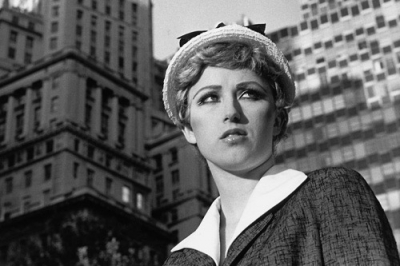
Cindy Sherman, Unititled Film Still