The Life of the Buccaneer Sir Henry Morgan: from Servitude to Success
EducationThe Life of the Buccaneer Sir Henry Morgan: from Servitude to Success

Henry Morgan’s career as a buccaneer only lasted ten years. Yet Morgan achieved much during his life time. His military experience, ambition and leadership took him from successful buccaneer, to wealthy plantation owner, lieutenant governor of Jamaica and a knighthood. Morgan achieved where Sir Francis Drake had failed one hundred years before him, and unlike many of his predecessors he lived into his old age. Morgan’s political endeavors in the Caribbean also help preserve British interests in the region, which still survive today.
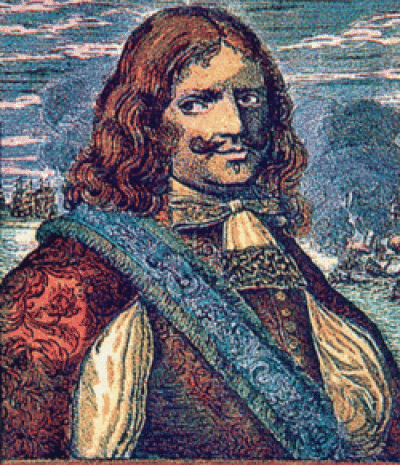
Morgan began his young life as an indentured servant in Barbados. He later joined the military and quickly rose through the ranks to become an officer. He was given a commission to head a militia by Thomas Modyford, the governor of Jamaica. Although England and Spain were technically at peace in 1667, Modyford was suspicious of Spain’s territorial ambitions in the Caribbean. Spain in the 16th century was a super power which had already colonized South and Central America. Morgan’s commission was an unofficial license to plunder Spanish galleons. The only stipulation was that Morgan hand over half of his captured booty to the English crown. However the terms of the agreement only applied at sea and did not include booty captured form tierra firma. No doubt the fact that Spanish flotillas were often large and heavenly armored also figured into Morgan’s plans.

Morgan first planned to attack and plunder the riches of Havana, but his force comprising of ten ships was not large enough, even with the addition of French buccaneers from the Tortugas. So Morgan chose less fortified targets such as Puerto Principe. Morgan’s next target was Portobello, a town that was key to the Spanish treasures fleets en route to Spain. Despite resistance from a Spanish garrison based at San Geronimo castle, Portabello was taken and its wealthy inhabitants tortured for the locations of their treasures. Word was sent to the governor of Panama that Portobello would be held to ransom for 350,000 pesos.
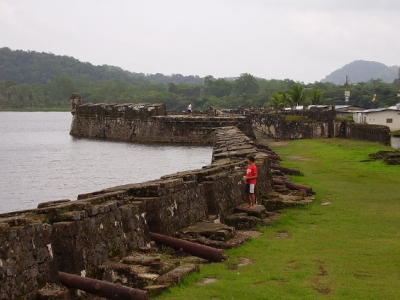
Geronimo Castle at Portobello.
The governor initially sent troops to recapture Portobello, but after this failed, the governor negotiated with Morgan and a ransom of 100,000 pesos was paid. Morgan and his pirates returned to Jamaica in early 1668 with the ransom money and 150,000 pesos in plundered booty.

This depiction is of the Spanish blockade that attempted to stop Morgan's fleet at Lake Maracaibo.
Undoubtedly Morgan’s successes in Cuba and Panama gave him the confidence and support to attack the cities of Maracaibo and Gibraltar in Venezuela, later that year. This time with a larger force that was once again joined by French buccaneers. Subsequent raids on the cities resulted in a battle with a squadron of Spanish warships, which had blockaded the harbor. However Morgan’s force got the upper hand and destroyed the Spanish galleons, capturing their booty of silver and gold.
By 1669 diplomatic pressure was being put on England by Spain that affected its interests, to stop the activity of the buccaneers. However Spanish reprisals gave Modyford the excuse to order Morgan to attack Panama. With a force of over 2,000 men and 33 ships, Morgan attacked and captured the fortress of San Lorenzo. Morgan’s force moved inland and engaged with Spanish cavalry and infantry, eventually forcing the Spanish to retreat into to the jungle. Panama's principle city, which would later be moved to a different location and named Panama City, was looted and destroyed by retreating Spanish militia. The booty recovered from the city was less than had been expected because the Spanish had by that time shipped most of the city’s wealth to Ecuador.
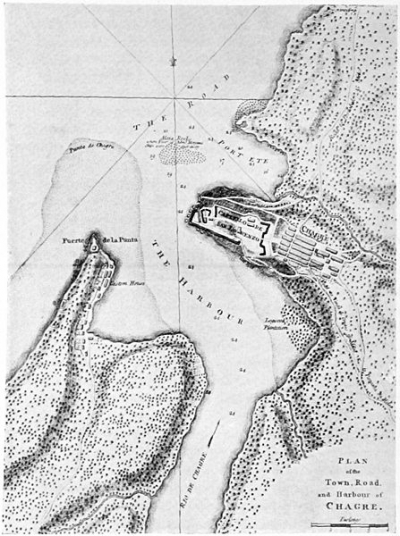
Map is of San Lorenzo fortress which guarded the mouth of the Chagres River, Panama.
After a peace treaty was agreed between England and Spain in 1670, known as the treaty of Madrid, Spain demanded the arrest of governor Modyford. Modyford had acted against Spanish interests without authorization.To appease Spain Modyford was placed in the Tower of London for two years. He would eventually return to Jamaica, ironically as chief justice. Morgan was brought back to England but was not arrested; this was attributed to his political connections. Instead he was knighted and he returned to Jamaica in 1675, where he lived out the rest of his life as a plantation owner.
All images from commons.wikimedia.com