The Greatest Global Disaster of Our Lifetime
EducationThe Greatest Global Disaster of Our Lifetime

If you were to ask 100 people what the greatest global disaster of our lifetime was, you probably would not get more than two or three correct answers. You might be lucky to get even that.
Some people might say “The Volcano erupting in Iceland”, others might suggest “Hurricane Katrina”, or any number of “Tsunamis”. All wrong.
Now if you were to point out that the greatest global disaster of our lifetime was without a doubt partially human caused, you might get guesses along the lines of the attacks on the Trade Towers in the United States, or even the disappearing Aral Sea. Again all wrong.
The greatest global disaster is one of our own making and it started about 10,000 years ago, and continues virtually unchecked even today. If not dealt with it will very likely result in a total obliteration of the human race.
This is the Holocene Extinction Event. While extinctions happen regularly it is not with the rate at which they are occurring today. As human populations have skyrocketed, other plant and animal populations have plummeted.
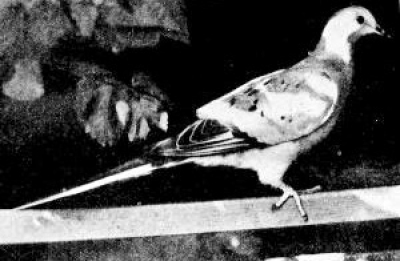
One example of this is the Passenger Pigeon, (below) a bird that was possibly the most abundant bird in the world in the 19th Century. With numbers in the billions, they were hunted to extinction, and suffered greatly when the forests they nested in were destroyed. The last Passenger Pigeon died in captivity in 1914.

The Moa, Quagga, Tarpan, and Steller's Sea Cow, are popular representations of animals that have gone extinct due to humans, or human activity. The Steller's Sea Cow being driven to extinction within only 27 years of its initial discovery. Blue Fin Tuna are expected to only be around for another 3 years if we do not reduce our fishing (aka eating) of these animals.
Indirectly species have been exterminated as a result of our actions, pollution, and introduced species. The Dodo birds population was only slightly hampered by hunting, it was species introduced to their island home (cats, dogs, monkeys, and swine) who eventually did this flightless birds in.
Several species have become extinct due to global warming (links to human activity are of course disputed on this). Coral reefs have died off when ocean temperatures are too warm, and all the life they support also dies off.
It is not just animal species, but plants too. We may never know how many plant (and animal) species have been lost with deforestation throughout the worlds rain forests. How many marine species have died as a result of the pollution that we have poured into our rivers and oceans?
Estimates put the number of species already lost between 20,000 and 2 million, with species going extinct daily.
Scientists have a list to monitor extinction, at the top of the list are things like humans, we are of Least Concern. In the middle of the list are Endangered Animals, things like many of our tigers and other predators. At the bottom of the list is Extinct in the Wild, in which the only living beings, are those in zoos. Then we have extinct, gone forever.
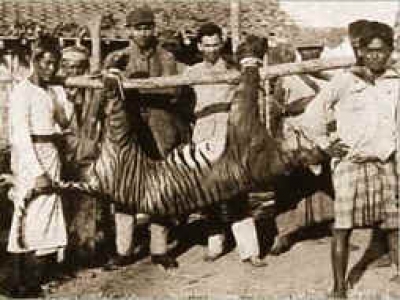

The Balinese Tiger, as pictured above, was declared to be extinct in 1937. Reasons: Hunting and habitat loss.
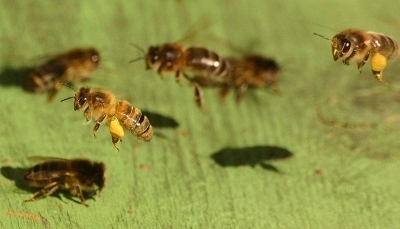
Honey bees has been noted for having a drop in population, every thing from cell phones, to pesticide use has been blamed, but really we do not know why bee populations are falling. One thing is certain, without honey bees, many species, possibly humans, will not continue to exist. For those who fail to understand this, we must note, honey bees are major pollinators. They pollinate many fruits and vegetables (including soybeans), but more importantly they pollinate plants such as alfalfa, and clover, major food sources for beef and dairy cattle.

We can continue to ignore the plight of animals, continue to allow species to be hunted to extinction, continue to allow the rain forest to be cleared, or we can take control of our own population and see that it stops its destructive path.
The Holocene Extinction Event is the most alarming, and under-talked-about global disaster of our lifetime.
Related Reading
20 Ways to make Life Better for Animals