Apparel
Artificial Intelligence
Automotive
Beauty
Blockchain & Web3
Business
Education
Electronics
Entertainment
Food & Restaurants
Health
Hobbies & Toys
Home & Garden
Money
Pets
Shopping
Software
Sports & Outdoors
The Great Blue Hole of Belize
EducationThe Great Blue Hole of Belize

At the coast of Belize is a large underwater sinkhole called “The Great Blue Hole of Belize.” During the last glacial period it was formed as a limestone cave system when sea levels were much lower, but when the ocean began to rise, the caves were flooded and the roof collapsed creating this perfectly circular limestone sinkhole.
.jpg)
Image via Google Images
A sinkhole is a natural hole caused by the removal of bedrock by water. When the rock below the land surface is limestone, salt beds, carbonate rocks, or rocks that can naturally be dissolved by circulating ground water, the common results are sinkholes.
.jpg)
Image via Google Images
The Great Blue Hole of Belize isn’t just an amazing geographical phenomenon, but also one of the best diving sites in the world. It’s circular in shape, over 300 meters (984 ft) across and 125 meters (410 ft) deep. The outer edge is merely a few feet underwater at high tide. The range of the stalactites and limestone formations which mould its walls seem to become more elaborate and intense the deeper one dives.

Image via Google Images
In 1971, Jacques-Yves Cousteau made the site famous by declaring it as one of the top ten scuba diving sites in the world. He took his famous research ship “Calypso” into the Blue Hole to chart its depths. Investigations from this expedition confirmed the hole's origin as typical limestone formations, formed before the sea level rose.
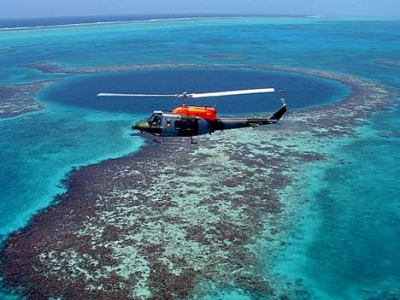
Image via Google Images
There were two popular rumors that sprang up regarding Cousteau's visit. The first was that Cousteau used explosives to blast a path through the atoll to reach the Blue Hole. The second rumor was that Cousteau’s son Philippe lost his life in the Blue Hole during that trip. The rumors were of course not true at all. Cousteau did not lose his son Philippe here; he died in a helicopter accident in Lisbon, Portugal a few years later. Neither did Cousteau use explosives to destroy the patch reefs while navigating the Calypso in the Blue Hole. He did selectively remove some by limited blasting, but those were very small areas just to enable the Calypso to reach the Blue Hole.

Image via google Images
At some time, many millions of years ago, there was a major earthquake and this probably caused the cave ceiling to collapse forming the sinkhole. The great depth of this sinkhole creates the deep blue indigo color and corals surround it. Water doesn’t circulate freely in the Blue Hole, so there is very little marine life below its shallow depths. The Great Blue Hole is the world’s largest blue hole, and in 1997 it became one of UNESCO’s World Heritage Site.