The Dogon Culture of Mali, West Africa
EducationThe Dogon Culture of Mali, West Africa

According to oral tradition, the Dogon originally came from an area southwest of modern-day Bamako, in West Africa, called Mande.
In the thirteenth century during the military campaigns of Sundiata Kita, founder of the Mali Empire, the Dogon culture was forced to migrate eastward, until finally reaching their modern-day location about 60 miles south of the Niger river at Bandiagarathe Cliff, sometime during the fourteenth or fifteenth century. Today they occupy an area south of the Sahara Desert near the city of Bandiagara in the Mopti region.
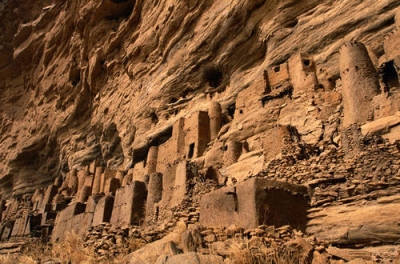
Bandiagarathe cliff, which is nearly 135 miles long and in some places rises 1000 feet above the Plain of Gondo, forms the boundary of a sandstone plateau dissected by canyons. Nestled in these canyon walls are countless shallow caves where the Dogon settled due to their remote inaccessibility, providing refuge from aggressive neighboring groups included the Mossi, Songhay, and Fulani.
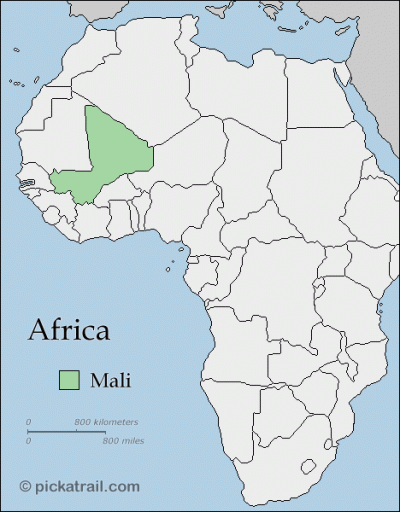
Today numbering an estimated 250,000 (though some sources claim there are as many as 800,000) spread over about 700 villages, the Dogon live much as their ancestors, in rectangular houses with flat roofs built with sun-dried mud bricks plastered over with mud. The villages are located at the foot of Bandiagarathe Cliff, not on flat land, but at the sloping foot. The houses are built in close proximity to one other and have small courtyards and square granaries.

In the not too distant past, the Dogon’s primary means of subsistence was the cultivation of millet, supplemented by a few cattle and goats. They also hunted sable antelope, gazelle, and dwarf buffalo using bow and arrows--until game became increasingly scarce. Today the Dogon are quite renown for their farming skills, cultivating a wide variety of crops including pearl millet, sorghum, and rice, as well as onions, tobacco, peanuts, and other vegetables. And this occurrence is largely due to French anthropologist Marcel Griaule.
Working and living among the Dogon during the 1920s and 30s, Griaule is credited with motivating the construction of a dam near Sangha, and with urging the Dogon to expand their agricultural practices to include onions. The economy of the Sangha region doubled since that time with its onions sold on the market as far away as the Ivory Coast. Additionally, the Dogon raise sheep, goats and chickens, with fishing done once a year as a collective ritual.

While a significant minority of the Dogon follow the Islamic faith today, (and to a lesser degree, Christianity), the majority of Dogon still practice an animist religion, including the worship of the ancestral spirit Nommo involving numerous festivals, as well as a mythology in which the star Sirius plays an important part.
Dogon mythology tells of creation of the universe, the struggle between order and disorder, and the Dogon place within it.
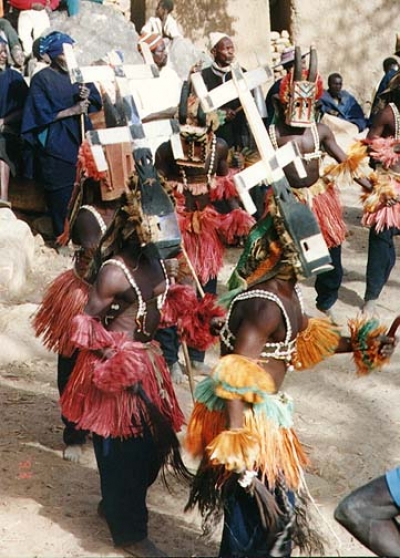
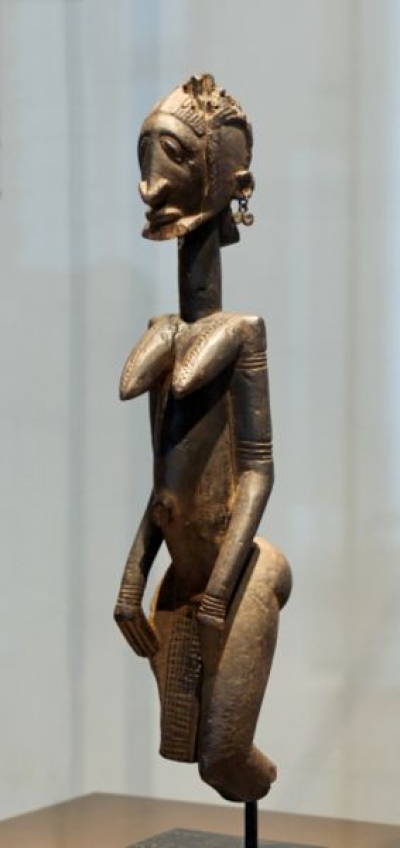
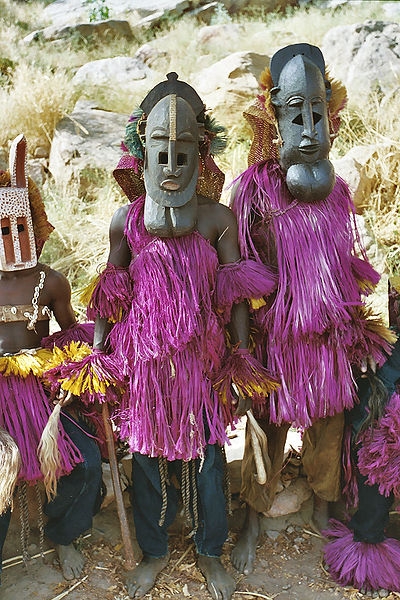
These myths provide the underpinnings to all day-to-day Dogon life including marriage, the physical layout of the village and their houses, and the cycle of ritual activities. The Dogon are renowned throughout the world for their artistic designs in woodcarvings and elaborate masks relating to their cosmology, with their dances including over 80 varieties of masks, each depending on the type of celebration.
In Dogon villages, the “Hogon” is the spiritual leader. He is elected from among the eldest men of the extended families of the village.
After election, he must follow a six-month initiation period during which he wears white clothes, is not allowed to shave or wash, and no one is permitted to touch him. A young virgin (who has not yet menstruated) is assigned to care for him, clean his house, and prepare his meals. After his initiation, he wears a red fez and an armband with a sacred pearl to symbolize his societal and religious function.

A Hogon, holy man
Like several other cultures of Africa, the Dogon societal structure evolves around occupational "castes" or status groups delineating those who craft iron, wood, and leather, as well as the “griots,” whose function is that of lineage genealogists,musicians, and poets (and in many cases, believed to possess powers of sorcerery as well).
Caste members live apart from the agriculturalists in special quarters reserved for them, outside the village, or in villages of their own. Each caste is endogamous and the members do not participate in the common religious cults. Village organization is kin-based within the overall framework of exogamous patrilineal lineages.
The men's society known as Awa among the Dogon, controls the cult of the masks.
In addition to the cult of the masks, there are numerous, fully-integrated cults including the Lebe cult (associated with the agricultural cycle; its chief priest is the hogon), the cult of Binu (often referred to as totemic, with members of the clan having the same name and respecting the same animal (or vegetable) prohibition.
Among their many rituals the Dogon practice are those related to coming of age.
Boys are circumcised (performed by the village blacksmith) in age groups of three years, for example, all boys between 9 and 12 years old. This marks the end of their youth, and they are now initiated. The Dogon are also one of several African ethnic groups which practice female genital cutting. While is some areas of Mali this involves girls around the age of 7 or 8 enduring extreme surgical procedures, in the Sangha region a milder form is practiced (meaning only the clitoral hood is removed, which is similar to male circumcision). Circumcision for both males and females is seen as essential for the individual to gain gender. Before circumcision they are seen as “neuter.”
Of their many annual rituals, the yingim and danyim rituals are among the most significant, each lasting a few days. They are held in honor of the elders that have died since the last Dama, a yearly rite of passage focused around the village‘s “keepers of the masks.”
The yingim involves the sacrifice of cows or other valuable animals, and large mock battles performed in order to help chase the spirit, known as the nyama, from the deceased body and village, and towards the path to the afterlife, while the danyim involves masqueraders performing dances every morning and evening for anytime up to six days depending on how that village performs this ritual. (Highly individualized, there is no one ritual formula, but varies greatly village to village.)
The masqueraders dance on the deceased’s rooftops, throughout the village, and in the fields around the village. Until the masqueraders have completed their dances and every ritual has been performed, it is said that any misfortune can be blamed on the remaining spirits of the dead.
One of the most noteworthy aspects of Dogon ritual and societal structure is its relationship to cosmology.
In 1976, American author Robert K. G. Temple wrote acontroversial book called The Sirius Mystery, arguing that the Dogon's astronomical system reveals precise knowledge of cosmological facts only known by the development of modern astronomy. Temple then argued that the Dogon's information, if traced back to ancient Egyptian sources and myth, indicated an extraterrestrial transmission of knowledge of the stars. While few modern scientists support this contention, it has raised a new area of study to better understand how the ancient Dogon acquired this information, and how it came to be so essential to their culture.
References:
The Dogon of the French Sudan, M Griaule, G Dieterlen
http://www.debunker.com/texts/dogon.html
Dogon: Africa's People of the Cliffs, Walter E.A. van Beek
The languages of Africa, H. Greenberg
http://lucy.ukc.ac.uk/EthnoAtlas/Hmar/Cult_dir/Culture.7840
http://www.kurahulanda.com/west-african-kingdoms/dogon-culture
http://www.teachersdomain.org/resource/vtl07.la.ws.process.dogondama/
Images via wikipedia.org except where credited otherwise (with my appreciation)
Related Articles:
> The Harappan Culture of Indus Valley
> Blacks and the Founding of the United States
> The Pikey Culture and Language
> Marriage Tradition of the Gamo of Ethiopia
> The Wodaabe of Northwest Africa
> Ritual Music of the United States
Visit JAMES R. COFFEY WRITING SERVICES & RESOURCE CENTER for more information