The Design and Construction of the Classical Guitar
EducationThe Design and Construction of the Classical Guitar

Today's classical guitar is based on the traditional design of the Spanish maker Antonio de Torres (1817-92). In the mid-19th century he developed a new large-body guitar with a pleasing outline and standardized rectangular bridge. His guitars took construction and sound a step forwards. The Torres guitar had extra volume and a good tone and was widely adopted by classical players. It replaced the small-body guitars of makers such as Panormo and Lacote.
Christopher Dean Classical
.jpg)
One of the outstanding English guitar makers, Christopher Dean has been building guitars professionally for over 20 years. He is part of a tradition going back nearly half a century to the early work of David Rubio. Dean worked at one time with prominent maker Paul Fischer, who in turn had worked with Rubio for a number of years. Dean continaully strives to refine and enhance his sound. His guitars have a a bright crisp string tone, and the body adds a pure resonance and depth. There is a good response in all registers. Dean's instruments are evolving within the tradition of European classical guitar building, influenced by Torres, Bouchet, Hauser and the philosophy and approach behind English making. The guitars are used widely for performing and recording.
Cutaway Guitar
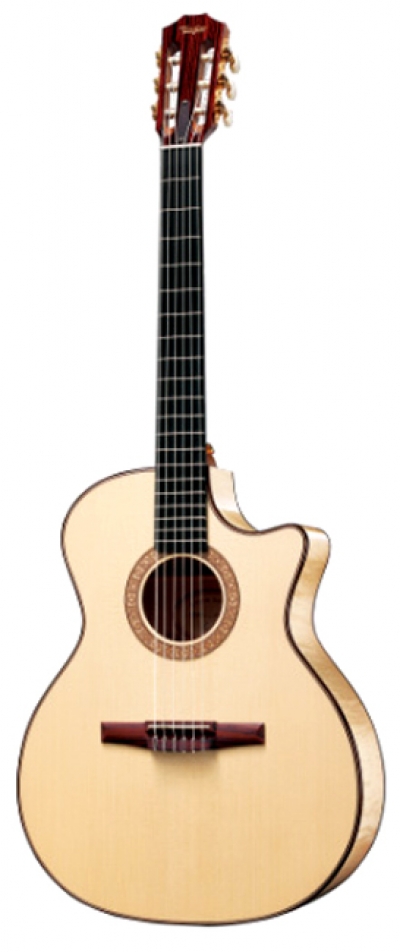
This innovative kind of guitar, made for the author Richard Chapman by Russell Fong in London in 1993, was designed to meet the need for a more modern instrument. The upper bout body shape was altered to give easy access to a higher registerm reaching notes that are just out of range on a standard design when using sophisticated fingering patterns and a stable thumb position. The neck joins the body one fret higher than normal, and a dropped shoulder on the treble side gives an extra two frets. The guitar has a rounded neck profile and the heel is cut in closer to the body than usual. Together, these structural changes let the player move three frets higher and play melodies, improvisation, and chords in a better register, similar to steel-string and electric guitars, while maintaining a beautiful full nylon-string sound.
Flamenco Guitar
.jpg)
The flamenco guitar is a classical guitar in outline, shape, and proportions, but it has a number a of important differences in construction that give it its own particular tonal qualities. It has lighter internal bracing than a classical guitar, a thinner top with a transparent golpeador tapping plate, and a light-coloured cypress-wood body with cedar neck. This string action is set lower. The overall effect is a warm, loose guitar with a pronounced string so0und. Nevertheless, the flamenco guitar player can produce a cutting attack from the instrument as well as a mellow, soulful quality.
Today, flamenco guitars have more in common with the modern classical guitar. Professional flamenco guitars have a slotted headstock with worm-and-gear tuners instead of pegs, which make the instrument difficult to tune. Many flamenco guitars are made with rosewood bodies, which give more power and density to the sound. Many leading guitarists today including the great Paco de Lucia, have to amplify their guitars on stage, particularly in a group.
Thanks for reading!