Facts About Tasmania, Australia's Island State
EducationFacts About Tasmania, Australia's Island State

Tasmania, fondly known as Tassie, is an Australian island and state, situated 240 km off the south eastern coast of mainland Australia.
Seperated from it's motherland by the Bass Strait, Tasmania has a total land area of 68,401 sq km and a population of just 500,000 people.
As well as being Australia's smallest state, Tasmania is by far Australia's greenest state and has remained almost unspoilt ecologically and environmentally.
The state also consists of 13 smaller offshore islands.
HISTORY.
The island was named after Dutch explorer Abel Tasman, who first spotted the island in 1642, but has been known by several other names during it's history, including Anthony Van Dieman's Land, Van Diemen's Land, the Colony of Tasmania, during the days of British colonial rule, and finally Tasmania.
The island was first colonised in 1803 as a penal colony, and is still mainly populated today from the British decendents of the convicts and prison guards who settled there at that time.
TOPOGRAPHY.
Situated along the path of the Roaring Forties, turbulent prevailing westerly winds, the island hosts some of the world's most distinctive rock formations and ecologically valuable landscapes on the planet.
It is a mostly mountainous state, interspersed by extemely diverse vegetation, that ranges from alpine heathlands to temperate rainforests and eucalypt forests, with fertile plains and open bushland bordered by high mountains and deep valleys.
It is home to many species of unique flora and fauna as well as 12 endemic bird species and it's exclusive Tasmanian Devil, a black, dog like, carnivorous marsupial with a penchant for being wholly anti - social, even to it's own kind.
During the island's history the landscape has produced a myriad of natural resources including copper, zinc, tin and iron ore.
It's 4,888 km Jurassic coastline has been the precursor to the island's bountiful crayfish and abalone fishing industry, as well as instigating a large and thriving tourist industry.
Tourists come to Tasmania in order to see it's wealth of ancient rock formations and it's stunning and often remote scenery.
40 % of the island is made up of national parks, nature reserves and world heritage sites, which are home to 19 national parks, 18 rivers, 7 lakes and some of the world's most distinct and ecologically diverse coastal regions.
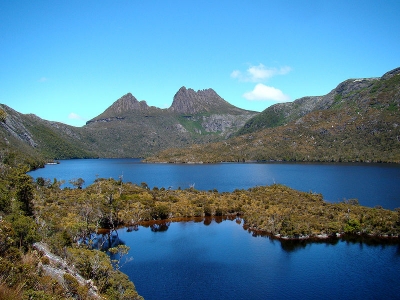
DOVE LAKE FLANKED BY CRADLE MOUNTAIN.
CLIMATE.
The climate of Tasmania is cool temperate in the south, to marine temperate in the north and is the only Australian state with four distinct seasons.
It is also Australia's wettest state, having a yearly precipitation of around 616 mm.
Tasmania's coolest month is June, with daily temperatures not rising much above 20 degrees celsius, and the hottest months are December, January and February, where temperatures can soar to as much as 40 degrees celsius in the north of the island to a high of 25 degrees celsius in the south.
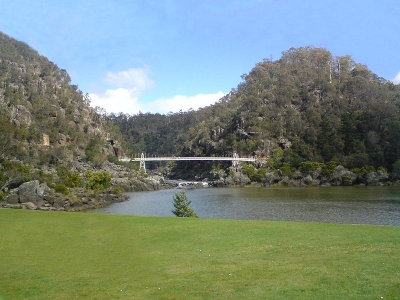
CATARACT GORGE
HOBART.
The island consists of 169 townships, which house a population of around 500,000 people, mainly decendents of British settlers and native Aborigines.
The capital city is Hobart, situated on the south east coast of the island, which was built along the estuary of the Derwent River, and flanked by the mighty and sometimes snow capped Mount Wellington, at 1,271 metres.
The greater metropolis of the city has a population of only 219,287 , making it Australia's smallest city. The city grew up around it's prison in the early 1800's, making it Australia's second oldest city after Sydney.
From the mid 1800's to present day, the port has become a busy Antarctic cargo port for people travelling to the French and Australian Antarctic base stations and a busy hub for visiting cruise liners.
The city's main industries are shipbuilding, brewing, vineyards and the main Cadbury's chocolate factory for the Southern Hemisphere, as well as a large tourist industry.
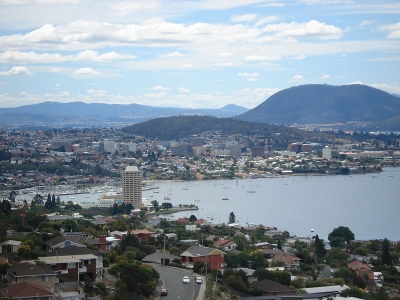
HOBART.
It's elegant promenade and cafe lined streets of the harbour area is a magnet for the city's locals and many tourists, which sport a myriad of fine shopping and cosmopolitan restaurants.
Other notable sites in the city are the Tasman Bridge, that links the two banks of the Derwent River, it's Botanical Gardens, Mount Wellington and the Moorilla Estate Vineyard, Australia's most prestigious, multi award winning winery.
Hobart is also home to Australia's oldest theatre, The Theatre Royal and Australia's oldest practicing synagogue.
The city is also served by the Federation Concert Hall, the Hobart Museum and Art Gallery and Australia's first ever legal casino, at the 17 storey, Wrest Point Hotel.
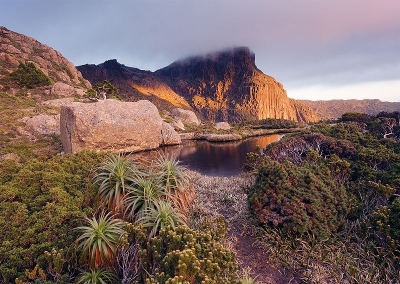
MOUNT ANNE.
TRANSPORT.
The city is served by it's busy port and Hobart International Airport, with daily flights to the Australian cities of Melbourne, Sydney, Brisbane and Adelaide, and a good road network.
Internally, the city is only served by buses, that can be problematic during the Summer months when there are many tourists, causing the city to become heavilly congested with through traffic.
The island is served by a large and well run ferry service situated on the north of the island at Devonport for transport links to Melbourne on the Australian mainland, by way of a ten hour overnight sea crossing..
Inter town to town travel can be taken by way of it's extensive road network or the island's efficient bus service.
There are no passenger train services on the island.
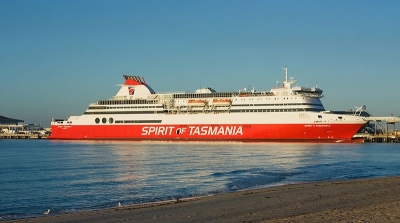
The Spirit of Tasmania, the ferry makes six nightly crossings a week to Melbourne.
PORT ARTHUR.
.jpg)
Port Arthur, showing the penetentiary building, the largest prison in Australia at the time, built by prisoners from Britain and Ireland and used between 1833 - 1877.
The eighty cell prison at Port Arthur was used to house re - offending prisoners already incarcerated in prisons on the Australian mainland, and was considered to be the harshest prison in all Australia at that time, where prisoners were forced to be hooded and denied speech in order to make them reflect upon their bad ways.
In 1855 the prison opened a juvenile correctional centre, where boys as young as nine years old were sent there for stealing food or toys.
The prisoners were employed in hard labour including stone cutting, construction and clearing the land of it's dense scrub.The prisoners built many of the older buildings in Port Arthur including the town's church.
.jpg)
A Chaingang working near Port Arthur.
The dead from the prison were buried at the nearby Island of the Dead, where there are 1,646 graves of both convicts and guards situated there. Only the graves of the prison guards are marked.
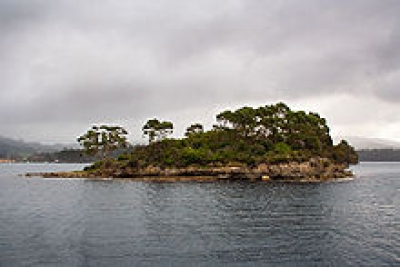
Island of the Dead, where the guards and prisoners from Port Arthur were buried.
( Main picture of Port Arthur, with kind permission of J.J Harrison. CC-BY-SA. 3.0 )
You may also be interested in is-australia-an-island-a-country-or-a-continent
.
© D.B.Bellamy.March.2010.
Images courtesy of wikimedia commons.