Guide to Taiwan, China's Asian Tiger
EducationGuide to Taiwan, China's Asian Tiger
Taiwan is a province and largest island of the Peoples Republic of -china/ which is politically known as the Republic of China.
Situated 120 km off the south east coast of China, it is seperated from mainland -china/ by the Taiwan strait.
The island has an overall area of 35,980 sq km and a 1,566 km coastline.
HISTORY.
Taiwan was originally populated by people of Malay and Polynesian descent, known as Aborigines, who called the island Pakan.
From 1624 until 1662 the island was under Dutch occupation. The Dutch called the island, Ilha Formosa, Portugese for beautiful island, which gave rise to the islands first modern name, Formosa.
During the Dutch occupation, Chinese migrant workers were brought over to the island to work the sugar plantations and rice fields there.
These workers eventually married local Aboriginal women and settled there, giving rise to a new nationality.
In 1887, the Chinese Manchu Imperial Authorities, declared Formosa a province of their Empire, in an attempt to outmanouver the Japanese who were expanding their Empire in the area.
In 1895, japan- defeated the Manchus in the Sino - Japanese war and China ceded Formosa to japan-, where it remained until 1949 when it was once more ceded unto -china/ again.
The second Chinese occupation was meant to be only a temporary one, but much to the Taiwanese peoples dismay, -china/ still holds sway over the island to this day.
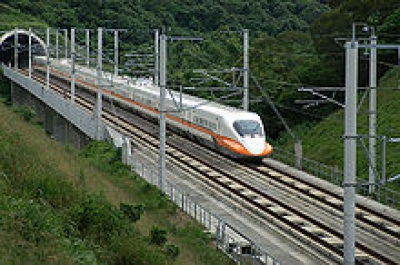
Taiwan's high speed Bullet train.
PROVINCIAL GOVERNMENT.
Today the island is a self governing Chinese province under an executive Yuan government, with a president as it's head, whose ministers are appointed by their president, who is internally voted from within the party, for a four year term.
The island has a highly developed economy and is known as one of the Four Asian Tigers, along with Hong Kong, Singapore and -south-korea/ .
After over a century of occupation the people of Taiwan are desperately seeking independence, although their newly elected President is a great advocate of tightening relationships with the motherland ( -china/ ).
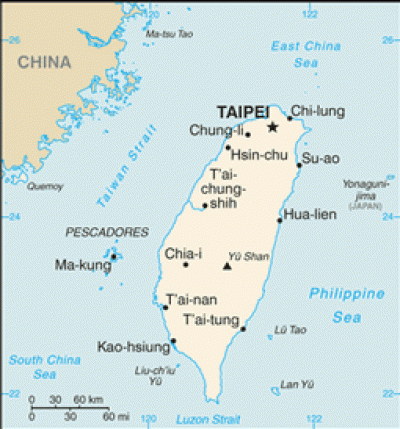
Map of the island of Taiwan.
TOPOGRAPHY.
Geographically Taiwan is divided by east and west, with the eastern side of the island being covered by steep, rugged, forest covered mountains of over 3,000 metres high and the western side of the island sporting flat, lush and fertile plains.
The island boasts 7 national parks depicting the islands diverse and picturesque terrain,flora, fauna and wildlife.
It's 1,566 km coastline is surrounded by white sandy beaches, with small coral reefs situated a few metres out to sea.
The west of the island lies on the Taiwan Straits coast, the east of the island on the -pacific-ocean-coast with the Luzon strait to the south and the East China Sea to the north.
Climatically the island is divided by a north and south divide, with the south of the island experiencing a tropically oceanic climate and the north experiencing a semi tropical climate.
The island experiences a rainy season between January and March, and the summers ( June - September ) are generally hot and humid.
Tropical storms and typhoons are a major, problematic climatic feature of the island.
The island is persistantly covered by dense cloud cover, due to the island's heavy pollution which is attributed to the islanders excessive use of petrol driven motor scooters.
Natural resources on the island consist of large reserves of coal, petroleum, and natural gas.
The island is situated along the -pacific-coast's Ring of Fire, and has witnessed several major earthquakes in it's geographical history.
On the earthquake U.G.S hazard rating scale, the island scores a 9 out of 10, with it's most recent quake on the 4th of March 2010, measuring 6.4 on the richter scale, occuring just days after a massive quake in Chile and weeks after a devastating quake on the island of Haiti.
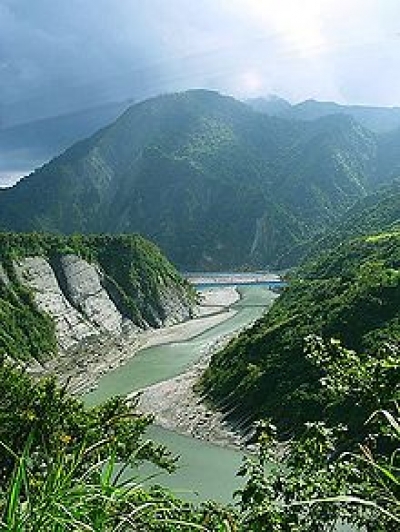
The Siouguluan River.
DEMOGRAPHY.
Todays population of Taiwan is mostly decended from mailand Han Chinese, from the southern Chinese province of Fujian.
The language of Taiwan is Taiwanese, which is a dialect of southern Fujian in -china/ and is spoken by 70 % of the population. The language was banned on the island by the Chinese government until the 1980,s, with Mandarin being encouraged as the official language.
English is taught in most of the secondary schools as a second language.
Japanese is spoken fluently by most of the population over 45.
Most of the islands 23 million population live on the islands western and northern coasts.
The dominant religions are Buddhism, Confucianism and Taoism.
The culture of Taiwan is a diverse and eclectic mix of Chinese,Japanese and Polynesian cultures.
Employment on the island centres mainly around the electronics manufacturing industry, world banking and tourism.
Sport is enjoyed by the vast majority of Taiwanese people, particularly martial arts, with baseball being the islands national spectator sport.
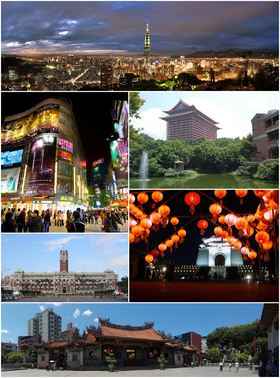
Landmarks in and around Taipei.
TAIPEI.
The provincial capital of the island is Taipei, situated in the north of the island.
The city is politically made up of 12 districts, built along the banks of the River Danshui to the west of the city and the River Xindian to the south.
A vibrant and modern city with a population of just over 2 and a half million people, it is one of the world's Alpha Cities that has witnessed a rapid economic development due to it's high tech products manufacture.
As well as it's modern western architecture the city hosts a myriad of beautiful Buddhist and Daoist temples, several performing arts venues, art galleries, 20 universities, 16 museums and a 165 hectare animal sanctuary and zoo.
The city is served by Songshan and Taoyuan airports, the -pacific- coast's Keelung Port, and a highly advanced rapid transit system within the city.
The city is also a shrine to the Chinese ex KRT leader, Chiang Kai - Shek, who fled mainland China in 1949, complete with the entire gold reserve of the country, giving rise to the islands fortuitous and rapid economic growth.
There are several ornate, public, national buildings in the city that bear his name.
Today the city is also a leading tourist destination, that sports seaside resorts complexes with luxury hotels, the famous Ximending shopping area and the Shilin night, street market.
The cities most impressive landmark is the Taipei 101, a 101 floor, 449 metre high tower that was constructed in 2004, which until January 2010, was the world's tallest building.
Currency: Taiwan dollar.
UTC : + 8.
Internet TLD : .tw
TAIWAN TOURISM WEBSITES.
.
© D.B.Bellamy.March.2010.
Images courtesy of wikimedia commons.
OTHER ARTICLES YOU MAY BE INTERESTED IN.
knoji.com/facts-and-figures-of-the-peoples-republic-of-china/
knoji.com/china-the-mighty-river-yangzte/