Rare Metal Churches from Around the World
EducationRare Metal Churches from Around the World

Metal churches were first constructed in the mid 1800's for speed of erection in new communities.
Most were manufactured in the United Kingdom and shipped to every corner of the globe during the days of the British Empire and used as mission churches.
They were also used by the British in new communities around Britain and were ideal as a quick way to erect a place of worship in areas where there was no permanent community, such as for use by road and railway workers or at the site of an out of town, large building project.
Many of these metal churches, nicknamed ' tin tabernacles ' were destroyed during Britain's two wars or simply left to decay, but some have survived to present day and are now listed buildings.
Other larger and more ornate metal churches have been constructed around the world for other reasons, such as in earthquake zones and high risk fire areas.
Few metal churches exist today, but I was able to find a few that I could include in this article.
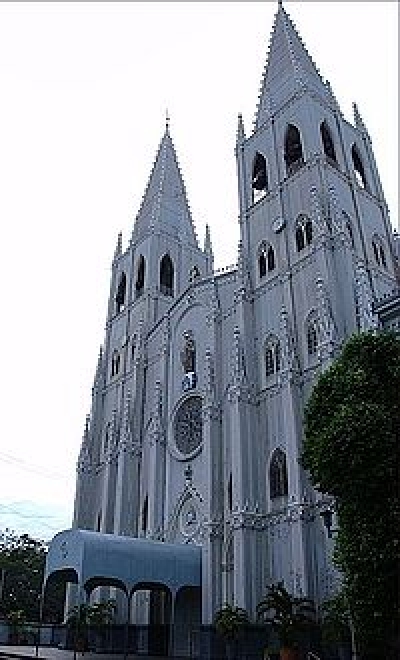
BASILICA OF SAN SEBASTIAN, MANILA, PHILIPPINES.
This huge Roman Catholic basilica was constructed between 1888 and 1891 after local priest Estaban Martinez wanted a new church that could withstand the ravages of an earthquake, after three previous houses of worship in the neighbourhood had suffered from such a fate.
Designed by architect Genaro Palacios in the neo - gothic style and made of steel,the metal sheets used in it's construction were manufactured in Binche, Belgium by the Societe Anonyme foundry, before being shipped out to Quiapo, an old district of the Philippines capital, Manila.
The large stained glass windows were manufactured in Germany.
It is possibly the first earthquake-proof church built in the world, and it is also rumoured that French architect Gustav Eiffel ( he of eiffel-tower fame ) had a hand in either it's design or construction.
Today the basilica is still used as a Catholic place of worship.
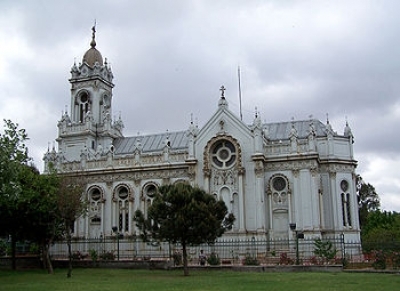
BULGARIAN CHURCH OF ST STEPHEN, ISTANBUL, TURKEY.
This large cast iron church built for the Bulgarian community in Istanbul, was constructed between 1896 and 1898, after their previous church burnt down in a fire.
The cast iron panels for the building were made in Vienna, Austria by the foundry of R.Ph.Waagner and shipped to Istanbul by boat.
Built in the neo - gothic / neo - baroque style, the church was possibly the world's first fire proof church.
The church is still used as a place of worship for the Bulgarian community today.
.jpg)
ST BARBARA'S, DEEPCUT GARRISON, SURREY, ENGLAND.
Originally built in 1901 for use by soldiers based at the Deepcut Garrison in Surrey, it was originally consecrated in the name of St Michael's and All Angels.
There are no details as to who the architect or builder was, but it is possibly one of the flat pack tin tabernacles that were being constructed in Britain in those days.
The church has had several restorations over the years and in 1967 the church was renamed in honour of St Barbara.
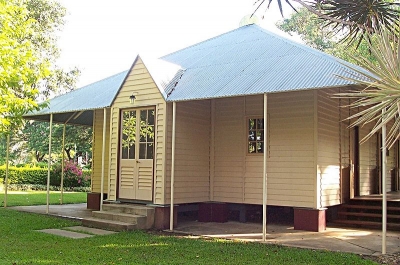
WESLEYAN CHURCH, ADELAIDE, SOUTH AUSTRALIA.
There is not much information about this recently restored tin tabernacle, other than the church is made from galvanised iron and is reported to have been made in Adelaide, South Australia before being taken to Darwin, Northern Territory in 1897.
The little church is still in use for Weslyan services to this day.
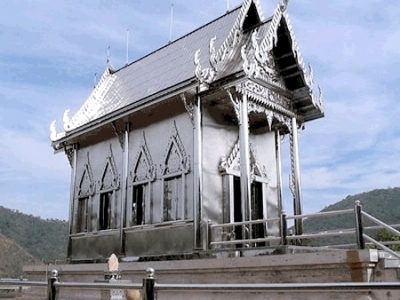
STAINLESS STEEL CHURCH, RATCHABURI, THAILAND.
I was unable to find out anything about this beautiful little church built in Ratchaburi central Thailand. Although classified as The Stainles Steel Church, Thailand, it actually looks more like a small shrine to one of their Buddhist Gods.
Either way, I think it is a beautiful building worthy of inclusion in this article.
There is only one site online with any information about this church and it is written in Thai, and when translation is applied, it translates as complete nonsense in English, so if anyone knows anything about this delightful building, I would be grateful for any information you can give me.
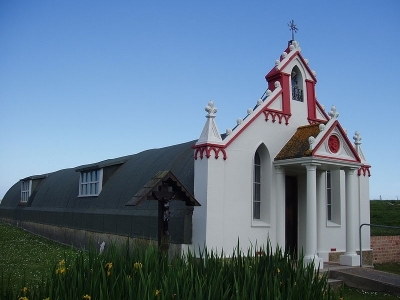
ITALIAN CHAPEL, LAMB HOLM, ORKNEY ISLES.
In 1945 British troops captured 500 Italian soldiers in North Africa. Declaring them as British prisoners of war,they were sent to the Orkney Islands in order to build defences on and around Scapa Flow.
Sixty of these prisoners of war were sent to the then uninhabited island of Lamb Holm, where they began to build themselves a Catholic chapel in their leisure time from two old nissan huts and any other materials they could find on and around the island.
The chapel was ornately decorated inside by Italian soldier Domenico Chiochetti, who stayed on the island after the end of the war in order to finish his work.
Today the tiny chapel is a grade 1 listed building, a popular tourist attraction, and still in use as a place of worship.
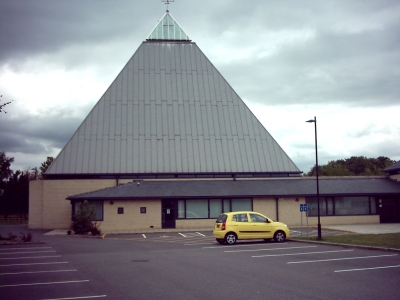
ST BEDE'S, R.C CHURCH, BASINGSTOKE, U.K.
The impressive pyramidal design of this modern church in Hampshire, southern England, is a unique structure made of Cotswold Stone and stainless steel.
It's high, lead coloured, metal roof is topped with glass that throws a warm glow throughout the building's interior during the hours of daylight.
Built to replace a former Victorian church, the present building was completed and consecrated in 2007.
.jpg)
TIN TABERNACLES STILL FOUND AROUND ENGLAND.
Other articles you may be interested in by the same author;
unique-churches-that-dont-resemble-churches
the-marble-church-of-st-margaret-bodelwyddan