Protect Your Vision From UV Damage: The Importance of Wearing Sunglasses
EducationProtect Your Vision From UV Damage: The Importance of Wearing Sunglasses

By now, most people know of the importance of using sunscreen to protect their skin from burning, wrinkles, and cancer due to the harmful effect of UV rays. Fewer people seem to be aware of the damaging effect the sun can have on their eyes; or, more specifically how UV rays can damage the retina, lens, or cornea. These harmful effects are increased when sunlight is reflected from sand, snow, water, or pavement.
A brief personal example of this will illustrate the point. In my youth, I sunburned my contact lenses onto my corneas (the clear refractive outer surface) while snow skiing without goggles or sunglasses. When I was finally able to soak and peel the contact lenses off my eyes, the resulting sensation was as if someone had poured salt and sand into them, and any light exacerbated the pain. I was essentially "snow blind" for days, during which time I stayed in bed with a cold cloth draped over my face to cool my eyes and block out any light. Fortunately, everything eventually healed, but not without it's consequences. Eye examinations since then indicate slight scarring of my corneal surface and problems with dry eye. . . even all these years later. Had I been wearing proper protective sunglasses, this could have been avoided.
It is still common to see people outside who aren't wearing sunglasses, even on a sunny, summer day. These people are unwittingly subjecting themselves to accumulated damage to their eyes that can cause cataracts (clouding of the lens), macular degeneration (which can lead to total blindness), corneal scarring, or abnormal tissue growth over the sclera and cornea (pterygium). [See the Canadian Ophthalmological Society website for more information on these eye conditions.]
Also, The American Academy of Ophthalmology warns of certain medications that make a person's skin and eyes more sensitive to light (called photosensitizing drugs). You should discuss precautions with your ophthalmologist or optometrist if you are taking any of the following drugs:
- Psoralens (used in treating psoriasis)
- Tetracycline
- Doxycycline
- Allopurinol
- Phenothiazine
So, how can you protect your vision? Begin by selecting proper sunglasses, and pair that with a wide-brimmed sun hat. The following is a guide to help you select protective sunglasses, and a few tips to dispel some common myths regarding this.
- Check the label for the UV absorption percentage. 99% UVA and UVB absorption is highly recommended (and usually easy to find now days). Every country should have regulations to control the standard of UV protection, but it varies from being lax to more rigid. (Vision1to1.com Gives an overview for USA, Canada, Europe, Britain, and Australia.)
- The color of the lens and the depth of tint are not good indicators of protection; just because a lens is dark, doesn't necessarily mean that it absorbs UV rays. Again, check the label. The most common color tints are grey, amber, and green. Be sure to select a tint that doesn't distort or decrease your vision, as some very dark tints can do.
- The price of a pair of sunglasses has no correlation to their protection. A designer brand may look and feel great, but it also needs to have sufficient coverage around the eyes, and indicate the % UV filter. A $20 pair of sunglasses can provide the same protection as a $600 pair (although, the construction may not be as sturdy).
- Do ensure the fit of the sunglasses minimizes the ability of light to enter your eyes at the sides or from above. A close fitting wrap style or large curved lenses will provide the best coverage. For this reason, clip-ons (sunglass lenses that clip on to your regular prescription glasses) aren't always the best choice, but are certainly better that using nothing at all.

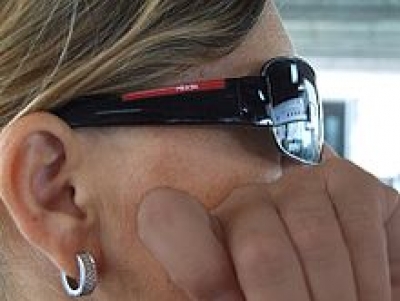
- Adding polarization to a lens will aid greatly in cutting glare, and is especially useful if you spend time around water, snow, or sand. I have personally found my prescription, polarized (and 100% UV filter) sunglasses are helpful during long road trips, where glare from the pavement would otherwise cause eye strain and poor vision.
- Photochromic lenses (lenses that change from clear to tint in response to UV rays) can be a good compromise if you cannot afford both regular prescription glasses, and prescription sunglasses. However, these lenses do not turn dark behind the windshield of an automobile, as the windshield contains UV filters which prevent the glasses from darkening.
- Currently, the FDA requires that all sunglasses and eyeglass lenses be made of impact resistant materials, so you can buy with confidence knowing that your eyes are also protected from potential injury if you should be the target of a wayward beach ball. (Check your country's current standard of protection.)
Certainly, you want your sunglasses to reflect your personal style, whether it be classic, sporty, funky or retro. With a little selective shopping, you should have no trouble finding a pair that suits your needs perfectly, and also provides the important protection you need. (But, you actually have to remember to wear them if they are going to protect your vision!) Your vision is priceless, and once lost, can rarely be restored. Whatever the cost of a pair of sunglasses, it certainly is well worth the price to ensure you can continue to enjoy many more days in sunny weather. . . worry free.
Copyright June 2010, Sharla Smith
Photo Source: Wikipedia
Additional information source:
The Ophthalmic Assistant, 8th Edition, pgs. 222-223, 374; Stein, Stein, and Freeman, 2006, Elsevier Inc.