London Guide - The London Underground System - History + Facts
EducationLondon Guide - The London Underground System - History + Facts

The London Underground is a Rapid Transit System which serves inner and greater London and parts of the counties of Buckinghamshire, Essex and Hertfordshire.
The system was opened on the 10th of January 1863, when the Metropolitan Railway ran a service from Paddington Station to Farringdon Street via Kings Cross, a route of four miles.
Since then, the system has grown to 250 miles of track with 270 stations including 77 former stations that have since been closed and 44 stations that were built, but for whatever reason, were never opened.
Today the London Underground holds the record for being the world's first ever underground railway, the first system to operate electric trains ( 1890 ) is the second longest system in the world after the Shanghai Metro in China, and has a daily customer base of just under 3 million passengers a day.
The system is known locally as the 'Tube' due to the shape of the tunnels in which the trains run.
The system's iconic signage was designed by Edward Johnson in 1916 and are called roundels, and were chosen because they looked like a bullseye sign, which developers thought would catch peoples attention.
The system runs 11 routes, known as lines, on both subsurface and deep level tracks.
The subsurface tracks are around 5 metres below the surface and the deep level tracks around 20 metres below the surface, although it varies greatly from area to area.Four of the system's lines are situated on subsurface track and 7 lines on deep level track.
The system's tunnels are 3.5 yards ( 11 ft 8 ins ) wide at their widest point.
Forty five per cent of the system is in tunnel,meaning that 55% is situated above ground, unusual for a system that is reknowned for being called The Underground !
The system's deepest platform is situated at Hampstead Station at 64 yards ( 192 feet ) below ground level.Hampstead Station is also home to the deepest lift shaft on the system at 181 feet deep.
The system's longest escalator is situated at Angel Station, at 197 feet long, which has a vertical rise of 90 feet.
The deepest platform below sea level is at Westminster Station, situated 36 yards ( 190 feet ) below sea level.
Seven London Boroughs are not served by the underground system, six of them being situated south of the River Thames.
The system runs on a 4 track, 1435mm ( 4ft 81/2 ins ) standard gauge track which is run by 210 v DC power, which provides a traction voltage of 630 volts.
The system's longest distance between stations is Chalfont and Latimer to Chesham on the Metropolitan Line with a distance of 3.89 miles.
The shortest distance between stations is from Leicester Square to Covent Garden on the Picadilly Line, which is just 280 yards.
The shortest distance between two street level stations is Charing Cross and Embankment on the Northern Line, with a distance of just 100 yards.
The system's most southerly station is situated at Morden on the Northern Line, both the system's most northerly and westerly station is Chesham on the Metropolitan Line and the system's most easterly station is Upminster on the District Line.
The system uses rolling stock built between the years 1960 and 2005, with higher, squared shaped trains used on the sub surface lines and shorter, rounder shaped trains on the deep level lines.
The system's largest and busiest station is King's Cross St Pancras, which is home to the underground's largest interchange, which uses six of the system's 11 lines and caters to over 66 million passengers every year.
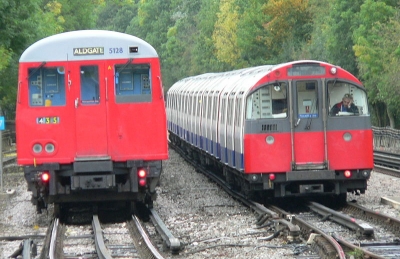
Image of both the square, high sub surface train and the shorter, rounded, deep level train.
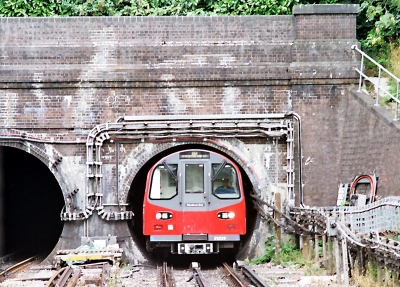
Image of a deep level train exiting a tube shaped tunnel
THE BAKERLOO LINE.
The Bakerloo Line was opened in 1906 and is 14.5 miles long. It is served by 25 stations between Elephant and Castle and Harrow and Wealdstone, 15 of which are situated underground at deep level.
The line is signified by the colour brown on an underground map.
THE CENTRAL LINE.
The Central Line was opened in 1900 and is 46 miles long, making it the longest line of the system, between the stations of Epping and West Ruislip.
The Central Line is one of only two lines which have stations outside the boundaries of Greater London.
The line is served by 49 stations, 20 of which are situated underground at deep level.
The line is signified by the colour red on an underground map.
THE CIRCLE LINE.
The Circle Line was opened in 1884 and is 17 miles in length.It is an orbital route that covers 35 stations around central London on a sub surface line that runs along side other central London lines in a continuous loop.
The line is signified by the colour yellow on an underground map.
THE DISTRICT LINE.
The District Line was opened in 1868 and is 40 miles in length. It is served by 60 stations, the largest amount of any line, between the stations of Ealing Broadway and Upminster. 25 stations are situated underground at sub surface level.
The line is signified by the colour green on an underground map.
THE HAMMERSMITH AND CITY LINE.
The Hammersmith and City Line was opened in 1864 and is 16.5 miles long.The line incorporates the first ever underground line between Paddington Station and Farringdon Street, opened in 1863.
The line is served by 29 stations between Hammersmith and Barking, 10 of which are situated underground at sub surface level.
The line is signified by the colour pink on an underground map.
THE JUBILEE LINE.
The Jubilee Line was opened in 1979 making it the system's youngest line.
It is 22.5 miles long and is served by 27 stations between Stratford and Stanmore, 13 of which are situated underground at deep level.
The line is signified by the colour silver on an underground map.
THE METROPOLITAN LINE.
The Metropolitan Line was opened in 1863 and is 41.5 miles long. The line's name is the oldest of all the lines, although this particular line now no longer runs along that first route.
The line is served by 34 stations between Baker Street and Amersham, 9 of which are situated underground at sub surface level.
The Metropolitan Line is one of only two lines which has stations beyond the boundaries of Greater London.
The line is signified by the colour magenta on an underground map.
THE NORTHERN LINE.
The Northern Line was opened in 1890 and is 36 miles long.
This line was the first rail line to be powered by electric, in the world, and was the first of the system's deep level lines.
Despite it's name it does not cover North London, quite the opposite in fact, as it covers all the system's 29 stations south of the River Thames.
The line is served by 50 stations between Bushey Heath and Morden, 36 of which are underground at deep level.
This line is classified as London's busiest service by way of passenger volume.
The line is signified by the colour black on an underground map.
THE PICADILLY LINE.
The Picadilly Line was opened in 1906 and is 44 miles long.
It is served by 53 stations between Cockfosters and Uxbridge and Cockfosters and Heathrow Airport terminals 1,2,3,4, and 5.
Twenty five of it's stations are situated underground at deep level.
The line is signified by the colour dark blue on an underground map.
THE VICTORIA LINE.
The Victoria Line was opened in 1968 and is 13 miles long.
It is served by 16 stations between Walthamstow Central and Brixton, all of which are situated underground at deep level.
The line is signified by the colour light blue on an underground map.
THE WATERLOO AND CITY LINE.
The Waterloo and City Line was opened in 1898 and is just 2 miles long, making it the shortest line in the system.
The line is served by two stations both of which are situated underground at deep level.
The line runs under the River Thames from Waterloo on the South Bank to Bank in the City of London, and is run exclusively for commuter traffic into the city, therefore It does not operate late at night or at the weekends.
The line is signified by the colour turquoise on an underground map.
For more concise information about the London Underground System, visit the London Transport Museum.Details below.
ADDRESS - Wellington Street, Covent Garden, City of Westminster.
POST CODE - WC2 E7.
TELEPHONE - 020 7379 6344.
WEBSITE - www.ltmuseum.co.uk
UNDERGROUND WEBSITE inc MAP - www.tfl.gov.uk/modalpages
OTHER ARTICLES ON LONDON FACTS -
facts-about-londons-mainline-railway-stations