Ingenuity by Indigenous People: Hydroelectric Power Plant Using Scrap Materials
EducationIngenuity by Indigenous People: Hydroelectric Power Plant Using Scrap Materials

Two days ago, the author visited a community of indigenous people in connection with a research on valuing natural resources. He was amazed at what he saw. A simple but working hydroelectric power plant was built out of the ingenuity of a Pala'wan, one of the indigenous people of Palawan. Palawan is a province in the Philippines located at the western boundary of the country.
A Simple Idea Can Produce Results
This is the experience of Boyet, a descendant of the Palawan tribe in the hinterlands of southern Palawan. He saw on television a hydroelectric power plant and how water generates electricity. He immediately put his own idea of the hydroelectric power plant to work.
Together with some friends, Boyet gathered scrap materials from the material recovery facility (MRF) of a mining company operating nearby Sitio Bohoy, their place of abode. The materials gathered for his hydroelectric power plant consist of corrugated PVC and GI pipes, corrugated GI roofing sheets, the rubber interior of dump truck tires, old folding beds, nails, plastic tubes, among others. He installed about a hundred meters of this pipe midstream by tying together the 3 to 6 inch diameter plastic pipes with the rubber interior that channeled the water downstream towards his improvised turbine that drives an electric generator. The electric generator is his only significant purchase at PhP6,500 (ca. $150). He then put the simple hydroelectric power plant to work by releasing water through the pipes. It worked! Electricity was produced.


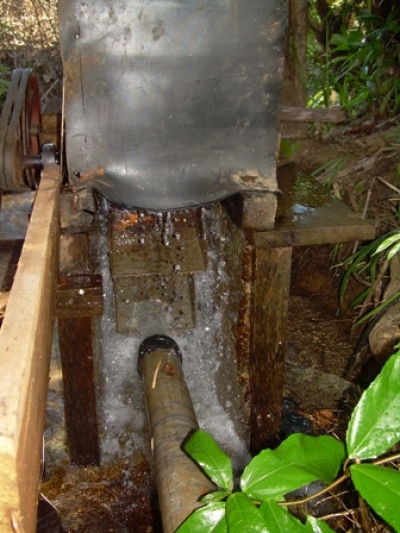

Clockwise: Boyet and his simple hydroelectric power plant, the welded turbine, power generator, water flowing to the turbine.
The Dam that Provides Power
To maintain water flow to drive the turbine, with help from hired hands, he built a makeshift dam made of sacks and some sturdy wood nailed at an angle sufficient to keep the old, corrugated GI sheets and sacks upright and keep the water at a height of barely a meter (0.89m). The dam sustains constant flow of water enough to drive the turbine downstream and produce electricity enough to supply 15 houses.
Fellow indigenous people would pay him Php100 (ca. $2) each month to maintain the disposable parts of the electric generator like the cables that connect the turbine with the generator. Two of these cables have to be replaced about once a month, at Php450 (ca. $10). The payments made by fellow indigenous people barely maintain the system because many of them are poor. Boyet noted that in reality, only 9 out of 15 households of indigenous people pay him regularly.

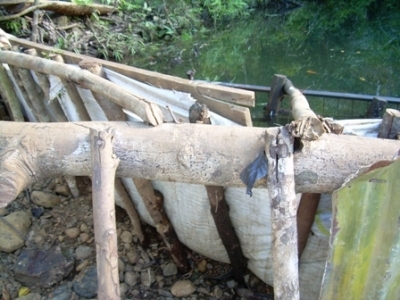

The dam: water outlet supplying the needed water pressure to drive the turbine downstream (left), dam support made of local and scrap materials (middle), the double layer of soil, stakes, and sacks keep water from flowing out provide support to the dam (right).
Having produced electric power provided the indigenous people the opportunity to see the latest news on television as well as enjoy "karaoke" or sing-along joints just like what the lowlanders do. Despite their ragged, unkempt appearance the indigenous people have the luxury of modern life high up along the slopes of a hill. You wouldn't suspect they are those indigenous people who many people think still live in isolation from the rest of the world.
Other Uses of the Pooled Water in the Dam
Aside from the electricity generated by the small hydroelectric power plant, the waters channeled through the pipes serve other uses. Some of those waters are diverted to the indigenous people's "kaingin" or slash-and-burn farms through small tubes jutting out of the large pipes while some are used to continuously provide water to their small fish ponds. At the other end, water is supplied to a ditch dug around the small sari-sari (mixed goods) store akin to a small moat, which prevents ants from spoiling packs of sugar stored in it.
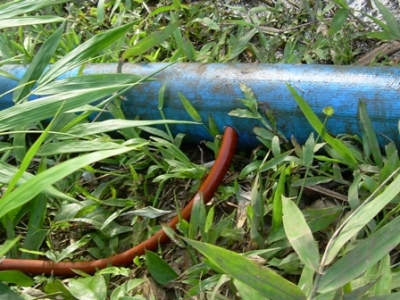

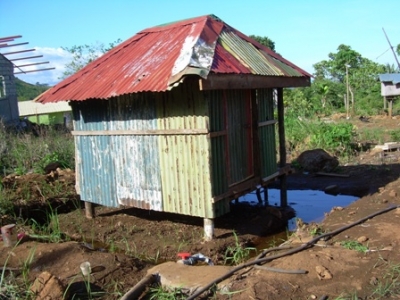
A small tube juts out of the main pipe to supply water to the farm (left), fishpond (middle), and the store with water (right).
After this simple hydroelectric power plant operated satisfactorily for a year and five months, a much modern small hydroelectric power plant was built at upper regions of the same river by the mining company. The new hydroelectric power plant lessened the volume of water that fed the turbine of the makeshift hydroelectric power plant by the indigenous people. Now, the indigenous people have to content themselves with limited electricity as the dam can sustain water enough to supply electricity only up to about 10 o'clock in the evening.
Distinct Way of Life is Gone
The ingenuity demonstrated by a member of indigenous people in remote areas like Sitio Bohoy have two implications. One, it is a good thing that the indigenous people are able to cope with changes in their environment particularly since their activities now approximate that of the lowlander. Second, this also shows that these indigenous people may no longer be considered as indigenous because they are living like anybody else in the modern world. Acculturation has pervaded the life of the tribe. Their distinct way of life has long been gone.
©2010 May 14 Patrick A. Regoniel