How to Do Calculations for a Parallel Circuit
EducationHow to Do Calculations for a Parallel Circuit

Parallel circuits are circuits in which there are two or more branches for current to flow through. The branches, as implied by the name, are in parallel. See the figure below.

In a parallel circuit the voltage source is in parallel with the various branches. As a rule, the voltage at each branch in parallel will be the same as the voltage in every other parallel branch. In essence, Vs = Va = Vb = Vc = Vd, and so on. See the figure below for clarification.
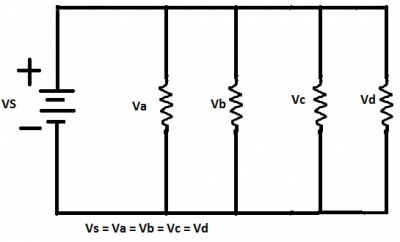
Unlike a series circuit, the constant factor in a parallel circuit is the voltage rather than the current. The current, you will find, will change in every branch that it travels through. According to Kirchoff’s Current Law, the sum of all currents entering a junction will equal the sum of the current that leaves the junction. This is to say that the amount of current that goes out has to be equal to the amount of current that comes back in. See below.
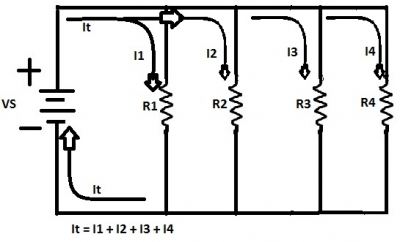
The rules regarding voltage as stated above only apply to parallel circuits where this is no series component. Once a series component is introduced the rules of Kirchoff’s Current Law remain the same, but the voltage values will change. There are individual rules for series/parallel circuits (complex circuits).
In parallel circuits most calculations will start with the basic values. For example, if we had the value of the voltage source (Vs) and the value of the total current (It), then we could find the value of each resistor. However, if we didn’t know the value of the current, but we know the value of R1, R2, R3, R4, and Vs, we could calculate the total current, and from there we could calculate the current that is going through each branch. See the calculations below.
.jpg)
Step 1: Find the total resistance of the circuit. In a parallel circuit the total resistance (Rt) is equal to 1/[(1/R1) + (1/R2) + (1/R3) + (1/R4)]. On your scientific calculator you can use the inverse button (if available) and just add up the values directly to get the same results.
Rt = 1/[(1/100) + (1/200) + (1/100) + (1/100)]
Rt = 28.57 Ohms
Step 2: Now that we know the total resistance of the circuit and the value of the voltage source, we can proceed to calculate It.
It = Vs / Rt (Ohm’s Law)
It = 15V / 28.57 Ohms
It = 0.525 Amps, or 525 mA
Now we know the value of the voltage source, the total resistance, and the total current! In this type of parallel circuit there is another way to calculate It, which takes a bit longer. All you have to do is find the current that is going through each branch and add them together. For example:
Step 1: Find the current through R1.
I1 = V1 / R1
I1 = 15V / 100 Ohms
I1 = 0.15 Amps, or 150 mA
Step 2: Find the current through R2.
I2 = V2 / R2
I2 = 15V / 200 Ohms
I2 = 0.075 Amps, or 75 mA
Step 3: Find the current through R3.
I3 = V3 / R3
I3 = 15V / 100 Ohms
I3 = 0.15 Amps, or 150 mA
Step 4: Find the current through R4.
I4 = V4 / R4
I4 = 15V / 100 Ohms
I4 = 0.15 Amps, or 150 mA
Step 5: Add all of the current values together
It = I1 + I2 + I3 + I4
It = 0.15 A + 0.075 A + 0.15 A + 0.15 A
It = 0.525 Amps, or 525 mA
It’s the same answer that we got using Ohm’s Law!
Parallel circuits are a little bit daunting at first, but once you get into the habit of working with them and making the calculations, you’ll find that they are fairly easy to understand and work with.