Holy Trinity Church, Sunderland
EducationHoly Trinity Church, Sunderland

Holy Trinity is a miraculous survival, a relic of Sunderland’s origins as a small parish carved out of Bishopwearmouth to serve the soaring population of the east end. Today one cannot help being struck by its antiquity, but when it was built in 1719 the church must have seemed a striking image of modernity. The classical design was radically different from the decayed Saxon and medieval fabric of Sunderland’s two older churches, and even the brick construction was novel in an era when most ecclesiastical buildings were executed in stone. Holy Trinity was an emphatically modern church for the new township of Sunderland.
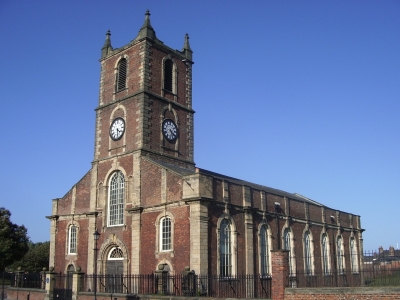
Attributed to William Etty of York, the design is a mix of simple elegance and provincial naivety. The church is a compact, symmetrical edifice surmounted by a tower that rises from the extreme end of the nave, but does not disrupt the rectangular floor plan. The whole is executed in warm red brick with sandstone dressings imparting a modest classicism. Tuscan pilasters are clasped to the façade and the large central door is set within a heavily rusticated arch. The two central pilasters are extended up to the base of the tower to support its weight and rusticated dressings strengthen the tower itself. The original short chancel still projects at the rear, but a remarkable new apse was added in 1735 – a large drum almost circular internally but flattened at its juncture with the church.
The interior is a revelation. In marked contrast to Sunderland’s two ancient churches there are no shadowed enclaves, no mystery or ‘dim religious light’, only a simple regular space suffused with light from the clear-glass windows. The rectilinear nave is divided by parades of Corinthian columns that shoulder the weight of a rich entablature. Each column rests on a panelled wooden plinth that originally rose from an expanse of wooden box pews, replaced by fine benches in 1935. At the west end of the nave is a gallery supported on slender Corinthian columns of fine workmanship. It is here that the church makes a display of its political loyalties. The arms of George I are flanked by those of the Bishops of Durham and London. A low Communion rail of turned balusters extends across the breadth of the church and with charming ingenuity a bowed central section swings open to allow access to the altar. The pulpit has been relegated to a secondary position at one side, but originally occupied the focal point of the church (in front of the altar), where it asserted the primacy of the word over ritual in 18th century liturgy.
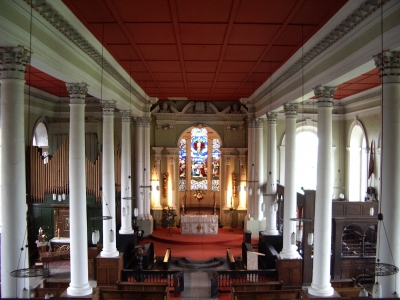
Above the altar, the chancel arch is enriched to form an elaborate reredos – an eruption of Baroque effusiveness reminiscent of Wren and Hawksmoor. Paired Corinthian columns support a round arch with winged cherubs’ heads beaming down from its summit. Towering above are three broken pediments enclosing sculpted symbols – Episcopal mitres flanking an open Bible. Beyond the arch is the circular chancel with a tripartite Venetian window filled with Victorian stained-glass. The vestibule-like chancel was added by the Rector Daniel Newcome in 1887 and reasserts the spiritual role of the church, as if to challenge the parish administrators who wielded political power from the vestry. A chapel occupies the end of the south aisle and the organ is housed in the north.
Holy Trinity was simultaneously a place of worship and a seat of local government. The west end of the church is given over to secular functions. This is expressed externally by a pilaster that separates nave from vestry. Internally, the officials involved in administering the parish are commemorated in stalls at the west end of the nave, each labelled with the title of its incumbent. The vestry is a large chamber that served as the administrative centre of the new parish. Twenty-four elected officials met around an oak table that still survives in situ. Alongside the vestry, the central entrance porch is housed beneath the tower. It is dominated by a grand statue of Robert Gray, a testament to the great esteem in which this former rector was held by his parishioners. The larger-than-life-size statue (1838) by David Dunbar of Carlisle stands on a monumental plinth with the words of a long eulogy inscribed on the base. Gray’s outstanding virtues are celebrated in reliefs of Faith and Charity that stand alongside his memorial – both are images of women nurturing young children.
Mediating between nave and vestry is a broad narthex, where a robust font stands on a single baluster of marble. The fluted bowl is surmounted by a vigorous confection of urns, cherubs’ heads and scrolled forms drawn together to form a canopy. This is part of an elaborate contraption allowing the heavy cover to be hoisted away from the bowl when baptisms are in progress. The cable for this mechanism is fed into a tiny dome set into the ceiling. Maintaining the theme of infancy, the inner surface is painted with winged cherubs cavorting in the sky and its circumference is ringed with the scripture, ‘Suffer the little children to come unto me for of such is the kingdom of heaven.’