Apparel
Artificial Intelligence
Automotive
Beauty
Blockchain & Web3
Business
Education
Electronics
Entertainment
Food & Restaurants
Health
Hobbies & Toys
Home & Garden
Money
Pets
Shopping
Software
Sports & Outdoors
Deriving the Quadratic Formula by Completing the Square Method
EducationDeriving the Quadratic Formula by Completing the Square Method

The quadratic formula can be easily derived by simply completing the square. This article will outline the mathematical steps to achieve this result. The math level of this article is written for individuals that have a basic understanding of elementary algebra.
A useful technique that students are taught when completing the square for a binomial equation is when the leading and last coefficients are perfect squares as is represented in Equation #1 below:
.jpg)
For example:
.jpg)
This simple method is useful when factoring an equation where the first and/or last terms are not perfect squares as noted below in Equation #3:
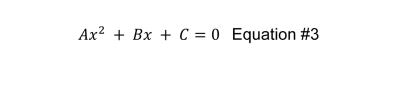
Step #1: Convert the first binomial term into a perfect square.
This is simply done by multiplying the entire equation by the coefficient “A”. This leads us to Equation #4 below:

Step 2: Apply Equation 2 to the second term
When using Equation #2, we note that the middle term needs to have a factor of 2 and Equation #4 does not have that. The problem can be easily resolved by noting this simple identity from algebra:
.jpg)
If we multiply Equation #4 by four, we have the desired result of getting at least a factor of 2 in the middle term while still keeping the first term a perfect square. Thus, Equation #4 becomes:
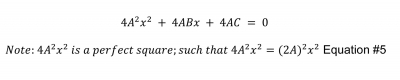
The next thing left is taking care of the “B” in the middle term. Noting that the last term needs to have a “B squared” in order to apply Equation #2. Since the last term in Equation #5 lacks a “B squared” term, we can simply add that term to both sides of the equation without altering the identity of the original equation as follows:
.jpg)
Since the first and last terms are perfect squares and the middle term has a factor of two in it, we can finally factor the left side:
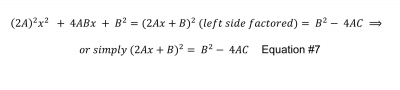
Step 3: Solving for X:
At this point we simply solve for X. We take the square root of both sides (Remember to list both the positive and negative values)
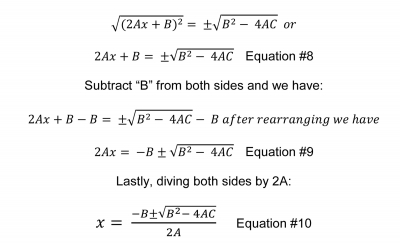
Thus, we have the desired result of solving for x and getting what is known as the quadratic formula by completing the square. This simple method is how you can derive the quadratic formula.
Other interesting math and science articles:
How to Read and Use Roman Numerals