How Does Art Evolve?
EducationHow Does Art Evolve?

.jpg)
Modernism was the cultural response to modernity – an age characterised by industrialisation, the 'democratisation of luxury', the rise of the metropolis, an accompanying decline in ruralism, rapid technological progress, and the growth of consumerism. The critic Meyer Schapiro argued that these social changes had direct influence on the development of visual art in this period. He attributed the features of Modernism to external factors, not simply an art-historical chain of cause and effect:
The history of art is not … a history of single wilful reactions, every new artist taking a stand opposite the last … flattening if the other modelled … The reactions were deeply motivated in the experience of the artists, in a changing world with which they had to come to terms and which shaped their practices and ideas in specific ways.2
This central contention of Schapiro's is perhaps verified by the Italian Futurist movement, whose art not only refuted established traditions, but also sought to encapsulate the mental and environmental changes of modernity.
.jpg)
Running Figure, Umberton Boccioni
A different explanation for the evolution of Modernism was postulated by Clement Greenberg, who argued that artistic changes were internal to the discipline itself. According to Greenberg, Modernist art is frequently preoccupied with the nature of the medium: the entire significance of a painting depended on the arrangement of forms on the canvas. This lead Greenberg to a formalist approach to art: he focused on the arrangment of colour and form, and dismissed the wider social context,believing that art was influenced only by intrinsic factors. Greenberg argued that Modernism was characterised by a self-critical tendency that originated with Kant, a philosopher whom he thus regarded as the first Modernist. This 'intensification' of the self-critical tendency is evident in the very use of the word 'Modernism' to describe this cultural development, as well as in the art produced under its banner. Greenberg wrote: 'The essence of Modernism lies … in the use of the characteristic methods of a discipline to criticise the discipline itself.' So, in the same way that Kant used logic to criticise logic, Modernist art searched for that which is 'unique and irreducible' to art. He argued that, in each art, this corresponded to what is unique to each medium. Therefore, painters should discover what this is in painting and exhibit it in their work, eliminating anything that originated in another medium. This would drastically reduce each art's area of concern, but what was left to it, it would possess all the more securely. In Greenberg's view, the essence of painting consists in its flat surface. Modelling in light and shade, the illusion of depth - these were borrowed from sculpture, and Modernist painters were required to banish them from their canvasses. By outlining these beliefs Greenberg accounted for the move towards abstraction, exemplified by Kandinsky, Malevich and so on. These artists were trying to create a 'pure' art, irrespective of the social changes emphasised by Schapiro.
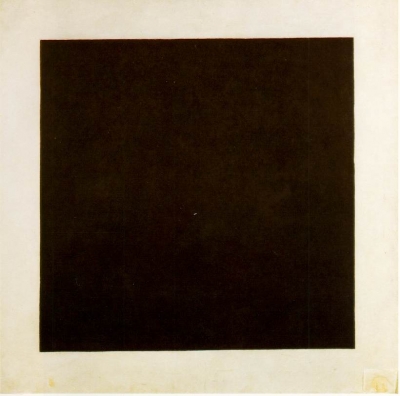
Black Square, Kasimir Malevich
For further discussion of these issues, please see my article on Cubism:
https://knoji.com/cubismfractured-perspectives/
Please check out my related articles:
https://knoji.com/futurism-celebrating-the-shock-of-the-new/
https://knoji.com/art-for-arts-sake-the-unparalleled-beauty-of-the-aesthetic-movement/
https://knoji.com/edouard-manet-the-painter-of-modern-life/