Chinese: An Inventive People
EducationChinese: An Inventive People

Many inventions were used in China hundreds of years before appearing in Europe. Some of these – printing, gunpowder, and the compass – change the history of Europe.
In 1620 the English philosopher and scientist Sir Francis Bacon wrote that three recent inventions – printing, the magnetic compass, and gunpowder – had changed the world. Printing had made it possible for ideas to spread more rapidly. Gunpowder and guns put an end to the era of knights and castles. The compass made possible the European voyages of discovery. What people don’t know was that the Chinese had been using these inventions centuries before the rest of the world even knew about them.
Silk and Paper
According to a Chinese legend, the wife of an emperor sat down under a mulberry tree in her garden. As she looked up, she saw caterpillars spinning their cocoons. “if only we could weave their thread into cloth,” she said, “how wonderful it would be.”
That is the legendary beginning of Chinese silk making. Archaeologists do know for sure that Chinese were weaving the threads of silkworms into cloth as early as 4,000 years ago. Silk has long been one of China’s most prized products. It gave its name to the Silk Road across Asia, along which it was carried to the west. It was rolled into scrolls and used as the background for painting and calligraphy.
Another legend says that an inspector in the workshops of the Han emperor invented paper. The first paper was made from mulberry bark that had been mashed to pulp. Water and plant gums were added to the pulp, and the mixture was strained and spread on a screen to dry. Paper caught on. It was cheaper than silk, and artists liked the way it held ink. Paper was used to cover window openings and walls. Chinese paper spread to Korea and from there to Japan. Later the paper-making techniques reached India and then the Arab Empire. It was through Muslim Spain that paper reached the rest of Europe around 1150.
Printing
Printing began during the Tang dynasty, hundreds of years after the invention of paper. Chinese Buddhist monks developed the idea of block printing in the seventh century. Someone sketched a manuscript page on a thin piece of paper. This was placed face down on a block of wood. The reversed characters were carved into the wood. A thin coating of ink was spread on the block, and fresh sheets of paper were pressed onto it to produce a printed page. The same technique was used for illustrations and drawings.
As people found more uses for printing, it spread rapidly. The Chinese government encouraged the printing of the Confucian classics, dynastic histories, law codes, and other official documents. It also helped to publish encyclopedias and texts on religion, philosophy, painting, poetry, law, astronomy, agriculture, and warfare.
The final development of printing occurred around 1048, when a scholar developed movable type. He realized that by making individual characters, he could rearrange them in any order instead of having to make new blocks. He molded the type out of clay and hardened it by firing. During the next few centuries, other Chinese began to make type out of wood, and then later from metal.
Paper Money
Another important use for printing was paper money. The Song government began to issue it in the eleventh century, the first time it appeared anywhere. The printing office, located near Hangzhou, employed about 200 printers. Almost as soon as paper money appeared, counterfeiters tried to copy it. So the government printers designed money with complicated designs, just like the ones you see on paper money today.
Gunpowder
Gunpowder was first invented in the ninth century. It was an accidental discovery that resulted from medical research. A Chinese pharmacist combined sulphur and saltpeter with charcoal. Sulphur was used to treat skin diseases, and saltpeter was used to lower fevers. The addition of charcoal produced huoyao or “fire medicine.” Huoyao was still used in medical treatments as late as the seventeenth century. However, the fact that it burned rapidly made it useful in other ways.
The first nonmedical use of gunpowder may have been for fireworks. Beautiful fireworks were used at festivals during the Song dynasty. One, called the box lantern, was hung in a high place and set afire. Layer by layer, paper characters appeared as a story unfolded in the midst of whirling sparks.
The Chinese soon found military uses for gunpowder. By the eleventh century, gunpowder was being used in simple bombs and grenades, as well as bamboo flame throwers and primitive rockets. By 1221, Chinese technicians could produce large bombs that were “shaped like gourds, with small mouths, and cast in iron two inches thick.” These weapons, according to a Chinese account, were capable of shattering city walls. The year 905 saw the invention of the “fire-spurting lance.” This weapon shot pellets out the end of a long piece of bamboo. This later led to the development of metal-barreled guns and cannons.
Navigation Tools
In the eleventh century Chinese magnets shaped like fish were placed in bowls of water so that their heads punted south. Around that time, Chinese ships began to take boxes with floating compass needles on sea journeys. This enabled their pilots to navigate at night or when the sky was overcast. During the Song dynasty, Chinese merchant ships traveled to Japan, Southeast Asia, India, and even beyond.
Some parts of China’s rivers were blocked by rapids and low waterfalls. Boats had to be carried around them on land. Chinese engineers developed locks to harness the rivers. These locks were like small dams. As a boat entered one part of the river, the lock behind it was closed. Gradually the water would rise, letting the boat float up to the next section of river. The locks greatly improved river transportation.
More Inventions
There are countless other inventions that Chinese people developed. The abacus, which originated in the Fertile Crescent, reached China in the sixth century B. C. the Chinese improved it so that it could be used for such complicated calculations as square roots and algebra.
The wheelbarrow seems like a simple idea. Yet a worker using one can carry heavier loads than two people lifting together. The first Chinese wheelbarrows appeared around A.D. 200. It was over a thousand years before Europeans used these labor-saving devices.
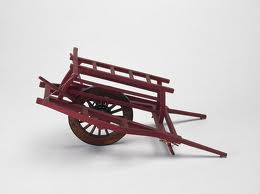
A Chinese scientist invented the first seismograph, or earthquake detector, in A.D 132. Chinese textile makers used water power to run machines in the fifth century. Mechanical clocks were being made in China in the eight century. Kites, suspension bridges, and porcelain technology are also among the many Chinese gifts to the world.
Photo credits: Google