China Bus & Rail Information
EducationChina Bus & Rail Information

The Peoples Republic of China ( PRC ) covers an area of 9.6 million square kilometres and is home to the world's second largest rail network ( 91,000 km ) and 3.3 million kms of road, although only 770, 265 km are paved.
Most of the country's road and rail networks are situated from it's central interior and span out towards it's east coast, but there are some long distance routes which traverse all the way to the borders of Kazakstan, Mongolia and Russia.
Because of it's vast size the most appropriate form of long distance travel in China is air travel, followed closely by train travel, river boat travel and then bus travel.
In this article we will deal with China's vast train network and it's bus services.
BUS SERVICES.
Most of China's 3.3 million kms of roads are poorly maintained, with 1.47 kms considered as village or mountain tracks and are known as the China National Trunk Highways.
Only 770,265 kms are paved and deemed worthy for long distance bus travel and these are known as the Expressways of China.
Long distance, inter city bus travel is done by coach and depending on the class of your ticket, you can expect anything from a coach with just a seat only to a coach with sleeper seats, air conditioning, TV, WC and meal service.
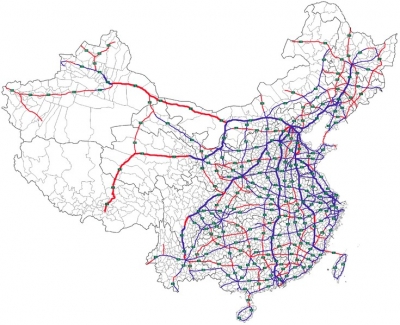
The China National Trunk Highways and Expressways of China.
China's long distance coaches come with either regular seat or sleeper seats.
It is rare that any of the bus company's personnel will speak any language other than their own, so communication could prove problematic for foreign travellers, although Chinese people are known for their friendliness and empathy towards non Chinese speaking people.
Coach travel in China is reliable and is a great way to see the country, but be prepared for delays - most of China's roads are not meant for high speed travel, particularly in rural or remote areas - be prepared for pot holes in the road - which can be quite jarring for the traveller - and don't expect a luxury coach as standard, one has to ask for things such as toilets, TV and air conditioning when booking coach travel in China.
Bus Rapid Transit ( BRT ) services can be found in the four large cities of Beijing, Dalian, Hangzhou and Kunming, with other large cities using local shuttle bus ( mini - bus ) services, which are also used to link the major towns and cities with the suburbs and outlying rural areas.
These local city services are generally very cheap to use but are notoriously crowded and uncomfortable.
In the above mentioned four cities, there are regulated routes with designated bus stops, but elsewhere, be prepared for the bus to stop where anyone wants to get on or off, particularly in rural areas.
The large bus terminals in the cities of Beijing and Shanghai have signage in both Chinese and English, as well as some English speaking personnel, but do not expect this in the smaller towns or rural locations.
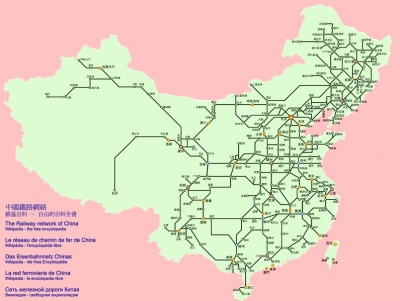
China's National Railroad System
RAIL SERVICES.
Rail travel is the primary mode of transport for the average citizen of China.
The Chinese Ministry of Railways who control China's National Railroad System own 15,456, 000 locomotives, maintain 91,000 kms of railtrack - 7,000 km of which are electrified culmulating in the world's longest high speed railtrack - which between them carry 24 % of the world's rail passengers and 2.2 trillion tons of freight every year.
There are also another 352 privately owned, local railroads within China and 604 joint - venture railroads, most of which are owned and run by local, provincial businesses or tourist concerns.
The Ministry of Railways also has a fleet of 100 steam locomotives which are used in government owned and run tourist locations.
China railways serve direct links to North Korea, the only country in the world to do so, as well as Hong Kong and Tibet.
There are also trains linking with the borders of neighbouring Kazakstan, Mongolia, Russia and Vietnam, although these journeys will entail a change of train once over the border due to these countries having a different rail gauge to that of China.
A branch of the Trans Siberian Express also travels through China, from Ulan Ude in Mongolia through to Beijing, this service also requires a change of train.
All long distance train fares are distance based on hard seat, with higher prices charged for better seats, sleeper seats and / or air conditioning. There is also a set charge of 2% of a hard seat fare over and above the regular train fare, for insurance purposes, and this is mandatory.
Most of China's railway stations are manned from 06.00 - 22.00 hrs, 7 days a week for rail information and ticket sales.
There are four different seat types - 1st class seat, 2nd class seat, hard seat and soft seat.
There are three different sleeper types - hard sleeper, soft sleeper and luxury sleeper.
All trains offer onboard catering services and washing facilities and all implement a no smoking policy.
Some private lines may allow smoking in restaurant cars or have designated smoking carriages, but these are few and far between.
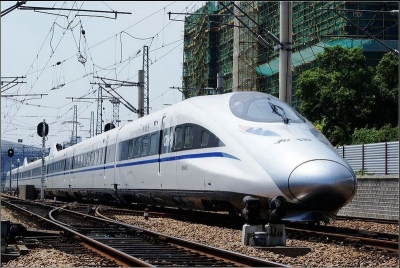
Nine cities in China are served by way of a High Speed Railtrack ( CRH ) with trains that can travel between 250 - 350 kmh. All fares on these trains are distance based, and the faster the train, the more expensive it is. All have onboard catering and a no smoking policy. Tickets are obtained by way of ticket booths or automatic ticket machines.
Train stations in Beijing and Shanghai will have signage in both English as well as Chinese, but other stations, depending upon the level of tourist traffic, will only be in Chinese.
These city to city CRH routes are -
Beijing - Tianjin - 117 kms.
Wuhan - Guanzhou - 968 kms.
Zengzhou - Xi'an - 457kms.
Shanghai - Nanjing - 301kms.
Shanghai - Hangzhou - 160 kms.
13 cities have a metro system in China, with 16 other cities having a metro under construction and a further 18 cities in the planning stages of a new metro system.
Shanghai has the largest metro system in China with 12 lines and 233 stations on 420 kms of track.
The Chinese capital Beijing is served by way of 228 kms of metro track that has 126 stations and 9 lines.
All metro trains have distance based fares with tickets obtained from either ticket booths or automatic ticket machines.
Beijing and Shanghai metro stations have signage in both Chinese and English and sell metro maps in either language.
China has one Mag Lev train system ( magnetic levitation ) which travels between the city of Shanghai and Pudong International Airport, a distance of 33kms.
This system uses a 10.3 metre long train that travels at 110 kms an hour making the 33 kms journey in 7 minutes 20 seconds.
When the system was first introduced in 2004, the train made history by travelling at 501 kmh, making it the world's fastest ever train.
All long distance and inter city trains in China are identified as ' up trains' or ' down trains' and this is dependent upon if the train is travelling towards or away from the centre of China's train industry at Beijing.
Therefore, a train travelling towards Beijing is an ' up train ' and a train coming from Beijing is a ' down train'.
For trains that do not go to Beijing, the ' up train / down train definition is made by way of which way the train is travelling in regards to Beijing, Beijing is in the north east of the country, so trains travelling in that direction are ' up trains' and trains travelling in a south or westerly direction are generally ' down trains'
The ' up train / down train ' definition is symbolised on train tickets by odd numbers for ' down trains' and even numbers for ' up trains'.
You may also want to read -
how-to-buy-tickets-for-train-travel-within-china
All images courtesy of wikimedia commons.