What is the Difference Between the Theoretical and the Conceptual Framework?
EducationWhat is the Difference Between the Theoretical and the Conceptual Framework?

Writing a research paper is a daunting task. Believe us, we’ve all been there. We feel and understand you. One of the things that makes the creation of a research paper overwhelming is that sometimes, we unknowingly confuse one term for another. The most common concepts that are almost always interchanged incorrectly are the theoretical framework and the conceptual framework. Distinguishing the difference between these frameworks can be a bit tricky and need careful understanding.
These frameworks are equally important in completing a research paper. They provide sufficient support to explain the relevance of the study, clarify its context and present how the research contributes to the already vast knowledge of information available. In this sense, we can acknowledge that these frameworks give life to the research. Identifying distinct factors that set these frameworks apart from each other is a huge help for the researcher to be able to fully present the information in their paper.
This article will help you evaluate the difference between the theoretical and the conceptual frameworks and the steps in formulating these frameworks.
What is the Difference Between the Conceptual Framework and the Theoretical Framework?
Conceptual Framework
A conceptual framework presents written or visual representations of the relevant variables in a study and how they relate to one another. The simplest way to define conceptual framework is that it’s a diagram of the relationship of variables in a study. This framework is the most effective way of explaining the relationships of, say, related literature reviews and studies. It’s also referred to as the research paradigm.
Remember to construct a conceptual framework before collecting data for the research.
Theoretical Framework
A theoretical framework provides a general representation of the relationship between things in a given phenomenon. It describes the theory that supports the research explaining that the study is grounded in established ideas.
Before we dive deeper into the concepts of these two frameworks, we need to take a quick review on the different key terms that revolve around these two.
Variables in research - Variables in research can be anything that the research is trying to measure (think a person, a place, an object or a phenomenon). Examples include number of students, distance, age, names of species, rating of answers in a survey, etc.
Dependent variables – These are variables that depend on other factors being measured. In other words, this type of variable relies on and can be changed by other factors. Examples of dependent variables are: 1. Student’s test score following hiring a tutor or; 2. one’s performance in a competition after training.
Independent variables - Independent variables are variables that the researcher changes, and are assumed to have a direct effect on the dependent variables. Examples of independent variables are: 1. Time spent studying or; 2. how often one trained for the competition.
Related reviews and studies - These are a comprehensive compilation of reviews related to the area of research the chosen study belongs. They include scholarly articles, journals, books and other relevant documents.
Theories in research – Theories are formulated to explain or to understand a phenomenon.
How Can Students Come Up with Their Theoretical and Conceptual Framework?
So now it’s time to come up with your own set of theoretical and conceptual frameworks that will guide your research. Generally, you must review the literature related to your chosen research topic in order to generate synthesis from these studies. You also need to look for gaps in knowledge from these studies and identify what questions need to be answered or what problems need solutions.
There are basic steps in formulating the frameworks so you’ll have a better idea on the difference between these two, i.e. their function(s) in the completion of a research paper and the concepts to be included in each of these frameworks.
Steps in Formulating Theoretical Framework
Here are some strategies to develop of an effective theoretical framework:
Examine your thesis and research problem. Remember that your research problem anchors your study and forms the basis from which you construct your theoretical framework.
Identify your key variables that might be relevant to your study and group them into independent and dependent variables.
Review related literature to find answers to your research questions.
Review the key theories that can best explain the relationships between the key variables in your study. Then discuss their assumptions or propositions and point out their relevance to your research.
Steps in Formulating Conceptual Framework
Here are some strategies to develop a conceptual framework.
Identify the important variables of your study, (the independent and the dependent variables).
Evaluate how the variables are related.
Create a visual diagram or a model.
Rectangles, circles, and arrows are usually used for the model. There are different ways in how you can create a visual diagram for your conceptual framework. But the three most common models are the independent-dependent variable model, the input-process-output (IPO) model, and concept maps.
Using the Independent-Dependent Variable Model.
You can create this model by putting the independent and dependent variables in separate rectangles and insert line segments between them. These line segments signal the direct relationship between the variables.
For example, if you want to know how the frequency of language exposure affects the language development of a child, you can create the independent-dependent variable model.
Independent Variable Dependent Variable
The Input-Process-Output (IPO) Mod
The input-process-output model is a great visual diagram if you want to emphasize your research process.
Here are the steps in creating your visual diagram using the IPO model.
Determine the inputs of your study. Inputs are the variables that you’ll use to arrive at your research result.
Outline your research process. Let’s say that you own a coffee shop and that your research is about the level of customer satisfaction in your coffee shop.
Using our chosen topic, the research process should go like this: Data collection of customer profiles → Administering questionnaires → Tabulation of customers’ responses → Statistical analysis of data.
It also helps if you state the research output and clearly indicate what you’re expecting once you’ve conducted the research. In our example below, the research output is the assessed level of satisfaction of customers in your coffee shop.
Here is the IPO model for our sample research topic.
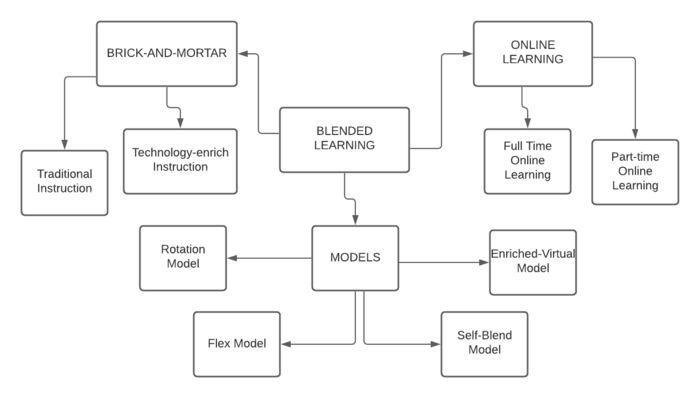
c. Using Concept Maps.
A concept map is a visual diagram to use if you have multiple variables that affect one another.
Let’s say your research is about the effectiveness of blended learning.
Presented below is the concept map for the research’s conceptual framework:
Very important reminders:
Simplicity is key. You should avoid using complicated diagrams or illustrations when creating your conceptual framework.
Allot a space for feedback. The open space is intended for input from a research panel. Allotting a space for feedback makes it easier to revise later.
For more information on examples of variables, visit simplyeducate.me, a free website devoted to research and statistics.
Buying Guide
You can read more about theoretical and conceptual frameworks by shopping at this online bookstores at https://knoji.com/rankings/bookstores/brands/
Want to save money as you learn? At Knoji, we’re always updating our list of promo codes for education product and resources at https://knoji.com/promo-codes/category=career-learning/
You can dig deeper into your own education by taking a wide variety of classes at https://udemy.knoji.com/