The Palermo Stone: the Other Egyptian Stone Tablet
EducationThe Palermo Stone: the Other Egyptian Stone Tablet

Though far less known than the famous Rosetta Stone, the Palermo Stone is no less significant, and in fact, reveals far more than its more celebrated stone cousin.
Essentially, the Palermo Stone is the oldest known history book of Egypt following the unification of Lower Egypt (the region of the Nile River Delta in the north of Egypt) and Upper Egypt (extending from the middle of modern Egypt to the southern border with Nubia).
Named for the museum in which it is housed, the Salinas Regional Archaeological Museum in Palermo, Italy, this basalt fragment, which was engraved toward the end of the Fifth Dynasty in the 25th Century BCE, provides records of the kings of Egypt from the First Dynasty through the Fifth Dynasty, a list of what is thought to be the mythical kings prior to the dynastic era, as well as information on cult ceremonies, sculpture, taxation, buildings, and public warfare.
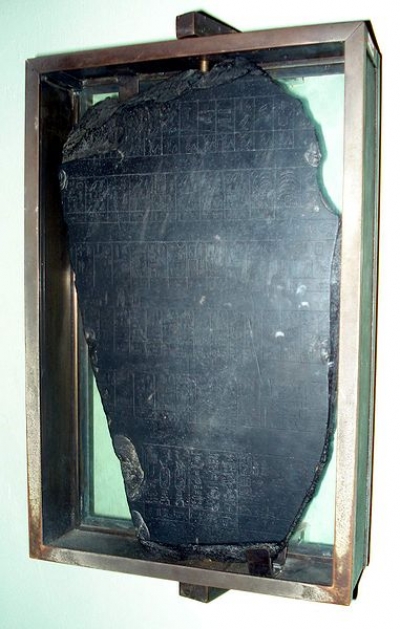
The Stone, commonly referred to as the Royal Annals of the Old Kingdom of Ancient Egypt, is one of several fragments discovered in 1866 which is inscribed on both sides and presumed to have once been part of a significantly larger stone stele perhaps 2.1 meters long (6.9 feet) and .6 meters wide (2 feet).
The largest piece of the stele is now at the Palermo Archaeological Museum in Sicily, while the smaller fragments are housed at the Egyptian Museum in Cairo and the Petrie Museum in London.
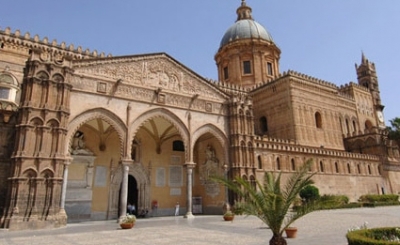
Palermo Archaeological Museum
Nothing is known about the Palermo Stone's place of origin, but together with the kings lists inscribed on temple walls, and the papyri kept in temple and palace archives, it is assumed to be one of the documents Manetho (the famous Egyptian historian and priest from Sebennytos who lived during the Ptolemaic era,) used to compile his often referenced history of Egypt.
The information on the Palermo Stone is similar to that recorded onwhat are called the ebony labels found at Abydos, Saqqara, and other historical sites, however, these labels include clerical information, while the Palermo Stone does not
The text begins by listing several thousands of years of rulers (presumed mythical), predating the rise of the god Horus, who is described as conferring the kingship on Menes, the first human ruler listed. (The text credits Menes with the unification of Egypt.) It also documents a number of early gods such as Min, a fertility god and symbol of male potency, and Heryshef (Arsaphes), also a fertility god usually represented in the form of a ram, or ram-headed man.

The ever-virile, Min
The text goes on to list the kings who ruled Egypt up to King Neferirkare Kakai, a ruler of the early Fifth Dynasty, although the original stele may have recorded events after his reign on the portions that were not recovered.
(It is significant to note that the Stone gives special importance to king's mothers, like Betrest and Meresankh I.)
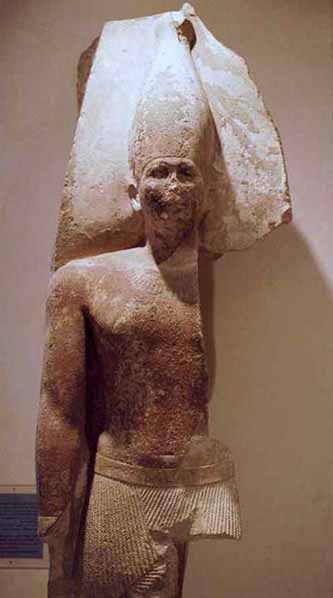
Supplying a significant amount of previously unknown information on the reign of Sneferu in particular (thought to be the builder of the well-known “Bent Pyramid”), founder of the Fourth Dynasty of Egypt (2613 BCE to 2589 BCE), the Stone provides a record of forty ships that brought wood from an unknown region outside Egypt during his reign, and also describes his military expeditions in Nubia that resulted in the capture of 7,000 slaves and 200,000 head of cattle, tells of his campaigns against the Libyans, as well as documenting quarrying expeditions to the turquoise mines of the Sinai.
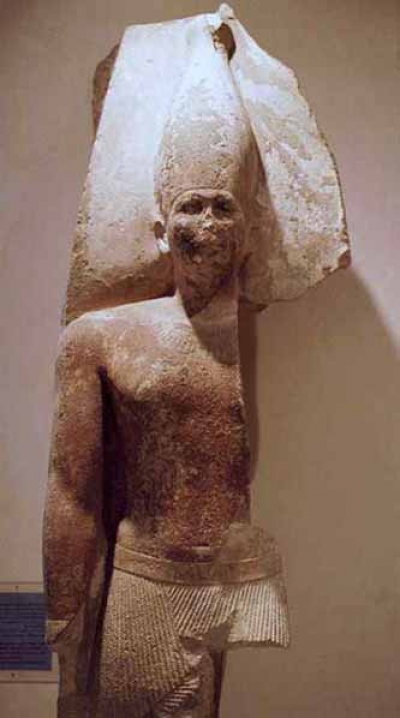
Sneferu
Other interesting information recorded on the Palermo Stone is the construction of a stone building called Men-netjeret, either in the reign of Khasekhemwy, the last ruler of the Second Dynasty, or Djoser's predecessor, Nebka (2686 BCE to 2667 BCE). Modern Egyptologists believe this may be the same structure known as Gisr el-Mudir at North Saqqara, which was never finished. However, that would predate Djoser's Step (or Styp) Pyramid, which is commonly credited as being the first large stone building constructed in Egypt.
The Palermo Stone also verifies that copper smelting was already taking place in this early period of history, and that copper statues were being created in the Second Dynasty (about 2890 BCE to 2686 BCE).
References:
http://www.touregypt.net/featurestories/palermo.htm
http://library.sebts.edu/smadden/Sunday/ancienthistory/egypt.htm
http://www.ancient-egypt.org/index.html
images via Wikipedia.org except where credited otherwise (with my appreciation)
Related Articles:
> The Egyptian Book of the Dead
Visit JAMES R. COFFEY WRITING SERVICES & RESOURCE CENTER for more information